Ocean as Refrigerator
Climate
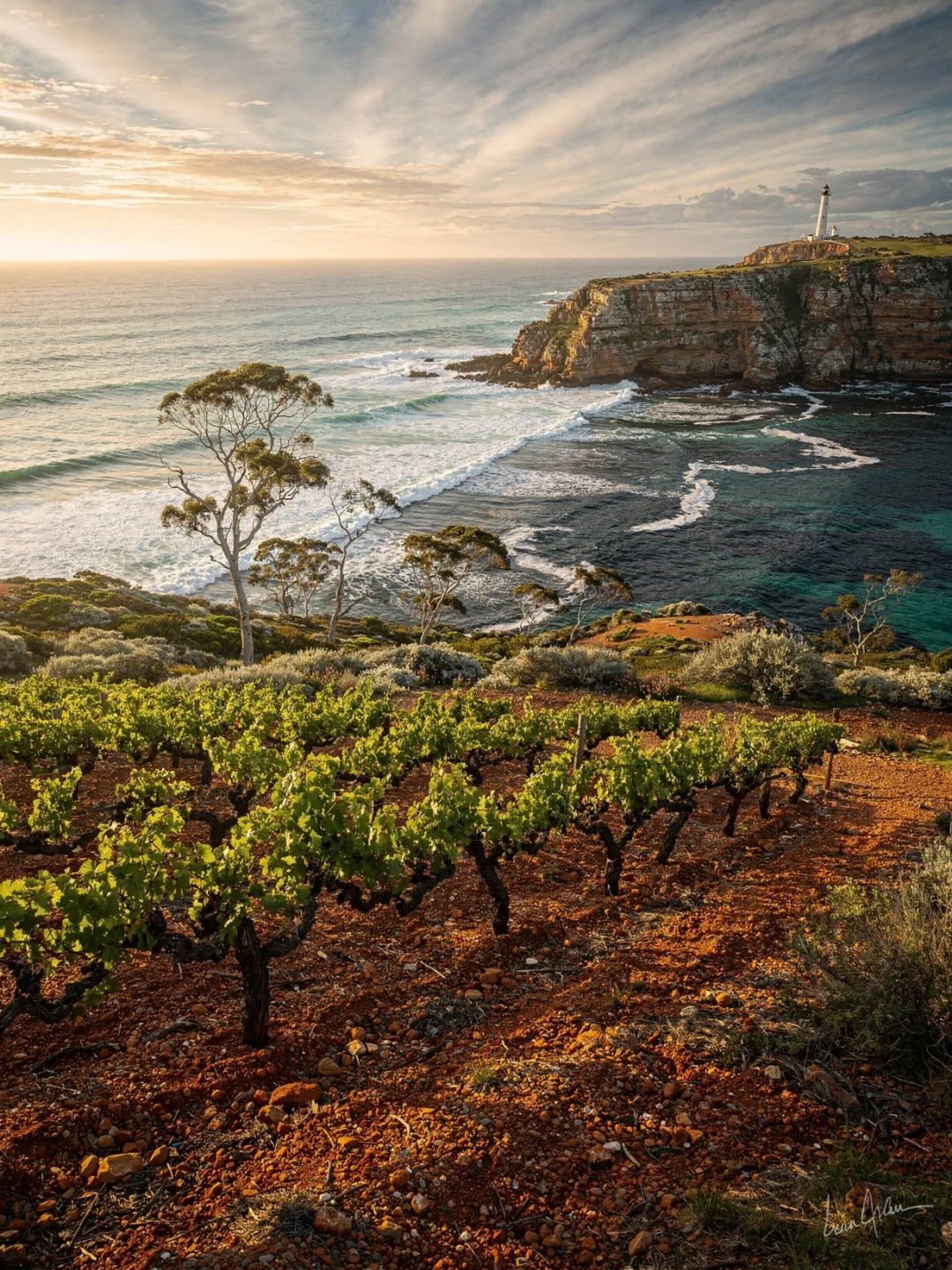
On the map, Margaret River looks like a narrow spit of land between two oceans—and that's exactly what it is. The Indian Ocean presses against the coast to the north and west, the Southern Ocean to the south, and the two meet near Cape Leeuwin at the tip of the peninsula. That cape gives the region its second name: Leeuwin-Naturaliste.
The surrounding water tempers every temperature swing. Day and night here often differ by only a few degrees, while a twenty-degree swing is normal in eastern Australia. As a result, the vines ripen slowly and evenly, without the heat spikes that elsewhere cook the acidity right out of the berry.
Rain falls mainly in winter, between May and August, totaling around a thousand millimeters a year—more than in Bordeaux. Summer, by contrast, stays dry, and that dryness is exactly the trick: the vines barely need to fend off fungal disease. They ripen calmly, well into autumn.
Almost every afternoon, the same wind arrives off the sea, cool and steady. Winemakers call it their natural air conditioning. It locks in the aromas that would simply evaporate under sustained heat, and it creates the long, calm ripening period. Even a late-ripening Cabernet Sauvignon reaches full maturity this way.
Within the region, distance from where the two oceans converge makes all the difference. Wilyabrup in the north lies a bit farther from the cooling southern coast and therefore closer to the warmth that powerful red blends need. Wallcliffe in the south, right above where the seas meet, stays cooler and gives white varieties extra weeks on the vine—exactly what they need for their acidity.