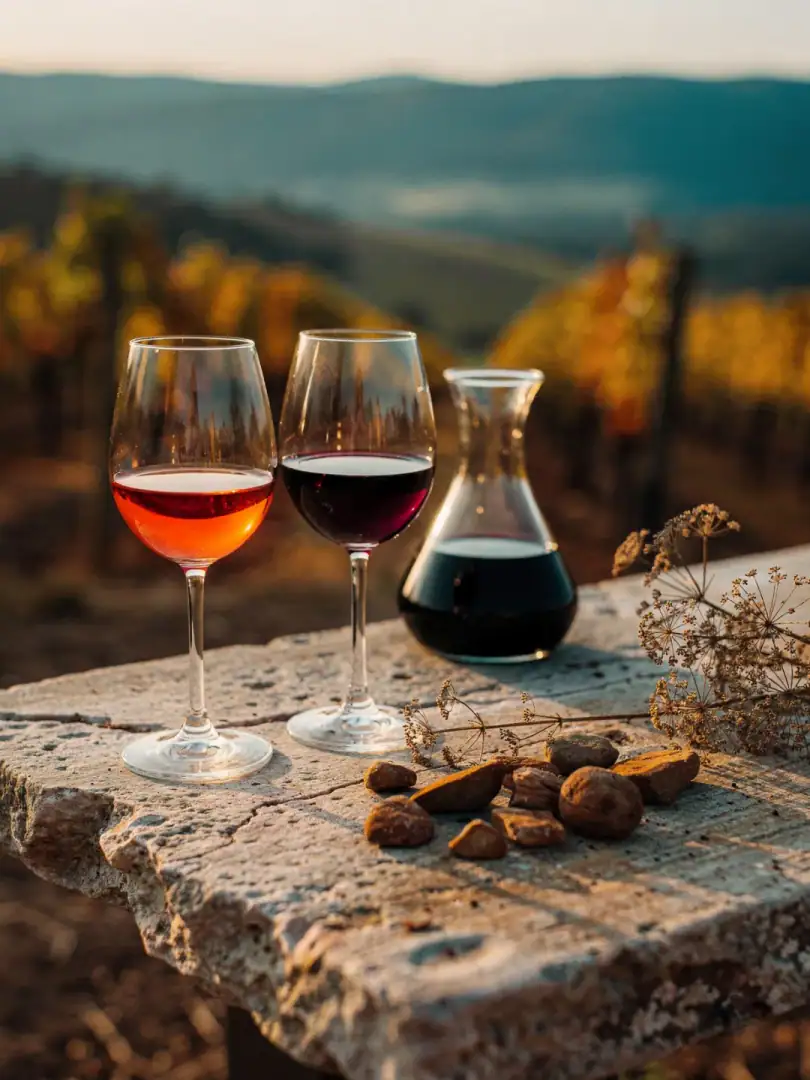
Shiraz Meets Grenache
Tasting
Two glasses of Shiraz reveal the difference immediately, one from Barossa Valley, one from McLaren Vale, and the color alone gives away where each one comes from. The Barossa wine tends to look denser and darker. McLaren Vale stays paler and more translucent in the glass. This is an early clue to the cooling sea breeze that sweeps over the vines here throughout the entire ripening season.
Smell before you even taste, it tells you a lot already. Barossa Shiraz often smells of blackcurrant and violets. McLaren Vale, by contrast, leans more toward ripe plum, red cherry, and dried herbs, with a touch of dark chocolate, a hint of mocha, and a wild, spicy note reminiscent of dry Australian bushland. Connoisseurs call this note garrigue, after the herb-covered landscape of southern France.
On the palate, the wine tends to stay medium-bodied rather than heavy-handed. Its tannin, the furry grip you feel on the gums, comes across as silky rather than angular, quite unlike Barossa Valley. The acidity, preserved by the cooling breeze, keeps the wine lively, since warmth alone never generates real intensity.
Grenache tastes completely different, even though it often comes from the same twelve kilometers of vineyard as the Shiraz right next door. Old bush vines grown in the sand of Blewitt Springs produce an almost translucent, pale red wine. It smells of raspberry, cherry, and white pepper. Blended with Shiraz and Mourvèdre into a GSM, the three complement each other naturally. Grenache brings the perfume, Shiraz the body, and Mourvèdre contributes the earthy spice on the finish. Either way, it remains unmistakably McLaren Vale.