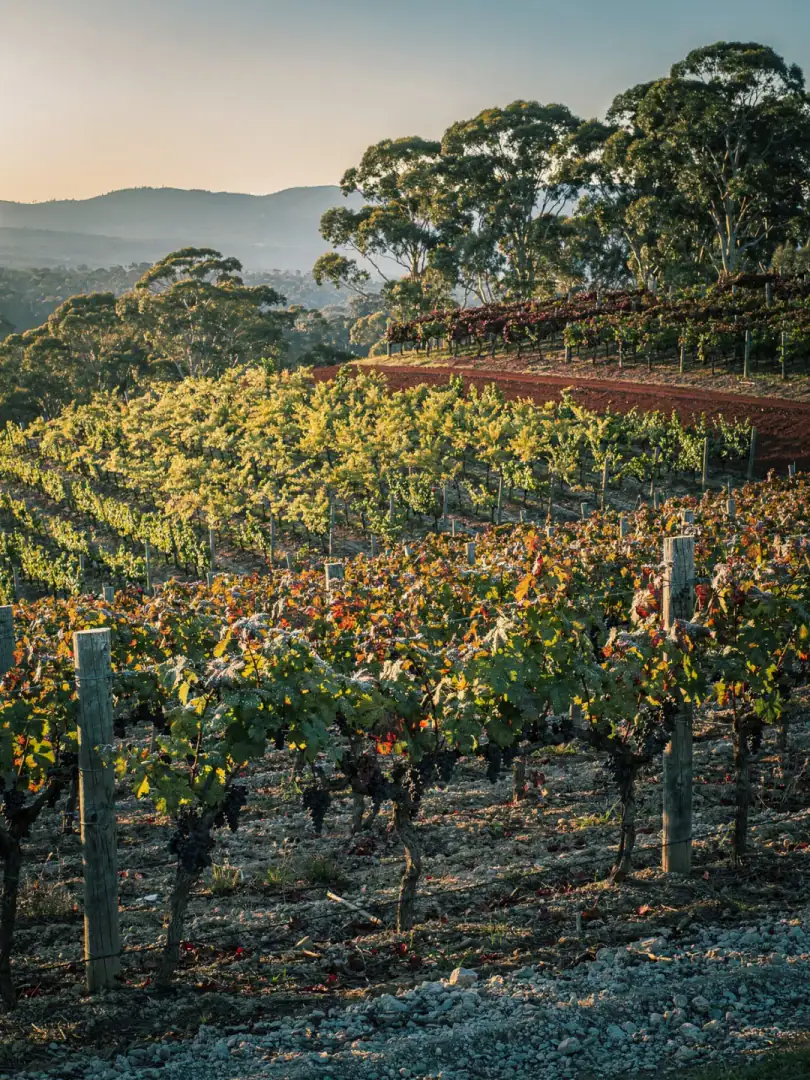
Pinot & Chardonnay
Grape Varieties
Chardonnay and Pinot Noir today account for nearly the entire harvest in the Yarra Valley. Pinot Noir, called just that here as it is throughout Australia, makes up around 43 percent of the harvested weight. Chardonnay accounts for a further 33 percent — together, nearly three-quarters of all the grapes grown in the valley. No other Australian region relies so heavily on these two Burgundian classics.
Cool nights determine whether Pinot Noir keeps its acidity or loses it. It's precisely the elevation between Lilydale and Warburton that provides this coolness. The variety is thin-skinned and temperamental, sensitive to every spike in heat. It's exactly this sensitivity that makes it a crowd favourite here. In the glass, Yarra Pinot Noir shows red cherry, wild strawberry, and often a spicy note. Compared to warmer Australian regions, it appears lighter in colour and leaner on the palate.
The region's Chardonnay has undergone a stylistic transformation. In the eighties and nineties, it was often rich and heavily oaked, with plenty of buttery character from a second, softening fermentation step in the cellar. Since the 2000s, most producers have shifted to earlier picking, less new oak, and a greater focus on the fruit itself: lemon, white peach, sometimes a flinty edge.
Paul de Castella was the first to bring Cabernet Sauvignon vines from Bordeaux in the 1850s, long before anyone here thought of Pinot Noir. A century later, John Middleton built his reputation at Mount Mary on exactly that foundation: Quintet, a blend of Cabernet Sauvignon, Merlot, Cabernet Franc, Malbec, and Petit Verdot modelled on Bordeaux. Alongside it grows cool-climate Shiraz, spicier and peppery compared to its relatives from the hot Barossa Valley. In the coolest sites, even Sauvignon Blanc thrives.