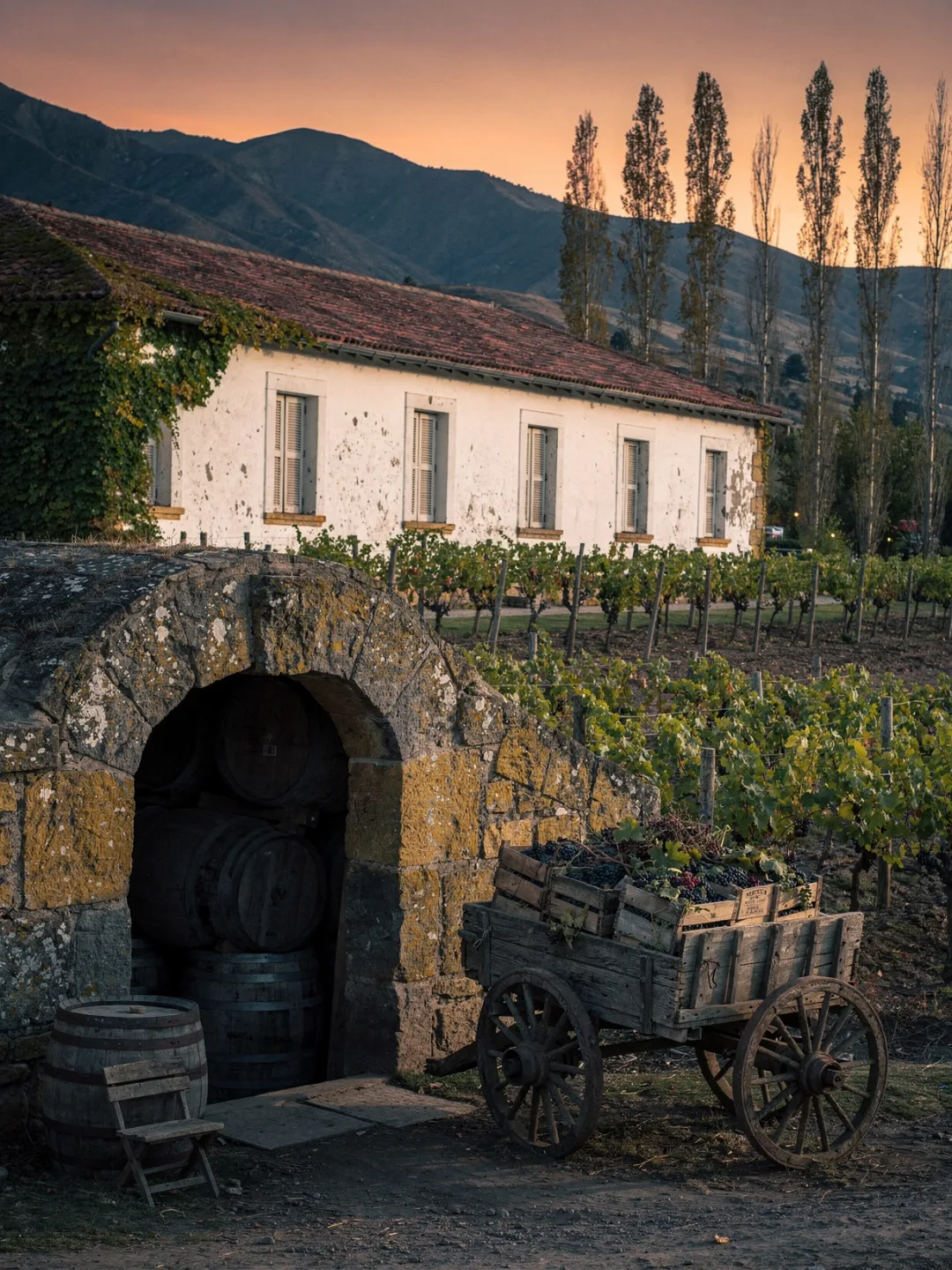
From Ochagavía to Almaviva
Region & History
Wine grew at the foot of the Andes long before it became famous. Spanish settlers brought the robust País grape variety in the 16th century, intended for simple everyday wine, not for the world market. That changed in 1851, thanks to a single man. Silvestre Ochagavía Errázuriz, a mining entrepreneur and large landowner, traveled to France and saw the estates of Bordeaux there. On the way back, he brought French vines with him — Cabernet Sauvignon, Malbec, Merlot, Pinot, Riesling, Sauvignon Blanc, and Sémillon — along with a French agronomist to help him cultivate them.
Other large landowners in the Maipo Valley quickly followed his example. Matías Cousiño bought the Hacienda Macul as early as 1856. His son Luis later had the first stone cellar vaults built there, together with his wife, Isidora Goyenechea. Domingo Fernández Concha founded Santa Rita in 1880. Melchor Concha y Toro followed in 1883 with the winery that still bears his name today. While phylloxera devastated Europe's vineyards during these decades, Chile was spared. Desert to the north, ocean to the west, the Andes to the east, and pack ice to the south kept the pest at bay — and still do today.
Even so, for a century no one here knew exactly what was growing in the vineyards. The Carmenère variety brought from Bordeaux was mistaken everywhere for Merlot, confused due to nearly identical leaves and grape clusters. It wasn't until November 1994 that French ampelographer Jean-Michel Boursiquot, while walking through vineyards in Maipo, discovered the difference: a slightly twisted stamen on the flower, a tiny detail that brought back an entire grape variety. In France, Carmenère had nearly disappeared after phylloxera, because it barely set fruit on the new American rootstocks. In Chile, unrecognized, it had long since spread across the entire country.
The valley's modern era begins in 1987, with the first vintage of Don Melchor. Concha y Toro wanted to prove that a single vineyard in Puente Alto could produce a world-class Cabernet Sauvignon. It was crafted by winemaker Enrique Tirado, together with French consultants Jacques and Éric Boissenot. Ten years later came Almaviva, a joint project between Concha y Toro and Baron Philippe de Rothschild of Bordeaux. The name comes from a character in Beaumarchais's "The Marriage of Figaro." Two wines, one message: the valley that had overlooked its most important grape variety for a hundred years now belonged among the world's elite.