Slate & Greywacke
Soils
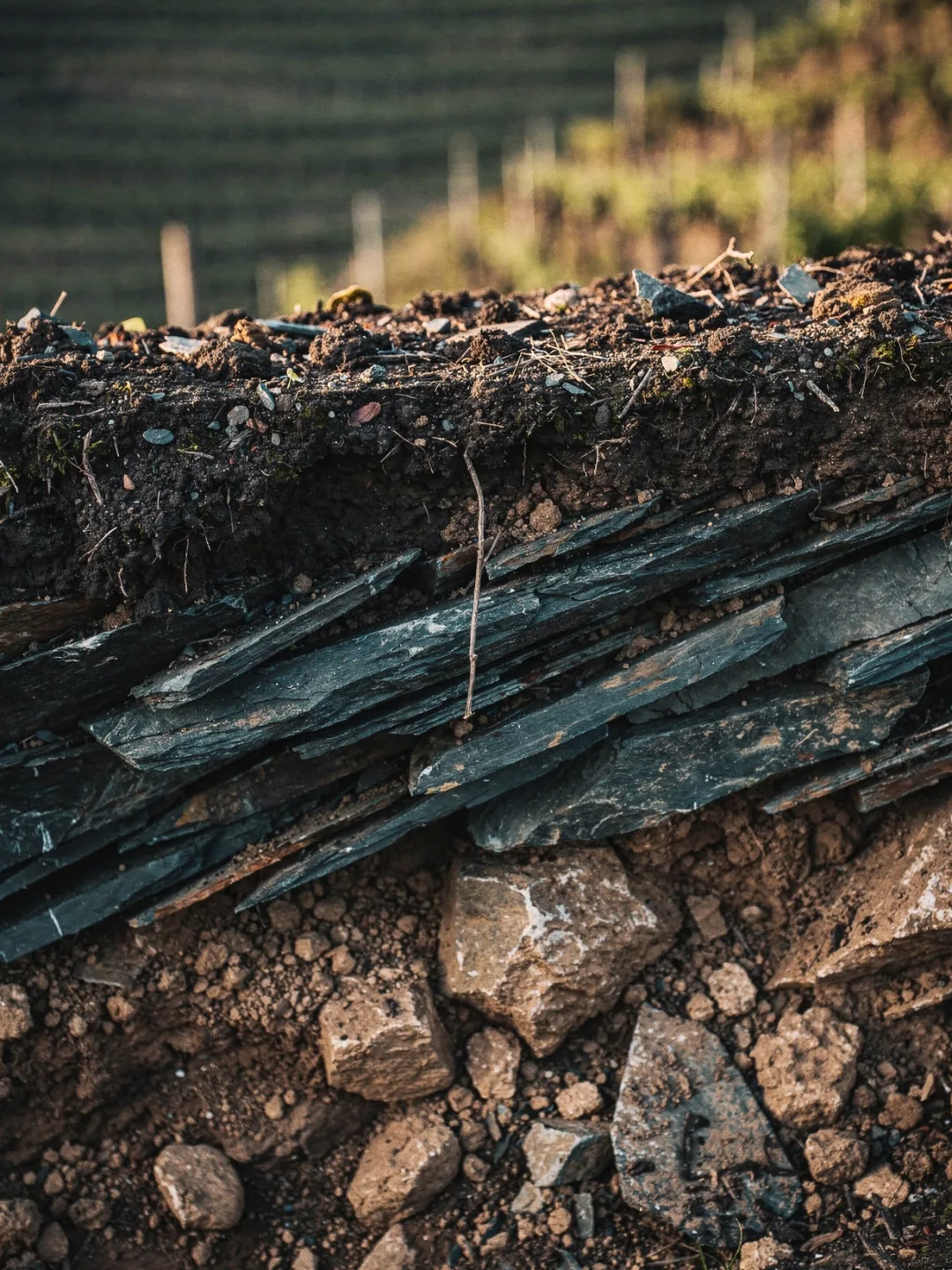
Dig a hole on a steep Ahr slope and you won't get far. After just a few spadefuls, you hit rock: thin, dark slabs that break apart easily when lifted out. This is Lower Devonian clay slate, more than 380 million years old.
It formed at the bottom of a primeval sea. Fine mud settled layer by layer and was compressed. Later, as the Rhenish Slate Mountains folded upward, it tilted out of the horizontal. Geologists call the formation common here Rauhflaser slate, named for its rough, fibrous fracture surface.
Right next to it, often in the very same parcel, lies greywacke — a coarse-grained, hard sandstone, also from the Lower Devonian, but considerably tougher than the soft slate above it. Together, both rocks built the dry-stone walls that terrace the valley. Stacked by hand, without mortar, some of them dating back to the Middle Ages.
One exception stands near Heimersheim: the Landskrone, an extinct volcanic cone of the Eifel rising in the middle of the slate valley. Vines have grown at its foot for centuries. Basalt soils like this are rare in the Ahr, but they show just how restless the ground truly was over millions of years.
For the vine root, slate is both a hardship and a blessing. It holds hardly any nutrients and lets water drain through quickly, so the root drives deep between the slabs, searching for both. This slows growth, shrinks the berries, and concentrates color and tannin in the skin — exactly what a Spätburgunder needs from this barren soil to avoid tasting thin.
A thin, dark layer of decomposed leaves and root remnants, rarely more than a hand's width deep on a steep Ahr slope.
The root: This is where the fine roots sit. They take in whatever rain has just delivered, and are the first to dry out when the sun blazes for days on end.