Shelter and Storage
Climate
Fifty degrees thirty minutes north latitude. At this latitude, hardly any red wine of note grows elsewhere, yet on the Ahr, Spätburgunder ripens reliably here nonetheless — thanks to a combination of shelter and storage found nowhere else in Germany.
The Eifel provides the shelter. It intercepts the moist westerly winds before they reach the narrow Ahr Valley. Behind it lies a rain shadow that pushes rainfall down to around 650 millimeters a year — noticeably drier than in most other German wine regions. On average over the long term, about 1,400 to 1,450 hours of sunshine accumulate. In especially good years like 2003, it was almost 2,000.
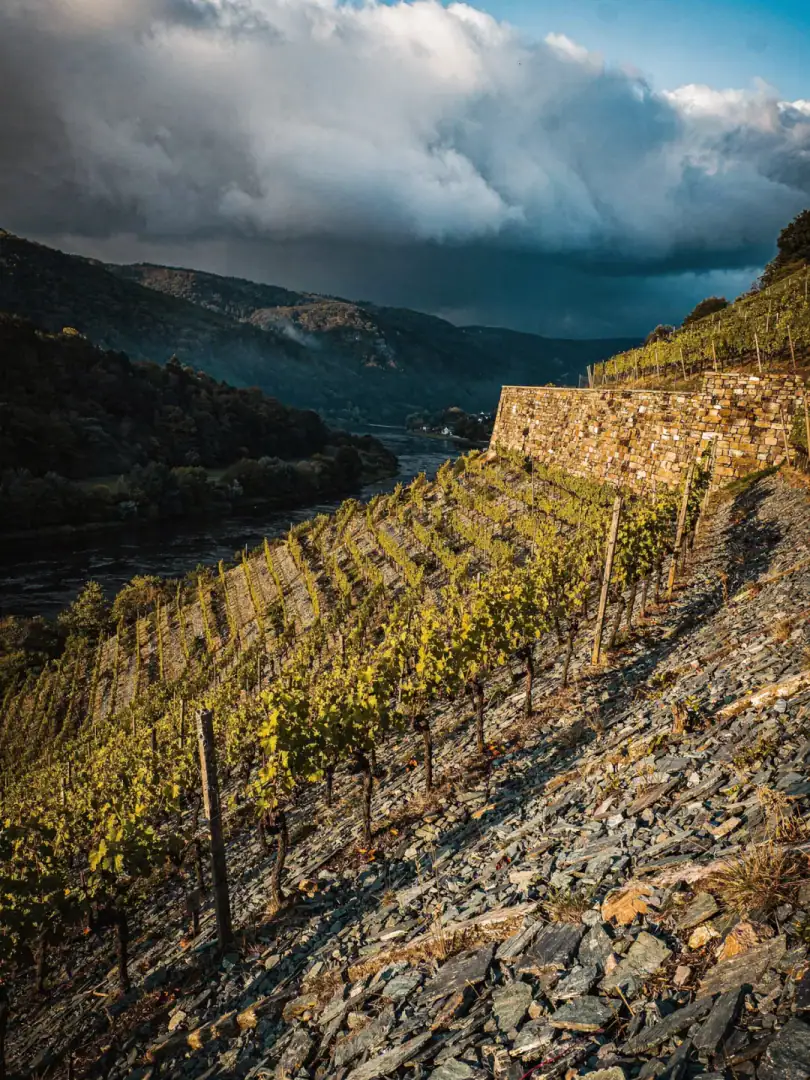
The stones themselves provide the storage. Slate and greywacke, which make up the steep slopes, heat up during the day in the blazing sun. At night, they slowly release that warmth again, almost like underfloor heating beneath the vines. Without this effect, the annual mean temperature of just under ten degrees Celsius in Bad Neuenahr would be too low for Spätburgunder to ripen reliably here.
How much a single site can matter is shown by a vineyard above Walporzheim. It lies at about 150 meters and faces south to southeast down toward the Ahr. In places it drops at a fifty percent gradient — so steep that machinery has no business there. Whoever works here does it by hand, or not at all.
Cold air tends to settle at the bottom in a narrow valley like this. Spring frost is therefore a constant worry. The steep slopes help here too: cold air flows down them like water and pools in the valley floor. The vines higher up the slope are usually spared. Whoever plants in the flat valley floor takes on more risk — which is why the best sites almost always lie higher up.