Monastery, Phylloxera, Flood
Region & History
Whether the Romans already planted vines in the Ahr Valley, nobody knows for certain — evidence is lacking, only speculation remains. What is certain is what a monk wrote down in a book in the year 893. The Prüm Urbar, the property register of the Benedictine Abbey of Prüm, lists vineyards in eight Ahr villages, making the valley one of the earliest documented wine landscapes in Germany.
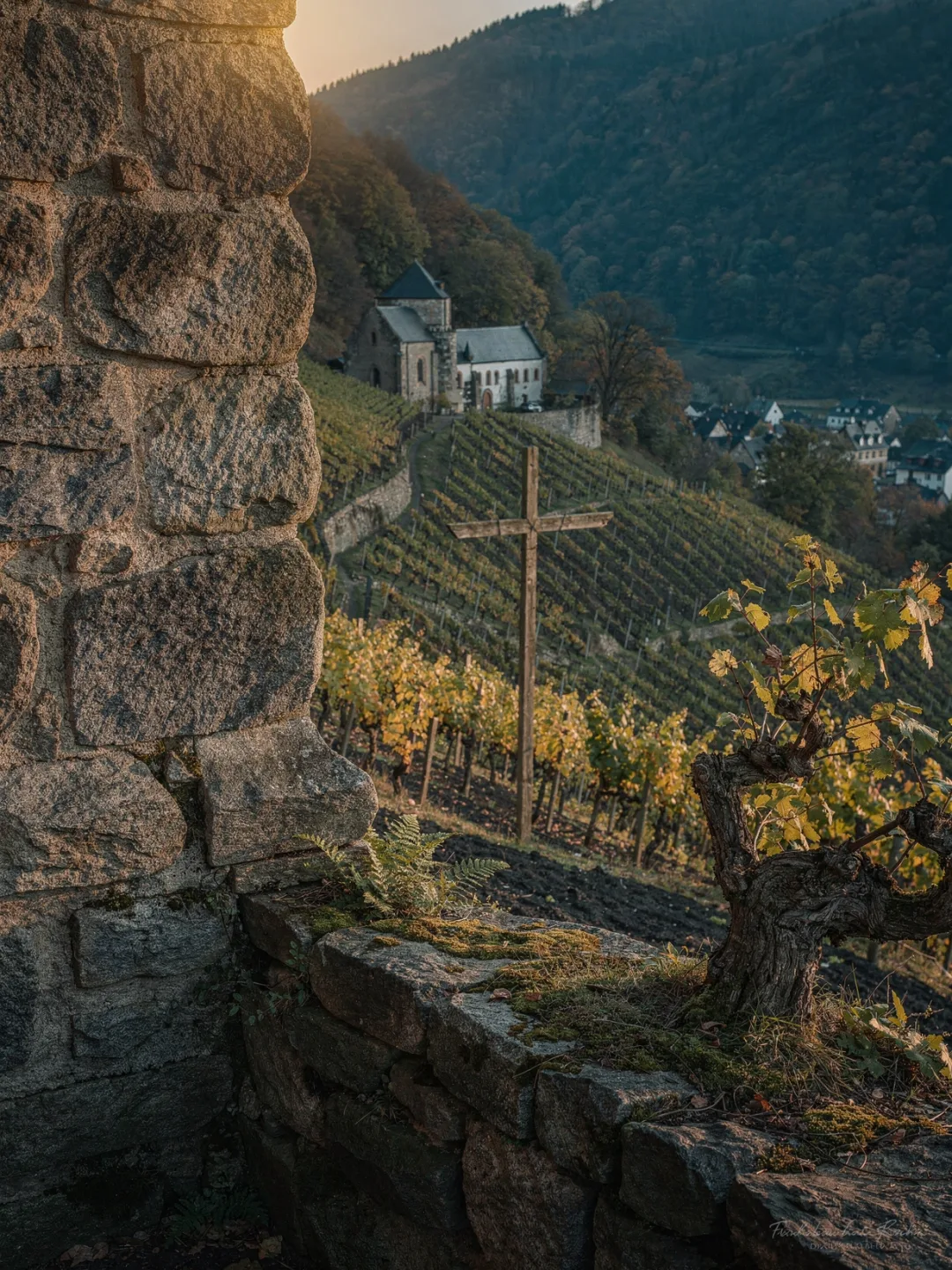
Winegrowing really gained momentum with the monasteries, though. In 1137, Augustinian canonesses from Klosterrath founded Marienthal Abbey in a side valley of the Ahr. From the very start, the nuns cultivated the steep slopes around it. What they laid out still shapes the landscape today: narrow terraces, hand-stacked dry-stone walls of slate and greywacke, enclosing the valley basin like an amphitheater. After secularization, the monastery's wine estate became a Prussian state domain in 1925.
In 1868, eighteen winegrowers from Mayschoß joined forces and founded the world's first winegrowers' cooperative, out of sheer necessity. Twenty more cooperatives followed along the Ahr by the turn of the century. Then came phylloxera. It first appeared in 1881 near Heimersheim, at the Landskrone, the valley's most famous vineyard, and over the following decades ate its way downstream through the sites.
What came out of the Ahr for more than a hundred years after that was mostly pale and sweetish. Internationally, this red wine was hardly taken seriously. A single winegrower from Dernau changed that. In the mid-1980s, Werner Näkel began aging his Spätburgunder dry and in barriques — at the time, that was considered a mistake, not a style. In 1989, he won the German Red Wine Prize with his 1987 vintage. The barrique fever that swept through the valley afterward transformed Ahr wine within a single generation.
On the night of July 15, 2021, the tranquil Ahr turned into a flood wave that swept away cellars, barrel stores, and entire wineries. Of 68 wine estates in the valley, 65 were damaged, some down to their foundations. Within a few weeks, the winegrowing community raised one of the largest crowdfunding sums in Germany, with nearly fifty thousand people contributing. Planting continued nonetheless. Already by the following autumn, harvest was underway again, in sites that had lain under mud just months before.