Spätburgunder & Relatives
Grape Varieties
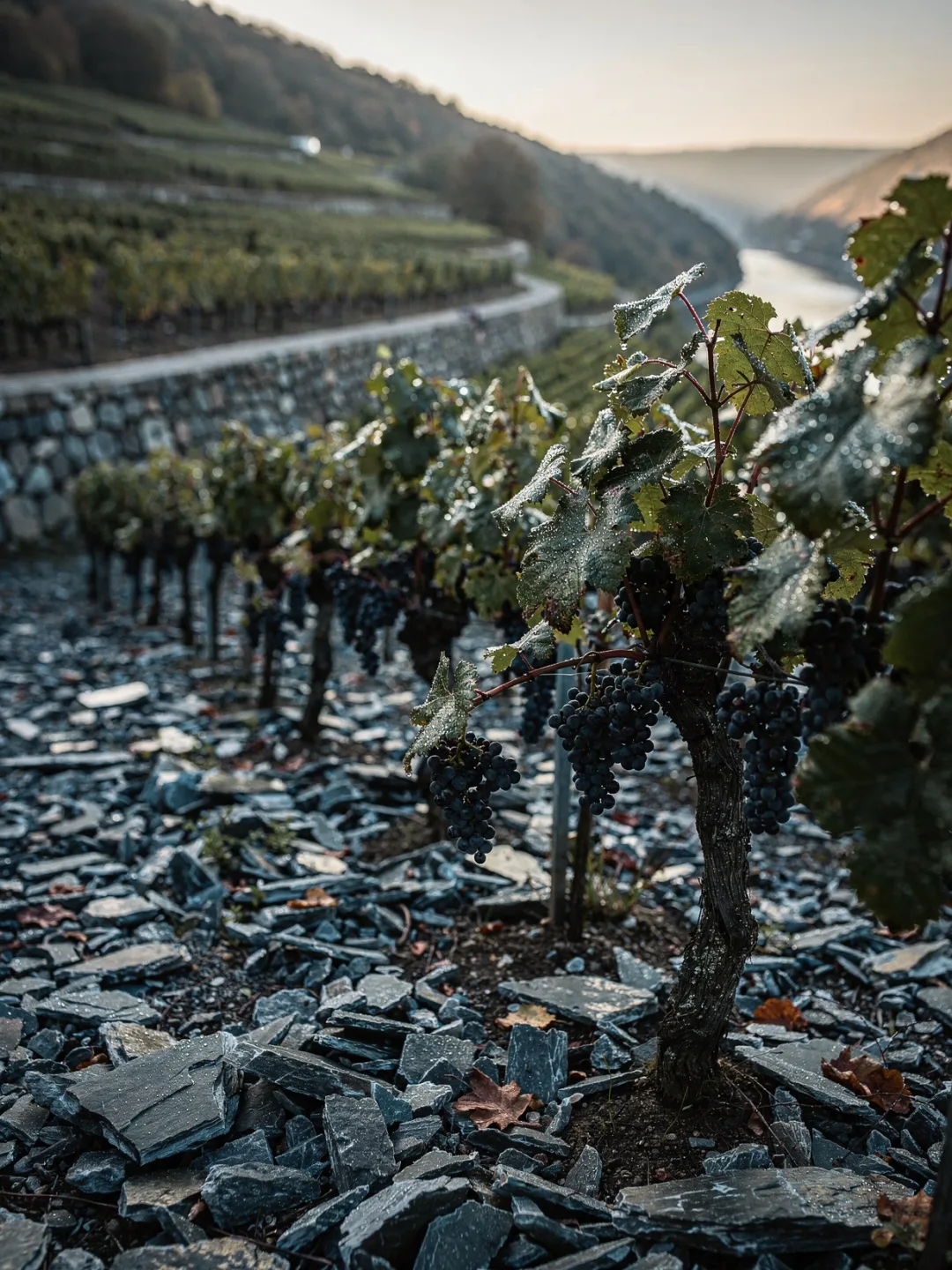
One variety dominates the Ahr Valley as completely as almost no other grape does anywhere else in Germany. Spätburgunder covers nearly two-thirds of the entire vineyard area, about 347 of 535 hectares. That makes the Ahr the northernmost wine region in the world where a red grape variety sets the tone. The grape is thin-skinned and temperamental. It wants warmth by day, calm at night, and a winegrower who watches closely.
The valley's second red specialty, by contrast, nearly disappeared. Frühburgunder is an early-ripening mutation of Spätburgunder, first mentioned under this name in 1824. It is grown in significant quantity almost nowhere else in Germany, and of the roughly two hundred hectares nationwide, no wine region is planted as densely with it as the Ahr. In the 1960s, it was replaced almost everywhere by higher-yielding varieties because of its low yields. Anyone planting it today does so out of conviction. The berries are small and ripen two to three weeks before Spätburgunder, yielding a paler, more fragrant wine with finer tannin.
For a long time, the order of importance was different. Well into the 20th century, Portugieser was the most important red variety in the valley, an early-ripening, high-yielding mass producer that supplied simple, pale wine for quick sale. Today it covers only a small remnant of the area, displaced by the more demanding but more rewarding Spätburgunder grape.
White wine plays a supporting role on the Ahr, but not a minor one. Riesling covers a good eight percent of the area, mostly on the warmest, steepest slopes. There it retains the acidity that defines it. Weißburgunder and Grauburgunder follow with a considerably smaller share, delivering broader, creamier wines that many estates keep alongside their red core range for balance.
What connects almost all the varieties here is their shared origin within the same family. Spätburgunder, Frühburgunder, Weißburgunder, and Grauburgunder are related to one another through generations of mutations. Over time, one grape changed color, ripening time, and character — and on the Ahr, it found a home in nearly all its forms.