Shell Limestone & Keuper
Soils
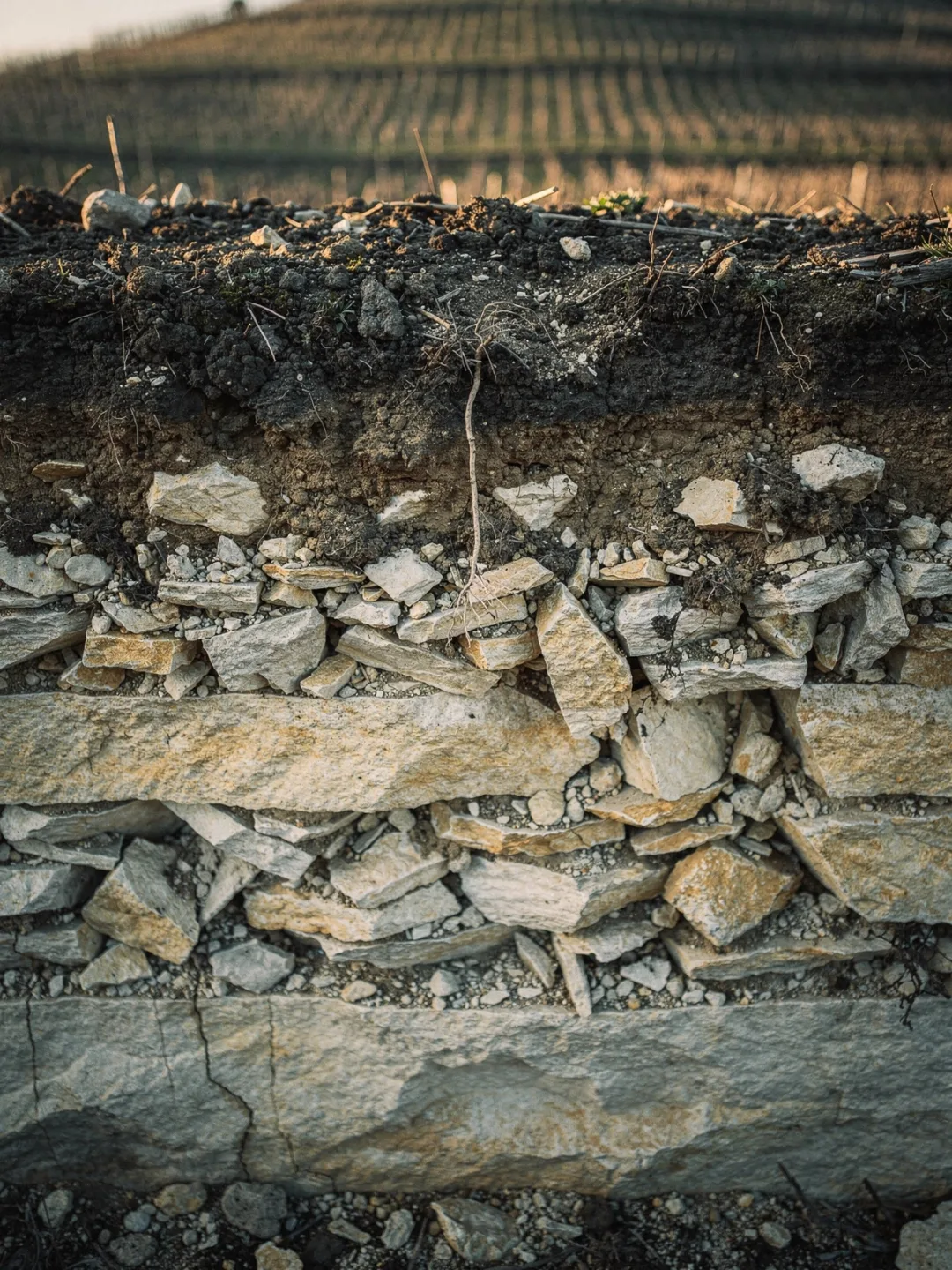
Try to dig a hole in the Würzburger Stein, and you won't get far. No topsoil, just stone. After a few inches of earth, the spade hits rock: yellowish-gray limestone slabs, wavy layers, hard as concrete — this is Wellenkalk, the lowest layer of the Muschelkalk that lies up to forty meters thick beneath the town.
The limestone formed some two hundred fifty million years ago, when a shallow sea covered large parts of Central Europe. Mussel shells and other calcareous skeletons sank to the seabed and compacted over millions of years into rock. What today stands as a steep slope above the Main was once the ocean floor. The name Wellenkalk comes from the wave-like patterns in the thin limestone bands, visible traces of the ancient seabed.
For the vine, such rock is both a challenge and a gift. Roots have to force their way through cracks and fissures instead of spreading through soft soil, and this very resistance keeps yields low; at the same time, the limestone stores rainwater in its pores and releases by day the warmth it has gathered from the sun. A natural oven that makes frosty nights a little more bearable.
But this limestone is only one of three soils that divide Franconia into three landscapes. In the west, in the Mainviereck around Aschaffenburg, red Buntsandstein predominates, favoring red wine above all. In the center, the Maindreieck around Würzburg, Muschelkalk dominates. In the east, in the Steigerwald, the younger Keuper follows above it, often as Gipskeuper with embedded layers of gypsum. Its wines are considered especially powerful and extract-rich. Three soils, three characters.
Silvaner responds to this difference more sensitively than almost any other variety. On Muschelkalk it turns taut and saline, on Keuper fuller and broader, and on Buntsandstein it's rarely found at all — other varieties grow there instead. Anyone tasting three Silvaners from these three areas side by side tastes a geological map without ever having seen one.
A thin layer of topsoil and fine loess clay, mixed with weathered limestone rubble. On the Würzburger Stein, rarely more than a hand's width deep.
The root: Only the fine roots reach here. After just a few rainy days, this layer is already dry again.