Continental & Dry
Climate
Franconia lies farther from the ocean's moderating influence than most German wine regions, and you can taste it. The climate is considered a transition between maritime and continental. But it leans distinctly toward the continental side: warm, often dry summers, cold winters, and little rainfall over the course of the year.
The average annual temperature is roughly eight and a half to nine degrees Celsius. Sunshine hours reach sixteen hundred to seventeen hundred fifty per year — more than in many cooler German wine regions. Rainfall stays comparatively low, at five hundred to six hundred liters per square meter, and for Silvaner, which tolerates rot poorly, this is a distinct advantage: dry berries, healthy harvests.
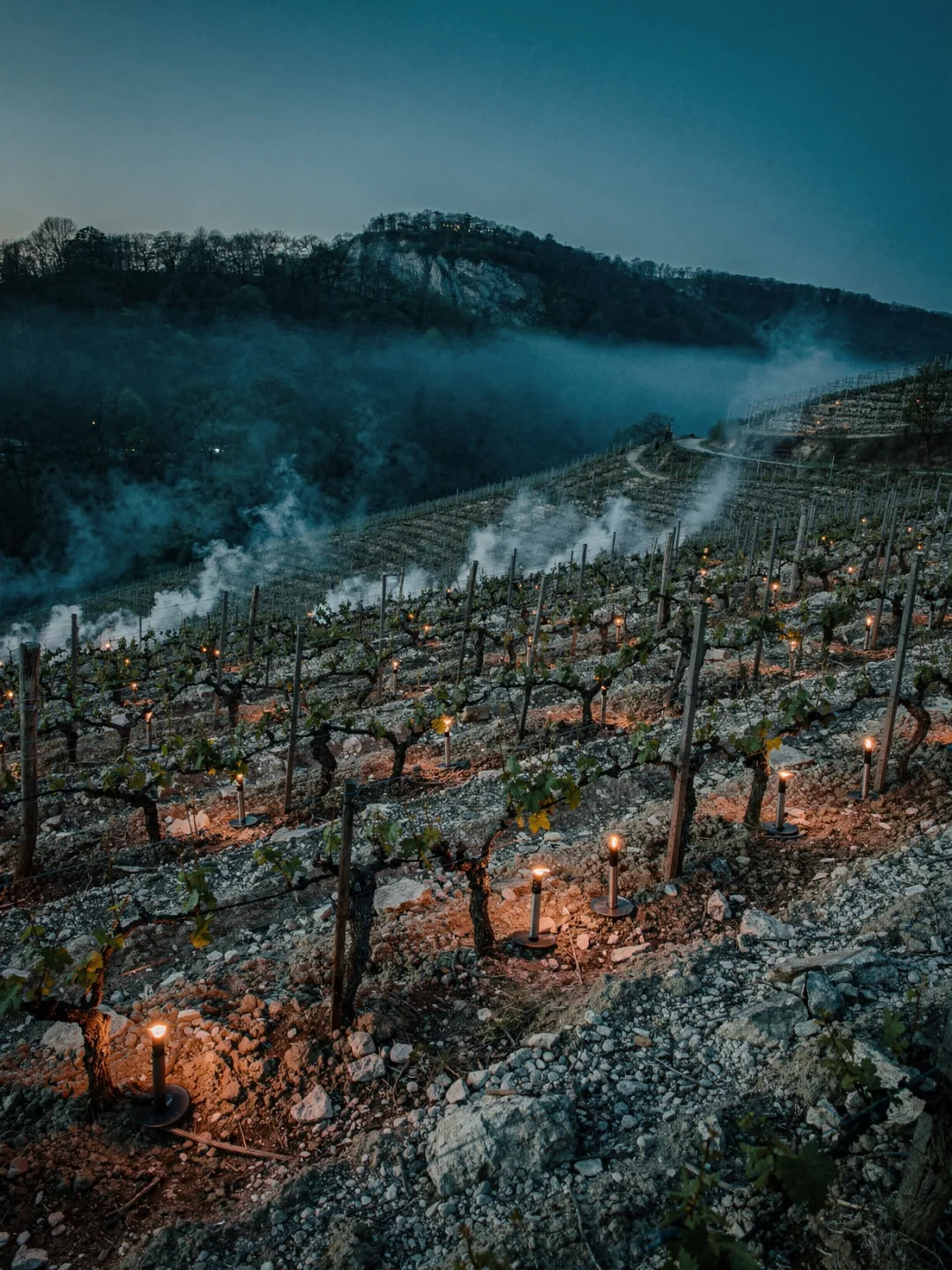
The flip side is frost. Until the 1960s, Franconian winters regularly plunged to minus twenty degrees Celsius; today it's usually still minus fifteen — cold enough to kill entire vines. Often more dangerous than winter is a single morning in May. If the vine buds early because April was warm, one night just below freezing is enough to destroy the young shoots and, with them, the harvest. Winemakers then light candles between the rows, sometimes burning through the entire night.
The summers, meanwhile, can tip over the edge — hot and dry right up to the limit of what the vines can withstand. Heat-loving varieties like Domina or Spätburgunder then ripen reliably. Silvaner holds onto its acidity remarkably well, as long as the soils retain enough water. And that's exactly what matters in the next step: what lies beneath the vines.