Buntsandstein and Loess
Soils
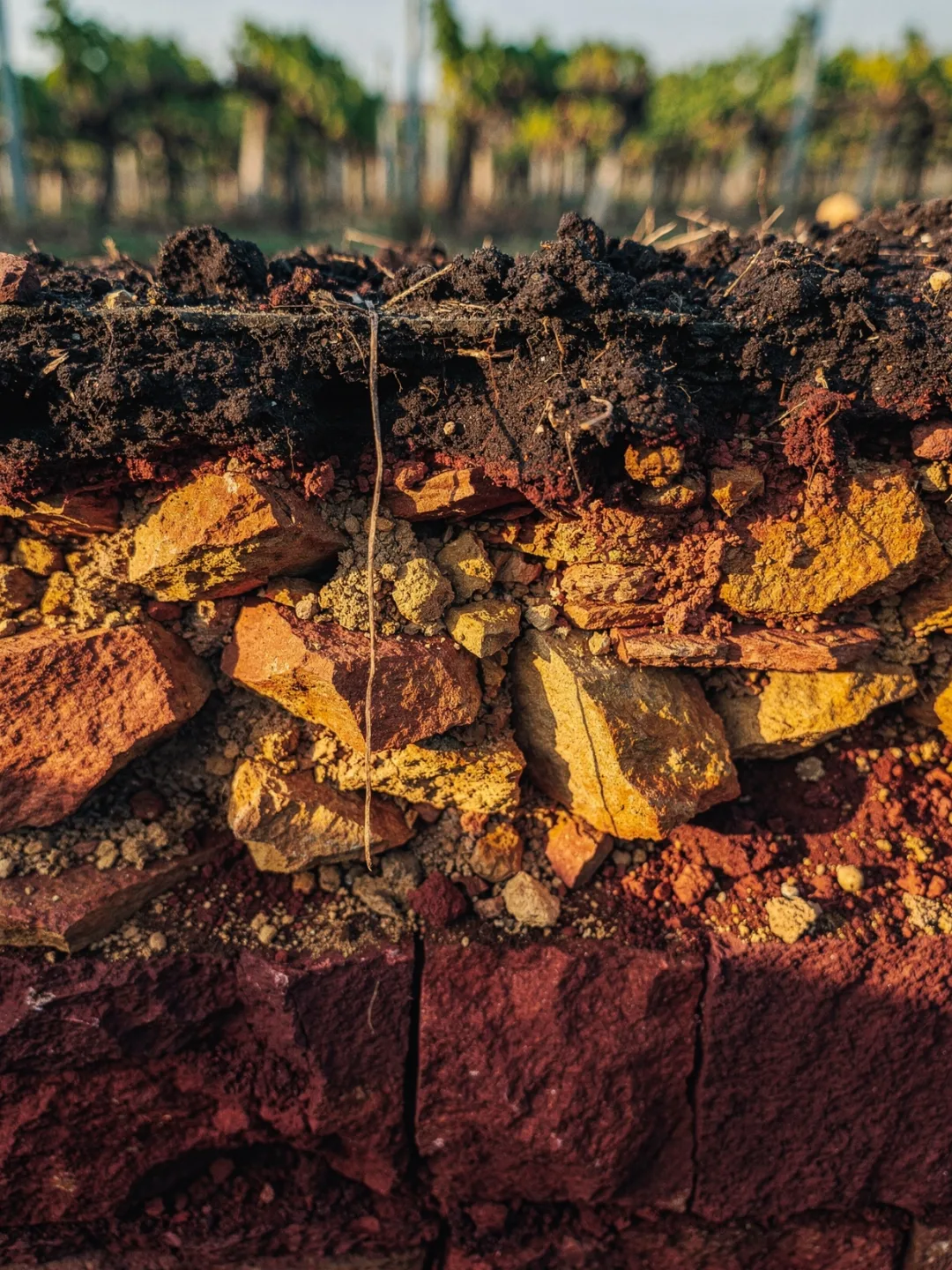
Dig a hole at the Heppenheimer Steinkopf, and within a few inches you'll hit red. Not limestone, not slate as in many other German vineyards, but weathered Buntsandstein. This rust-red, soft sandstone explains, even from a distance, the color of the steep slopes above Heppenheim. The Steinkopf is no recent discovery. It's already mentioned under this name in 1655. In 1842, the wine researcher Johann Philipp Bronner described it as Heppenheim's finest site.
The Buntsandstein formed some two hundred fifty million years ago, when a river-and-desert landscape lay here and iron oxide stained the sand rust-red. Today the rock breaks apart into loose, angular chunks, permeable to both water and roots, and near the surface, where weathering and oxygen have the greatest effect, the soil is yellowish-red and loose. With depth it grows denser and darker, almost blood-red, and retains moisture there even through dry summers.
The vine responds to this the way it does on any lean, rocky soil: it roots deep. Among the sandstone fragments, there's barely any nutrient to be found, so the roots push downward, toward the water waiting below. The resulting berries stay small. A small berry has proportionally more skin relative to juice, and it's exactly there that aroma and the fine mineral edge reside that set a Steinkopf Riesling apart from one grown on the Rhine plain.
Just a few kilometers away, in Bensheim's Kalkgasse, the soil already looks quite different. Shallow, weathered granite, topped by a thin layer of limestone that gave the site its name. In the Umstadt district, the Odenwald wine island, basalt even lies beneath the loess – volcanic rock from a time when the earth here was still churning. Three vineyard sites, three entirely different soils, all within a single small wine region.
One word still needs a caveat, though: mineral. What many take to be a directly tasteable mineral flavor straight from the rock is, in truth, a detour. The roots don't absorb meaningful amounts of iron or quartz that could later be recognized in the glass. What the Buntsandstein actually provides is warmth, stored during the day and released at night, and a water supply that runs just short at exactly the right moment. The rest is the vine's own work.
A thin layer of loess and decomposed leaf litter, barely a hand's width deep.
The root: This is where the fine roots sit, the first to catch the rain — and the first to dry out again.