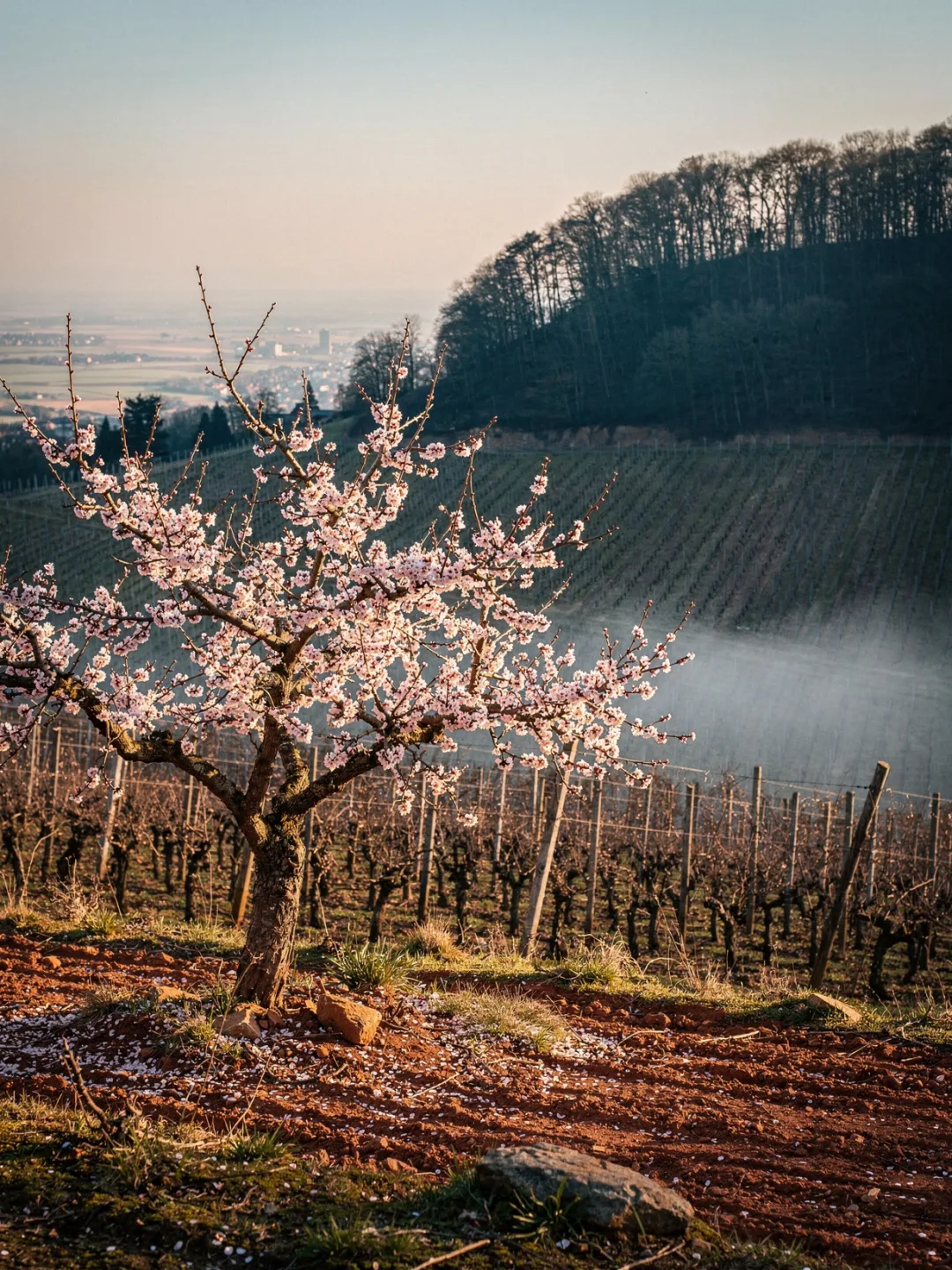
Spring Arrives First
Climate
The Bergstraße sits at a meeting point. Behind it rises the Odenwald, which blocks cold north and east winds, while ahead the Rhine plain opens up, storing warmth in summer and releasing it again at night. Between the two, on a narrow strip along the lower slopes, lie the vineyards – sheltered, yet facing the sun.
What that means in practice is shown by the winegrowers' association's figures for an average year: around twelve degrees Celsius annual average temperature, more than 1,700 hours of sunshine per year, and only about 690 millimeters of rainfall. That's more sun and less rain than most wine regions further north see. It's enough to reliably ripen Riesling here, even in a cooler-than-usual year.
This shows most strikingly in spring, long before the first grape even flowers. While frost still threatens elsewhere in Germany, the almond trees along the Bergstraße are already opening their blossoms in March, followed by cherries, apricots, and forsythia, bathing the slopes in pink and yellow for weeks on end. Locals therefore call their home the Spring Garden of Germany. That's no exaggeration, but a phenomenon you can observe fresh every year from late February onward.
This warmth also shifts the calendar in the vineyard. The vine buds earlier here than in the Rheingau or on the Mosel, and flowers earlier too. In a normal year, harvest already begins in early September. For Riesling, that's an advantage: the grapes get more time to ripen at leisure, without running into a wet, cold October, as other wine regions more often do.
Still, the climate isn't entirely uniform across the region. The main area around Bensheim and Heppenheim, the Starkenburg district, sits right at the warm edge of the Rhine plain. The smaller Umstadt district, by contrast, known as the Odenwald wine island, lies well within the Odenwald itself, noticeably higher and cooler. Only a few kilometers separate the two as the crow flies, and yet each has its own distinct microclimate.