From Monks to Riesling
Region & History
The Romans called the old road at the foot of the Odenwald strata montana, the Bergstraße. Some two thousand years ago they are said to have planted the first vines here, on the sun-warmed slopes between forest and the Rhine plain. Hard evidence is scarce. What is documented in solid black and white, however, comes from the monks of Lorsch. In the eighth century, they first put winegrowing along the Bergstraße in writing in their vast property register, the Codex Laureshamensis, a work with well over three thousand entries in which more than a thousand places appear for the very first time. Heppenheim itself is already recorded there on 17 July 755. A priest named Hiebo notarized the donation of a farm in Weinheim to the local Church of St. Peter.
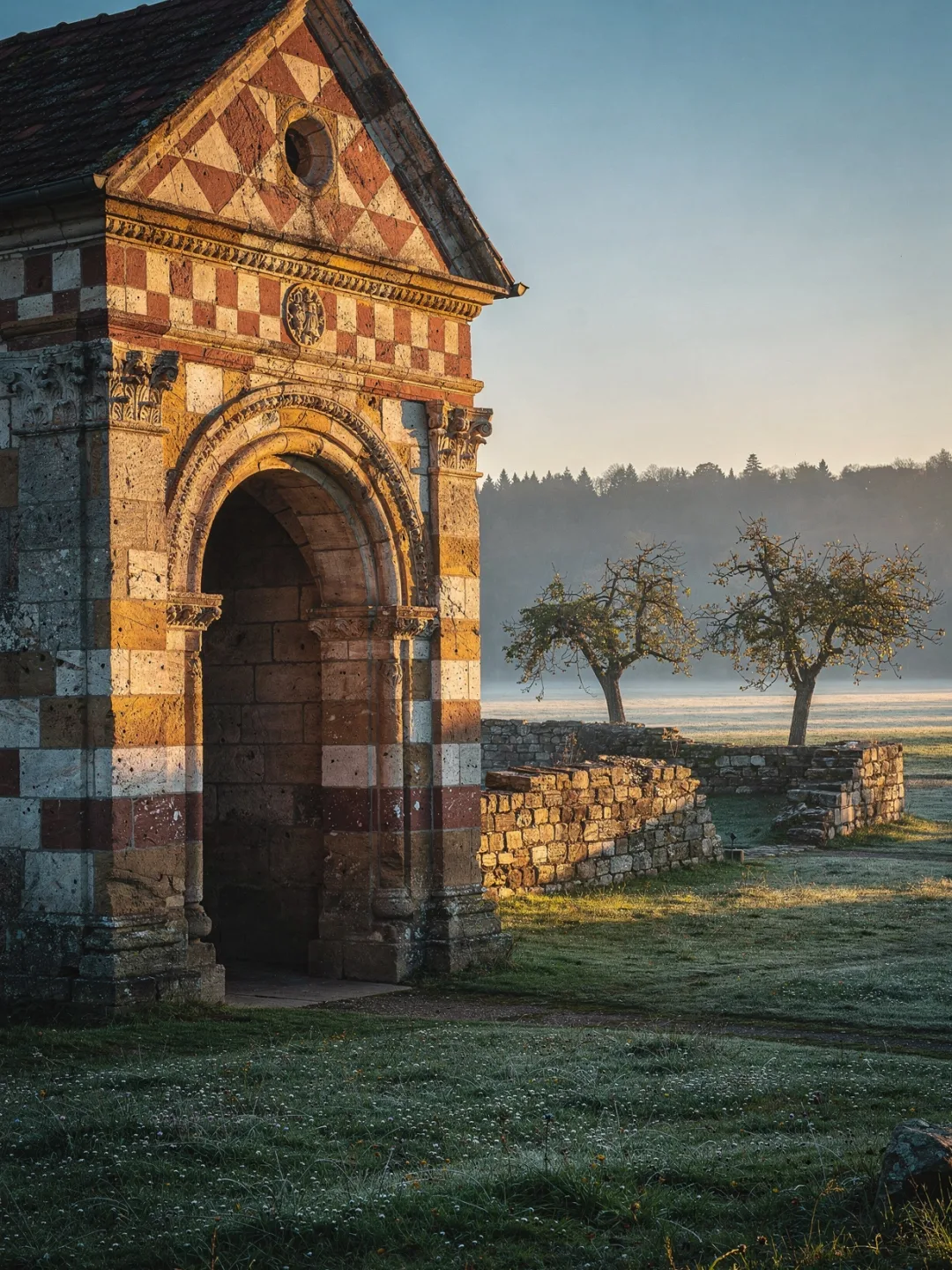
Anyone visiting Lorsch Abbey today easily underestimates how powerful it once was. It ranked among the most important imperial abbeys in Charlemagne's Frankish Empire, with holdings stretching from the Vosges to the North Sea, and its gatehouse still stands today, nearly twelve hundred years old. Since 1991 it has been a UNESCO World Heritage Site, the first architectural monument in all of Hesse. Monks with that kind of backing had land in abundance and time for their vines. They could pass on their knowledge across generations, while elsewhere rulers came and went, and with them, vineyards often fell into neglect.
After that, the land long belonged to the Electorate of Mainz, later to the Electoral Palatinate, split among shifting rulers. Order only arrived in 1803, and with a single stroke of the pen: the Reichsdeputationshauptschluss, a sweeping redistribution of German small states after the end of old ecclesiastical rule. Hesse-Darmstadt and Baden swapped their territories along the Bergstraße. Since then, the border has run right through the landscape, between Heppenheim and Laudenbach. Everything to the north became Hessian, everything to the south Badenese – and stayed that way. When people today speak of the Baden Bergstraße, they mean a separate wine region with its own history, not this one.
According to tradition, Emperor Joseph II stopped on a Bergstraße hillside in 1764, on his way back from his coronation in Frankfurt. He is said to have exclaimed: "Here Germany begins to turn into Italy." Nobody today knows for certain whether he really said those exact words. The phrase stuck anyway, because it captures something true. Almond trees bloom here as early as March, when frost still lingers elsewhere in Germany. The vineyard terraces between the villages genuinely evoke a slice of Tuscany that slid up against the Odenwald.