Riesling, Twice Over
Grape Varieties
Almost every other vine along the Bergstraße is Riesling. Of 440 hectares of vineyard, 149 are planted with this single variety, a good third of the entire region. No other wine shapes the area's reputation quite as much. That's no accident. Riesling ripens late, tolerates cool nights well, and retains its acidity even where it gets warm. Soil and climate along the Bergstraße deliver exactly that combination.
A clear step behind follows Grauburgunder (Pinot Gris), with 56 hectares, just over an eighth of the area. Spätburgunder (Pinot Noir) accounts for roughly eleven percent, Weißburgunder (Pinot Blanc) for just under six. In total, eight out of ten vines here are white varieties, with only one in five given over to red. That's more reminiscent of the neighboring Rheingau than of warmer, more southerly wine regions – even though the Bergstraße ranks among the warmest wine regions in Germany.
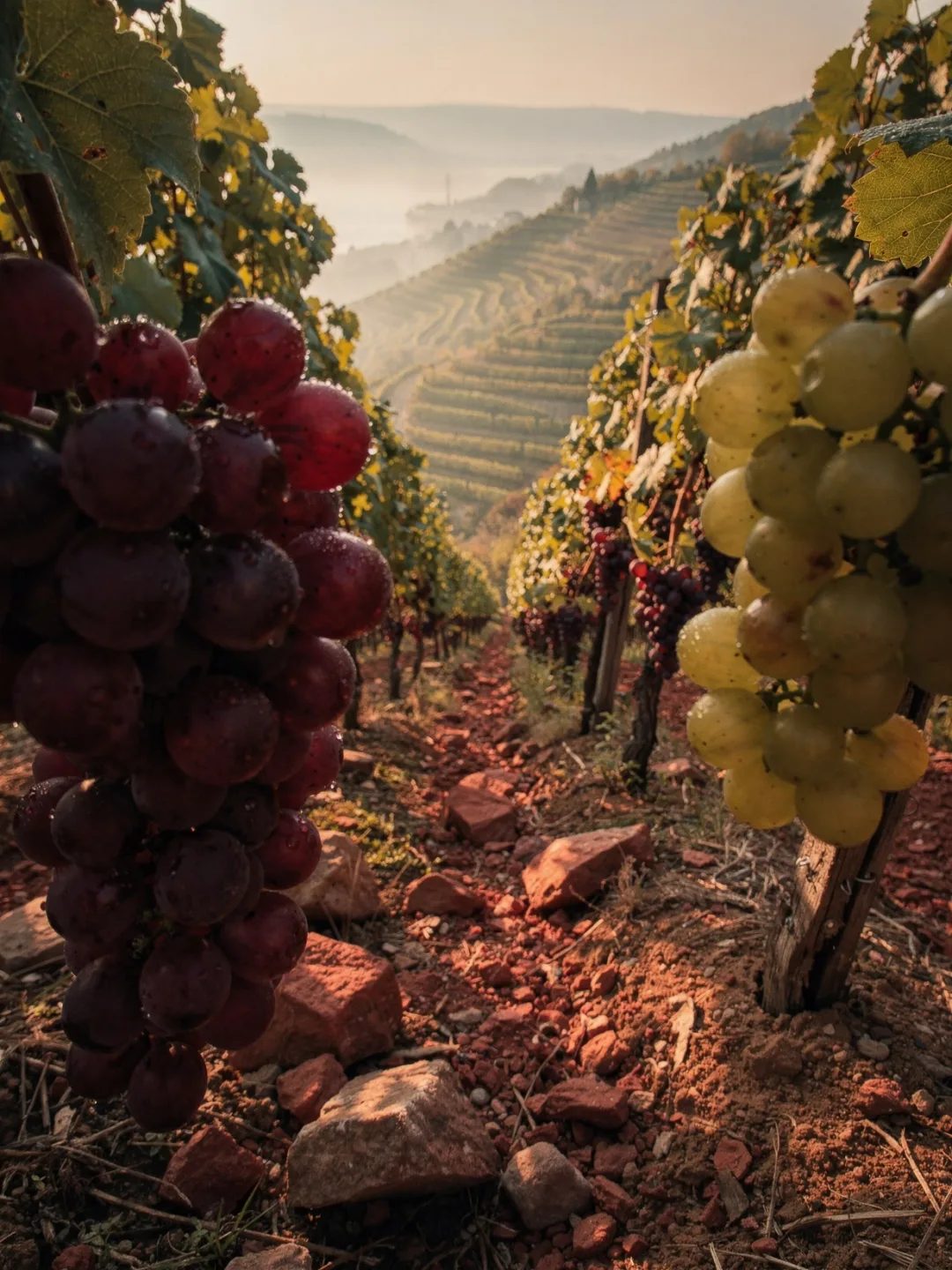
The real specialty, though, shares its name with its more famous sibling: Roter Riesling. For a long time it was believed to be the original, older form of Riesling, since winegrowers kept observing white berries turning red, never the reverse. Only a genetic study in 2016 revealed the opposite. White Riesling is in fact the older variety, and Roter Riesling merely a mutation in which red pigments called anthocyanins accumulate in the berry skin. Because it yielded less and birds preferred pecking at the conspicuous red grapes, it nearly fell into oblivion.
It was rescued in the Rheingau, at Geisenheim University, starting in 1991, from a handful of surviving vines. Winegrowers along the Bergstraße picked up the idea in 2006 and replanted it. The success was so great that the region now holds the largest contiguous planting of Roter Riesling in all of Germany, over fifteen hectares. In the glass, despite its name, it appears old gold rather than red, but fuller and denser than its white namesake, with a hint of spice alongside the familiar fruit.
The rest of the area is shared by smaller varieties such as Müller-Thurgau and Silvaner, once widespread, now more the exception. Anyone planting vines along the Bergstraße almost always chooses one of two colors: pale gold or deep ruby red, rarely anything in between.