Slate & Trachyte
Soils
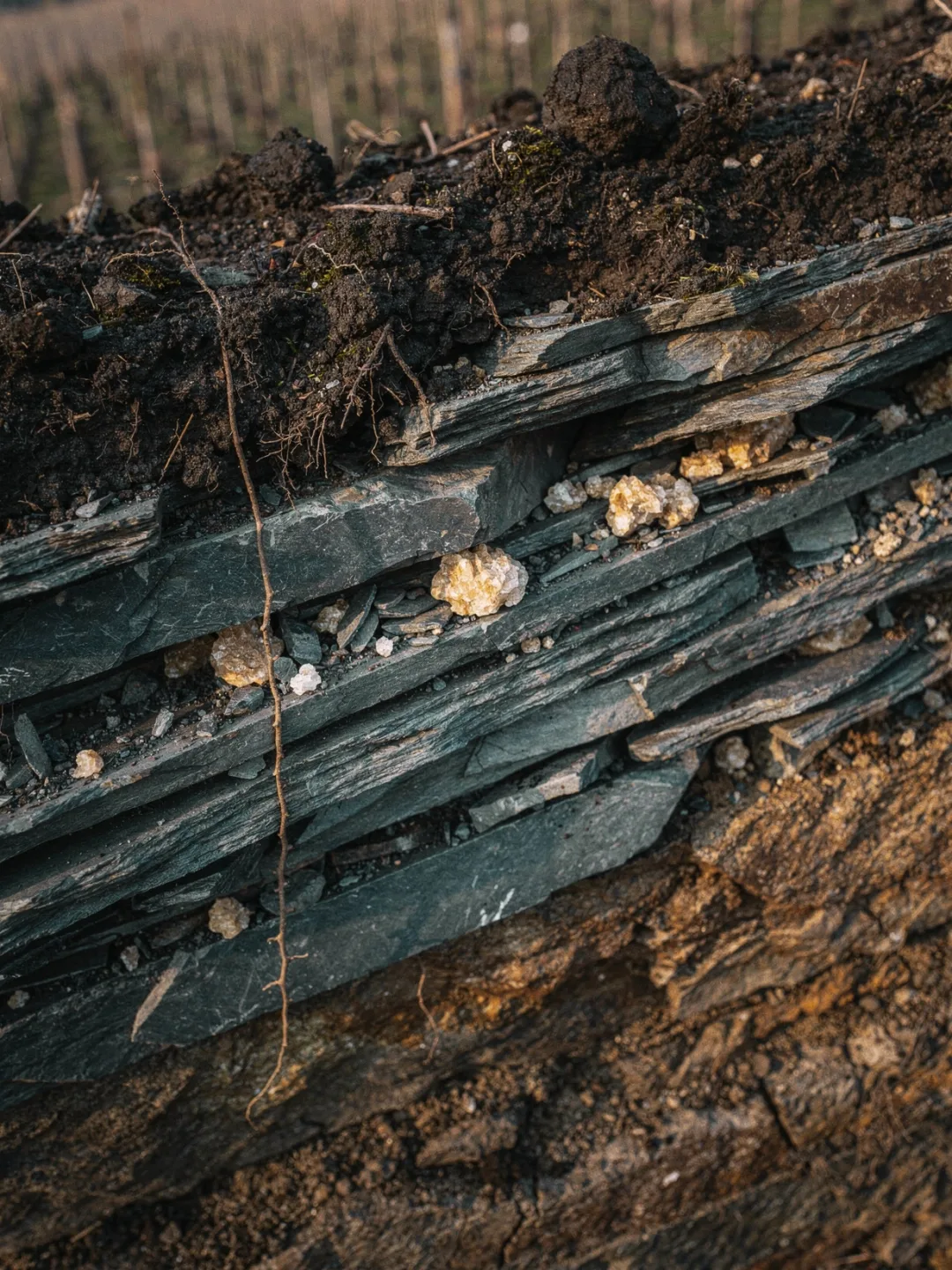
Dig a hole in the Bopparder Hamm and you won't get far. After barely a hand's width of soil, you hit rock: dark, blue-grey plates studded with small, hard nodules of silica. This is Kieselgallenschiefer, named after exactly these nodules. It forms the backbone of the largest contiguous vineyard site on the Mittelrhein.
Its history stretches back roughly four hundred million years, to a sea that no longer exists. Sand and mud settled on the seabed, were compressed, and later tilted upright during the folding of the Rhenish Slate Mountains. What now stands nearly vertical on the slope once lay flat on the ocean floor.
Vine roots don't have an easy time here. The slate holds almost no nutrients. Water drains away between the plates almost unchecked, forcing the roots to squeeze through the crevices, deep, sometimes several meters down. This very stress produces small, concentrated berries — and a small berry carries proportionally more skin, and thus more aroma, than a large one.
Further north, in the volcanic Siebengebirge, the subsoil looks entirely different. Around twenty-five million years ago, volcanoes there spewed out enormous quantities of ash, which compacted into tuff before magma pushed through as trachyte. This rock warms faster than slate and holds the heat longer, which is why wines from there come across rounder and softer than the lean, taut Rieslings from the south.
You often hear that a wine tastes mineral because the vine draws minerals straight from the slate and passes them directly into the glass. It's not that simple. What comes in through the roots are dissolved salts in tiny quantities, far too little to actually taste. The soil works indirectly — through its water balance, its heat retention, and how deep it forces the roots to search. That indirect path is what ultimately shapes the wine in the glass.
A thin, dark layer of decomposed leaves and roots, often barely a hand's width deep on the steep slopes of the Bopparder Hamm.
The root: This is where the fine roots sit, absorbing whatever the scarce rainfall brings.