The River as an Oven
Climate
In January, the Mittelrhein often stays milder than areas just a few kilometers away in the Hunsrück highlands. The river lies deep within the narrow valley, sheltered by hills on both sides. Even so, the average annual temperature remains a cool nine degrees Celsius by German winegrowing standards. Riesling has ripened here for centuries nonetheless, and the reason lies less in the warmth itself than in how cleverly it's distributed between day and night.
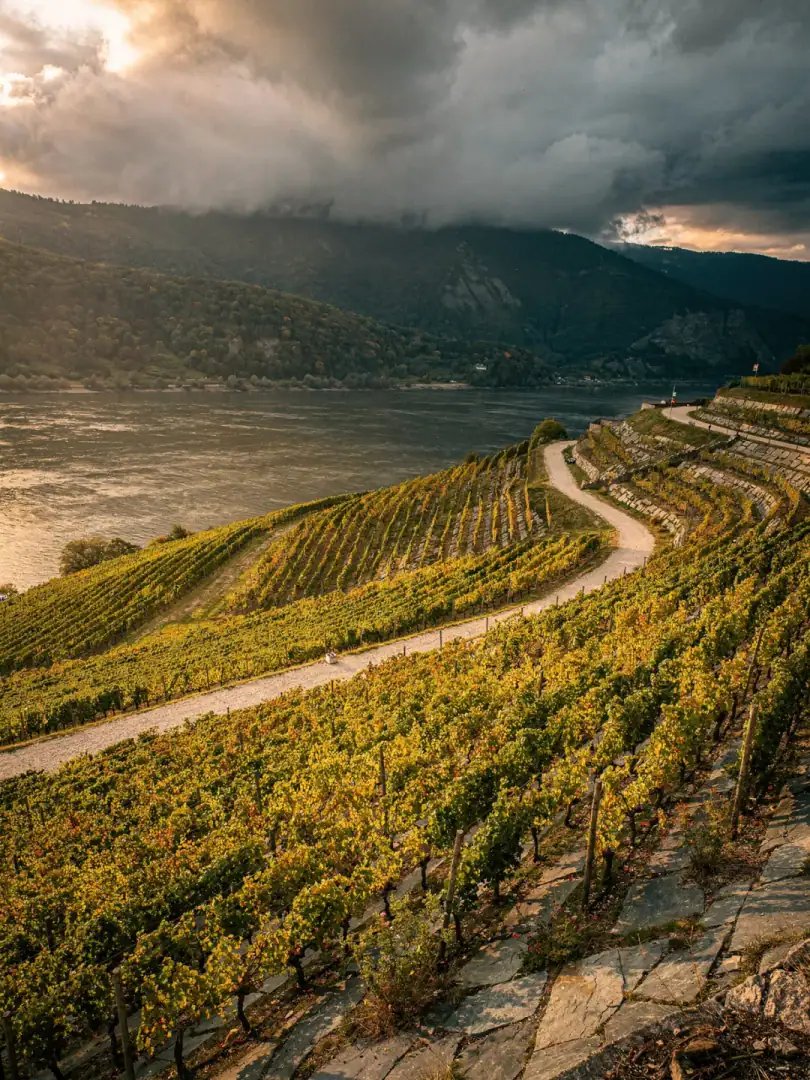
The Rhine itself acts like a giant water-filled oven. During the day it stores solar heat, releasing it slowly overnight, and the vines on the lowest, steepest slopes benefit the most. The slate in the soil does the same thing on a smaller scale: it warms quickly, holds the heat, and passes it on to the roots long after the air has cooled.
On steep slopes, cold air drains away quickly instead of pooling at ground level. This protects young shoots from frost in spring, one of the greatest dangers in viticulture. The incline does even more: on a thirty- or forty-degree slope, spring sunlight hits the vines almost vertically, as if standing at the equator. Flat vineyards don't receive the same energy until weeks later.
Rain rarely falls in excess along the Mittelrhein. Around 570 millimeters accumulate per year, notably less than in most German wine regions, since the heights of the Hunsrück intercept moist air coming from the west. What does get through usually rises up the narrow valley as a mild south wind, sparing the vines from waterlogging. For Riesling, which handles rot poorly, that's a genuine stroke of luck.
All of this together produces grapes with high acidity and relatively low sugar compared to warmer German regions. In the past, that was barely enough for a dry wine, but today this very freshness stands as the Mittelrhein's signature. Anyone growing Riesling at the Loreley or in the Bopparder Hamm therefore often harvests later than elsewhere, accepting cooler October nights in return. The grapes reward this patience with aromas that warmth alone could never produce.