Romans, Prince-Elector, Monastery
Region & History
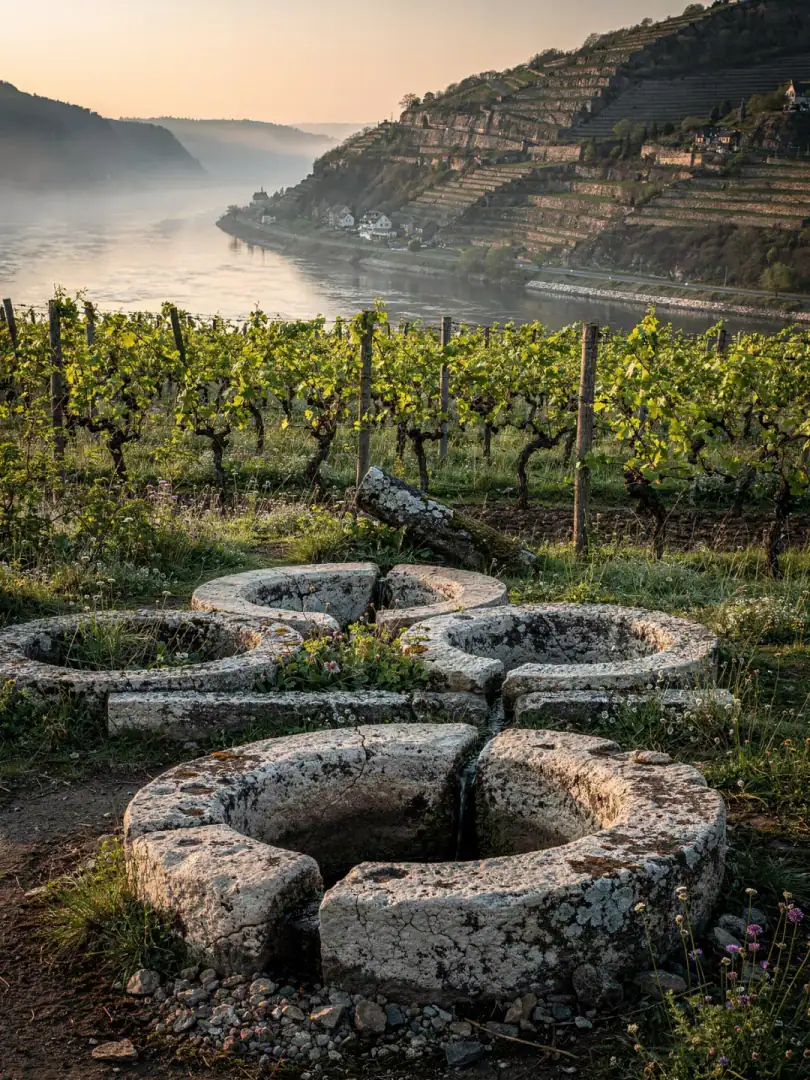
Between Piesport and Ferres lies one of the largest Roman wine-pressing facilities north of the Alps, excavated in the 1980s and open to visitors to this day. Six basins, an operation dating to the fourth century. Up to 60,000 liters of wine were pressed here in a single season. When the Trier-born poet Ausonius wrote his poem Mosella around the year 371, he described these very slopes — green vines mirrored in the water, and winegrowers calling up to their hillside plots from boats below.
After the Romans came the monasteries. As early as 1083, vineyards belonging to Trier Cathedral are documented on the Petrisberg. Over the centuries, monks and the Archbishop himself continued to expand the steep sites. Until the sixteenth century, the Prince-Elector was entitled to harvest first, two days ahead of everyone else — a privilege that shows just how much wine meant power here, far more than a simple drink.
The biggest turning point came from a man who wasn't a winegrower at all. Clemens Wenzeslaus of Saxony, the last Prince-Elector and Archbishop of Trier, decreed on October 30, 1787, that inferior vines were to be uprooted within seven years and replaced with as much Riesling as possible. The Mosel thereby became the largest contiguous Riesling-growing region in the world — and it has remained so ever since.
Around Bernkastel, another story persists stubbornly despite being pure invention. Legend has it that a mortally ill Prince-Elector was cured in the fourteenth century by a sip of Bernkastel wine, which is supposedly why the site is still called Doctor today. None of it is documented. The first record of the name dates to 1677, when a clergyman with an academic title inherited the vineyard — a far less romantic, but true, origin.
In 1868, Prussian officials surveyed every single parcel for tax purposes, ranking them by yield and soil value. These maps later became the foundation on which the VDP has classified its top sites since 2002. The region has officially been known simply as Mosel only since 2007; before that, every label bore the clunkier name Mosel-Saar-Ruwer.
The steep sites still demand backbreaking effort that barely pays off financially. At the Calmont near Bremm, Europe's steepest vineyard, a single hectare requires up to 1,800 working hours a year. Since the 1990s, a monorail has helped with transport. Only about fourteen of the site's twenty-two hectares are still cultivated at all — the rest is too steep even for hand labor.