Riesling & Elbling
Grape Varieties
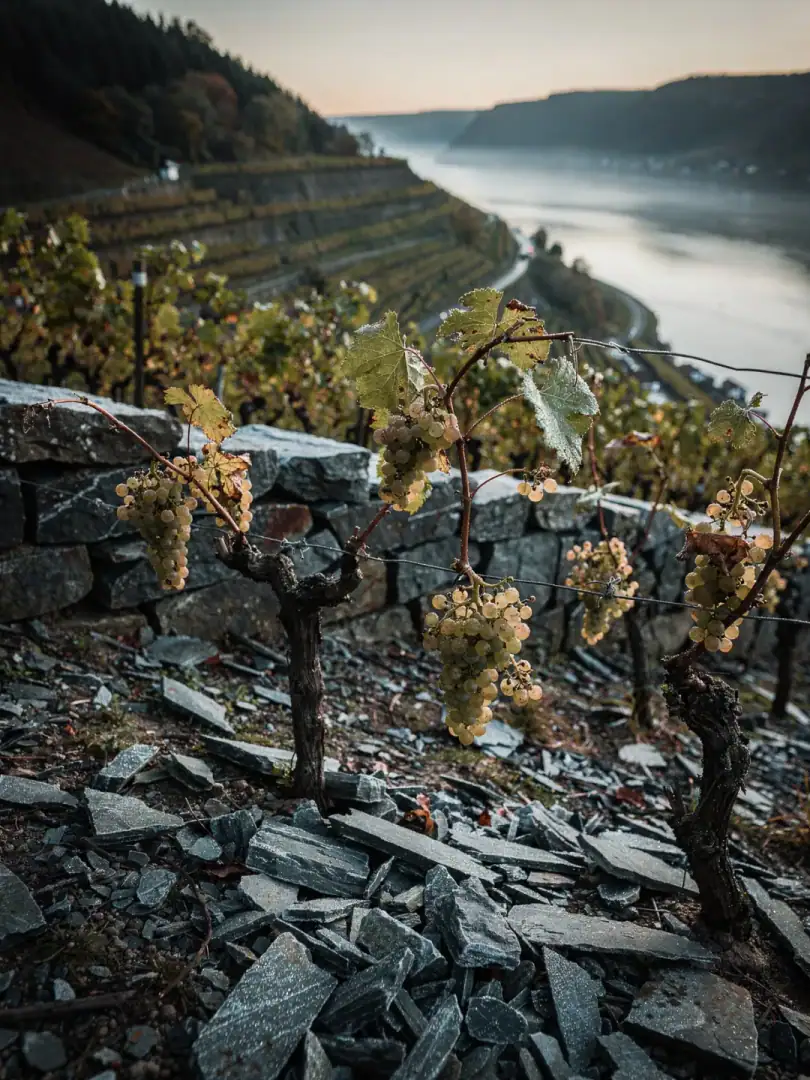
One variety dominates the Mosel like almost no other grape dominates its region. Riesling covers around 62 percent of the vineyard area, roughly 5,300 of the region's total 8,440 hectares — more than anywhere else in the world. It ripens late, often not until October. No other cool-climate region north of the Alps gives it so much time to do so.
In the glass, Riesling reveals its origin through acidity. Green apple, lime, sometimes white peach, alongside a stony, almost salty note that connoisseurs call mineral, though this doesn't mean an actual mineral taste but rather the impression of cool, crisp acidity on the palate. After years in the bottle, a scent of petrol often develops, known among experts as TDN. It forms from pigments in the grape skin and is considered a sign of maturity on the Mosel, not a flaw.
The second variety is far older, but far smaller: Elbling. It has grown on the Obermosel for over 2,000 years, likely brought by the Romans. Today it covers only around 450 hectares, just five percent of the area, almost exclusively on the shell limestone between Nittel and Perl. Its acidity is enormous, its aroma rather neutral — poor qualities for a still wine, but ideal for sparkling wine. A large share of the harvest is therefore fermented into base wine for Winzersekt.
Müller-Thurgau accounts for just under nine percent of the vineyard area. It yields soft, uncomplicated wines meant for quick enjoyment, without Riesling's aging potential. Spätburgunder, the only red variety of any significance, grows on a good five percent of the area and, on these cool slopes, tends to stay pale and light — a red that tastes more like a robust white.
What sets Mosel Riesling apart from its cousins in the Rheingau or the Pfalz is above all its acidity. Warmer sites let sugar rise faster while acidity drops. On the Mosel, both stay in balance longer, because ripening stretches out over many weeks. That's why many Mosel wines carry a touch of residual sweetness despite low alcohol, without ever tasting cloying. The acidity carries it.