Trout & Game
Wine & Food
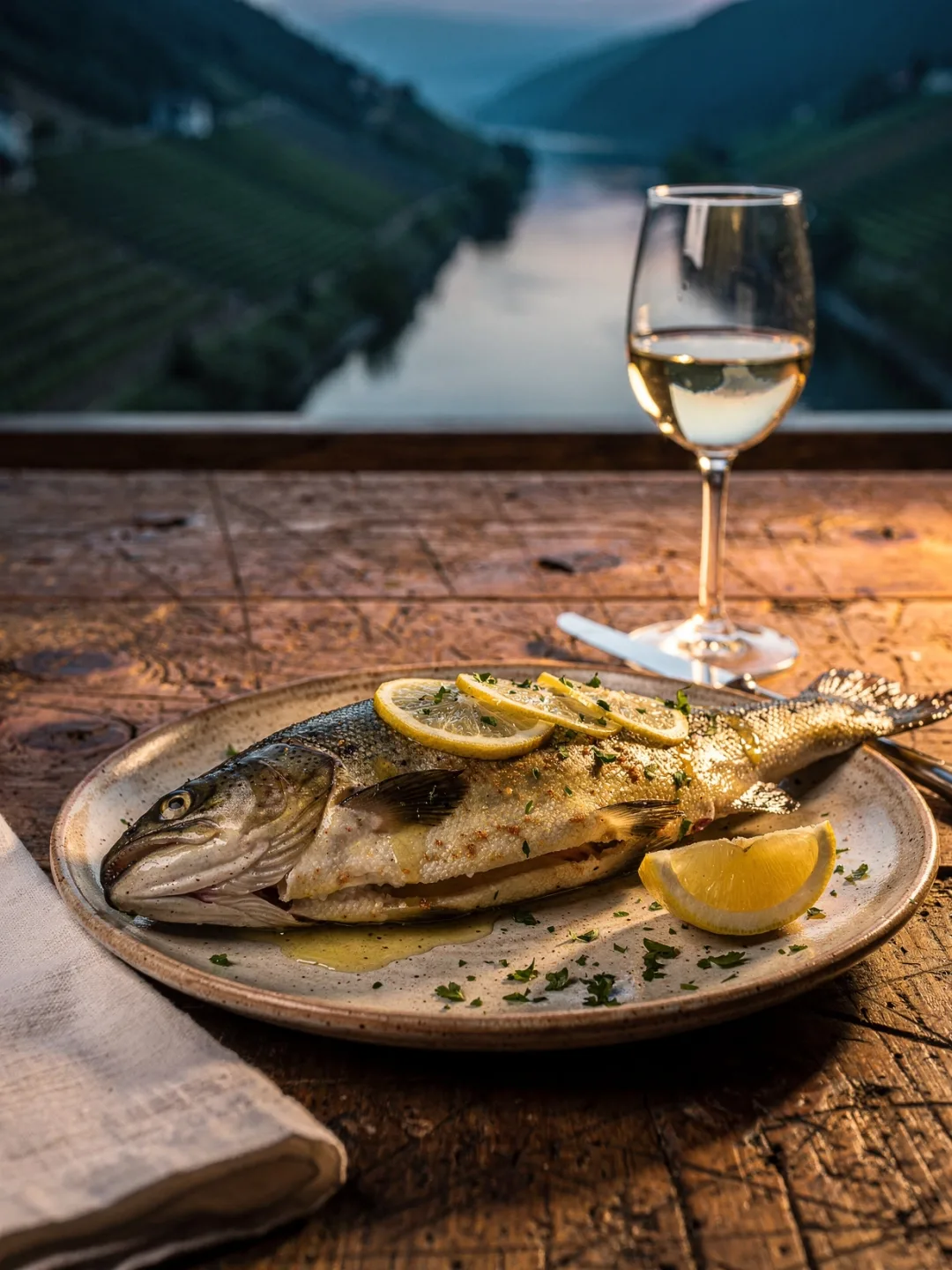
The streams flowing from the Hunsrück and Soonwald into the Nahe are cold and clear enough for trout, and in many villages along the river it still appears on the menu. Smoked or poached blue, with just a little butter and lemon, it calls for a wine that won't overpower it. A dry Kabinett Riesling from the lower Nahe suits best, bright in fruit, with enough acidity to match the fish's faintly earthy character.
Game arrives from the forests of the Hunsrück and Soonwald in autumn, mainly venison and wild boar. It's usually braised, with juniper and dark root vegetables. Riesling no longer fits here; instead, reach for the fuller-bodied Spätburgunder from the warm porphyry slopes of the middle Nahe, with enough tannin and fruit to hold its own against the dish's rich seasoning.
An old exception in innkeeping law still shapes how people eat along the Nahe today. Winegrowers are allowed to pour wine in their Straußwirtschaften, seasonal taverns, for up to four months a year without a full restaurant license, on the condition that it's their own wine. No one needs to be a trained innkeeper to run one. What's served alongside is usually simple: sausage, cheese, dark bread. And it's in this unpretentious setting that a young, unassuming wine often shows more of itself than it would at a formal dinner table, because no one expects more from it than it can give.
In autumn, when the young wine still comes cloudy and slightly sweet from the barrel, Zwiebelkuchen (onion tart) is the traditional accompaniment along the Nahe, as it is elsewhere along the Rhine. It's served warm with caraway and bacon. To round off a special meal, though, nothing beats a glass of the sweet wines that made sites like the Kupfergrube famous. It's enjoyed with mature blue cheese, or simply on its own, in small sips, just as it was back in 1921.