From Romans to the Wine Route
Region & History
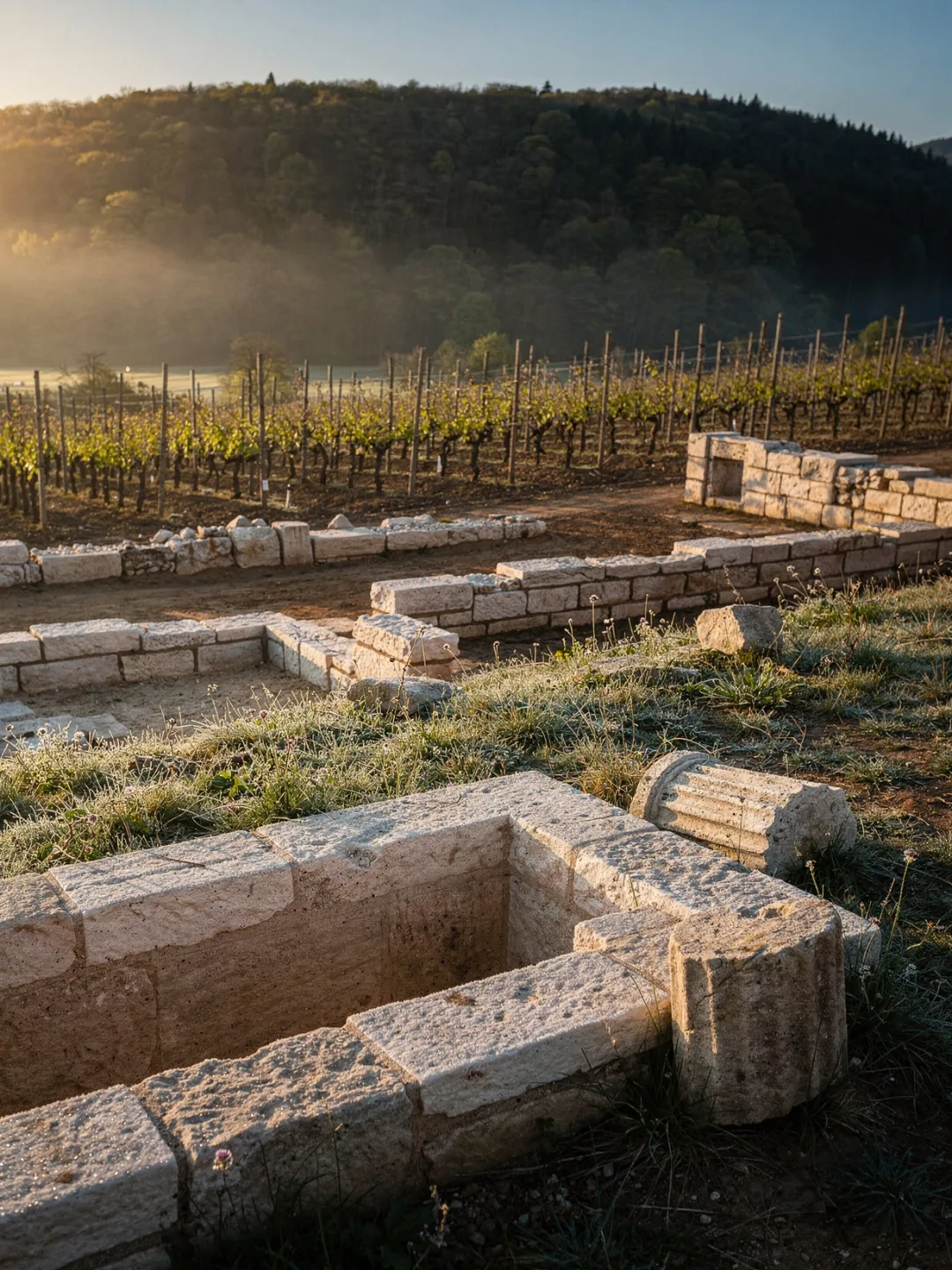
In 1981, archaeologists in Ungstein near Bad Dürkheim uncovered the foundations of a Roman villa. The find is called Weilberg. It included a pressing house with a press that turned grapes into must nearly two thousand years ago, and the site remains open to visitors today. Rome had just made the Rhine a frontier, and with the legions came viticulture, crossing the river into the Palatinate. It stayed long after the legions had withdrawn.
After the Romans, viticulture endured, even as rule over the Palatinate shifted repeatedly over the centuries. Counts, bishops and monasteries held vineyards, leased them out, and fought over them. With the Congress of Vienna in 1816 came the next break: the Palatinate fell to Bavaria and was initially administered as the Rhine District, later called Rheinpfalz. Only in 1993 did the wine region officially receive its current, shorter name.
Another event in the Palatinate has only a marginal connection to wine. In May 1832, up to thirty thousand people gathered at Hambach Castle near Neustadt. The gathering was registered as a harmless folk festival, since political rallies were banned under Bavarian rule. They called for a united, free Germany. For the first time, many of them carried the black, red and gold flag in large numbers. The Hambach Festival has since been regarded as the birthplace of German democracy, right in the middle of a landscape that was, at the time, already growing and selling wine under the Bavarian flag.
Economically, the Palatinate had already weathered a different crisis by then. Two record harvests in a row, in 1934 and 1935, drove prices down so low that many winegrowers could barely sell their wine. In response, the German Wine Route was created in 1935, Germany's very first tourist scenic route. It runs from Bockenheim in the north to the German Wine Gate in Schweigen on the French border. Along the way, it links wine villages such as Wachenheim, Forst, Deidesheim and Ruppertsberg, which still represent the finest sites of the Mittelhaardt today. At the same time, estates such as Bürklin-Wolf, whose roots reach back to 1597, built the reputation of Palatinate Riesling at European royal courts from the early nineteenth century onward.