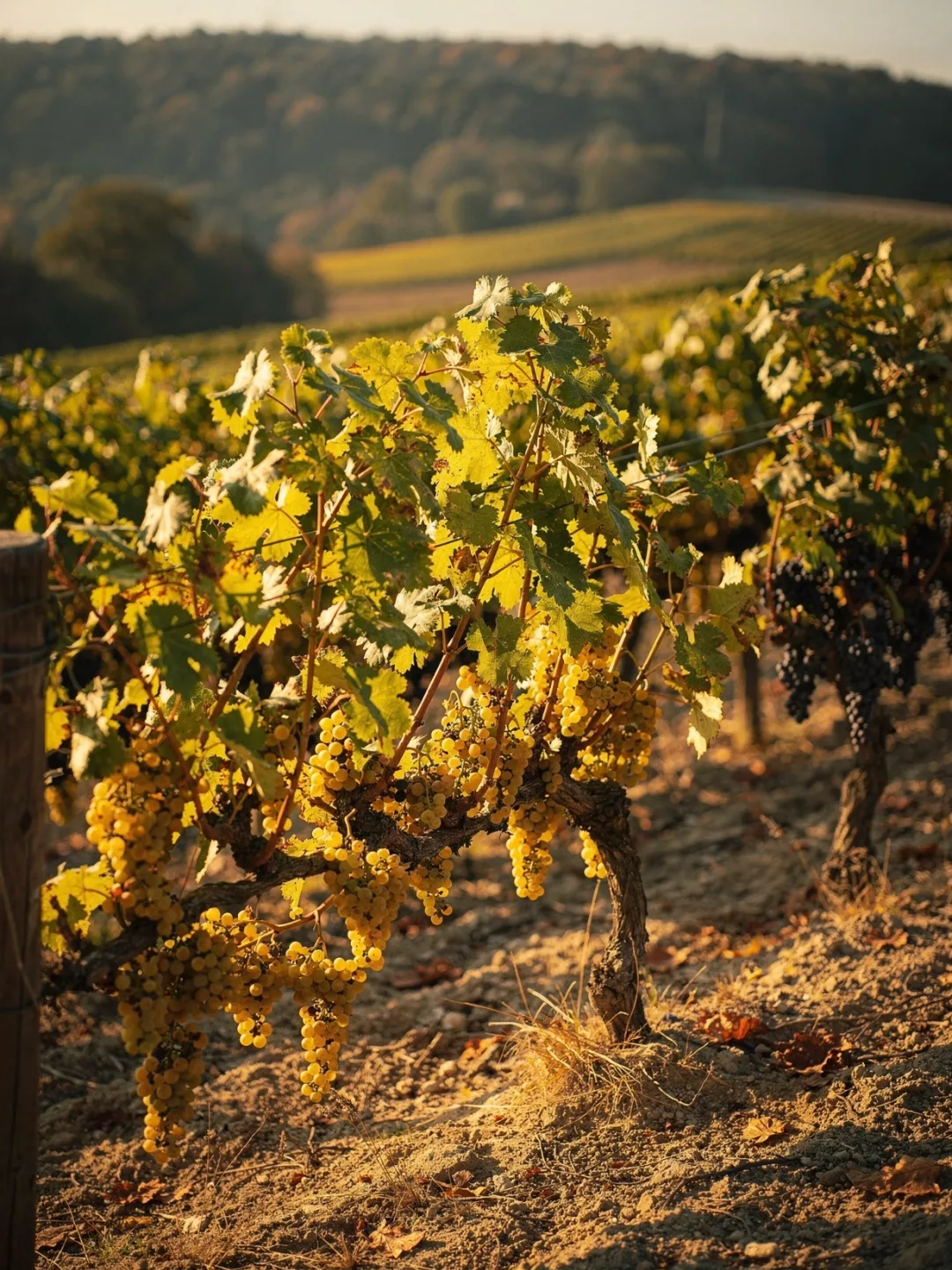
Riesling & Dornfelder
Grape Varieties
One single variety shapes the Palatinate more than any other. Riesling covers around a quarter of the entire vineyard area. That makes this region home to more Riesling vines than any other wine region in the world, even more than the storied Mosel just a few kilometers to the north. Since the 1990s, the acreage has kept growing steadily, while other white varieties have lost ground.
Unlike on the steep, cool slopes of the Mosel, Riesling here ripens on gentle hills in warmer air. The grapes often hang well into October, gathering sugar and aroma, but also losing some of the piercing acidity that defines Rieslings from cooler sites. The result is a wine with more power and riper fruit that still tastes dry, because hardly any residual sugar remains.
In second place, surprisingly for a white wine region, comes a red variety: Dornfelder, with a good tenth of the vineyard area. It was bred in 1955 in Weinsberg, Württemberg, far from the Palatinate, and named after the institute's founder, Immanuel Dornfeld. Yet it found its largest acreage in the Palatinate, because its thick, pigment-rich skin still delivers dark, easy-drinking red wine even in a relatively cool German summer.
Next comes the Pinot family in several guises. Pinot Gris covers almost a tenth of the area, with Pinot Blanc close behind. Pinot Noir is the most important red Pinot variety. It increasingly yields serious wines matured in oak. Müller-Thurgau was once the most widely planted German grape of all. In the Palatinate it has long since slipped to one of the lower ranks: uncomplicated, mild and early-ripening, but lacking the stature now demanded of Riesling or Pinot Noir.