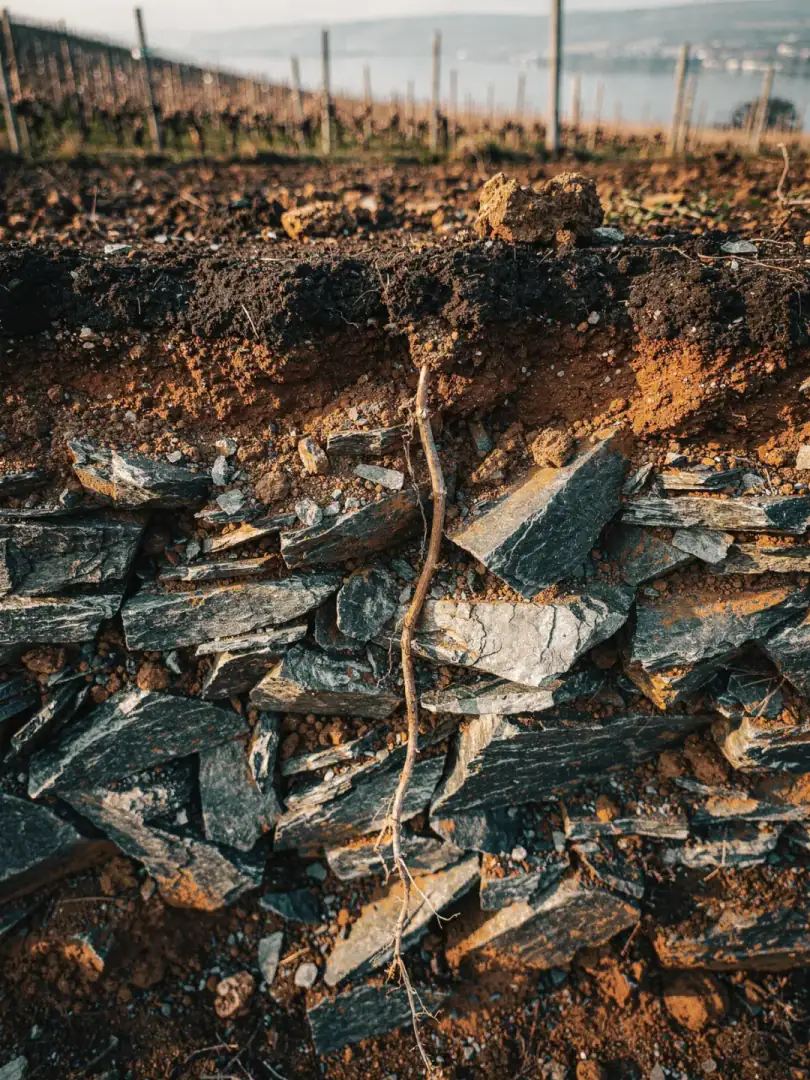
Slate, Quartzite, Loess
Soils
Dig a hole on the Rüdesheimer Berg and you won't get far. After a few spadefuls, the tool hits hard, blue-grey rock: Taunus quartzite, the hard core of the mountain range behind the Rheingau. This rock was once sand on the floor of a sea, deposited around 410 million years ago in the Devonian period, later compressed into quartzite and pushed upward during the folding of the Rhenish Slate Mountains.
Where it reaches the surface, as on the Rüdesheimer Berg Schlossberg, the steepest site in the entire Rheingau results. There, the slope gradient reaches up to seventy percent. Machines can barely work such a slope. A bit further west, beneath the Höllenberg of Assmannshausen, the rock changes to phyllite, a softer, shinier clay slate from a similarly ancient time. It stores heat during the day. At night it releases it again, a built-in oven within the slope.
That warmth is exactly what the Rheingau's late-ripening, cold-sensitive red variety needs. Without the slate, Assmannshausen would likely grow no Spätburgunder at all, but Riesling like everywhere else in the region.
Downstream, around Johannisberg, Winkel, and Oestrich, the slate disappears beneath a completely different layer: loess, fine dust that the wind blew across the land during the last ice ages. Loess stores water like a sponge and reliably feeds the vine with nutrients. Wines from here therefore often feel fuller and rounder than the lean slate wines from the west.
In the Steinberg, the vineyard walled in by the Cistercians in 1767 near Kloster Eberbach, both nearly overlap. A layer of loess sits atop weathered slate, with marl-limestone below. At the eastern end of the region, in Hochheim am Main, a completely different soil dominates: heavy, clay-marl subsoil. It gives Hochheim Riesling a fuller, less sharp acidity, a style for which English wine merchants in the nineteenth century even coined their own word: Hock.
Thin, stony loam layer with fragments of slate, leached and low in nutrients.
The root: Fine roots reach for every rainfall here, but are quickly left to fend for themselves afterward.