Rheinknie & Taunus
Climate
A river that changes direction is what made winegrowing here possible in the first place. Near Wiesbaden, the Rhine bends almost at a right angle from its usual north-south course to flow west — the so-called Rheinknie — running fifty kilometers in this atypical direction before turning north again at Bingen. The Rheingau lies exactly in this bend, on a slope that therefore faces south instead of east.
At its back stands the Taunus. This low mountain range blocks the cold north wind before it reaches the vineyards. At the same time, it forces moist air upward, where it rains out instead of lingering over the vines. Without this shelter, the Rheingau would be no warmer than the surrounding land. With it, the average annual temperature sits around 10.7 degrees Celsius, and the average during the growing season around 15.7 degrees.
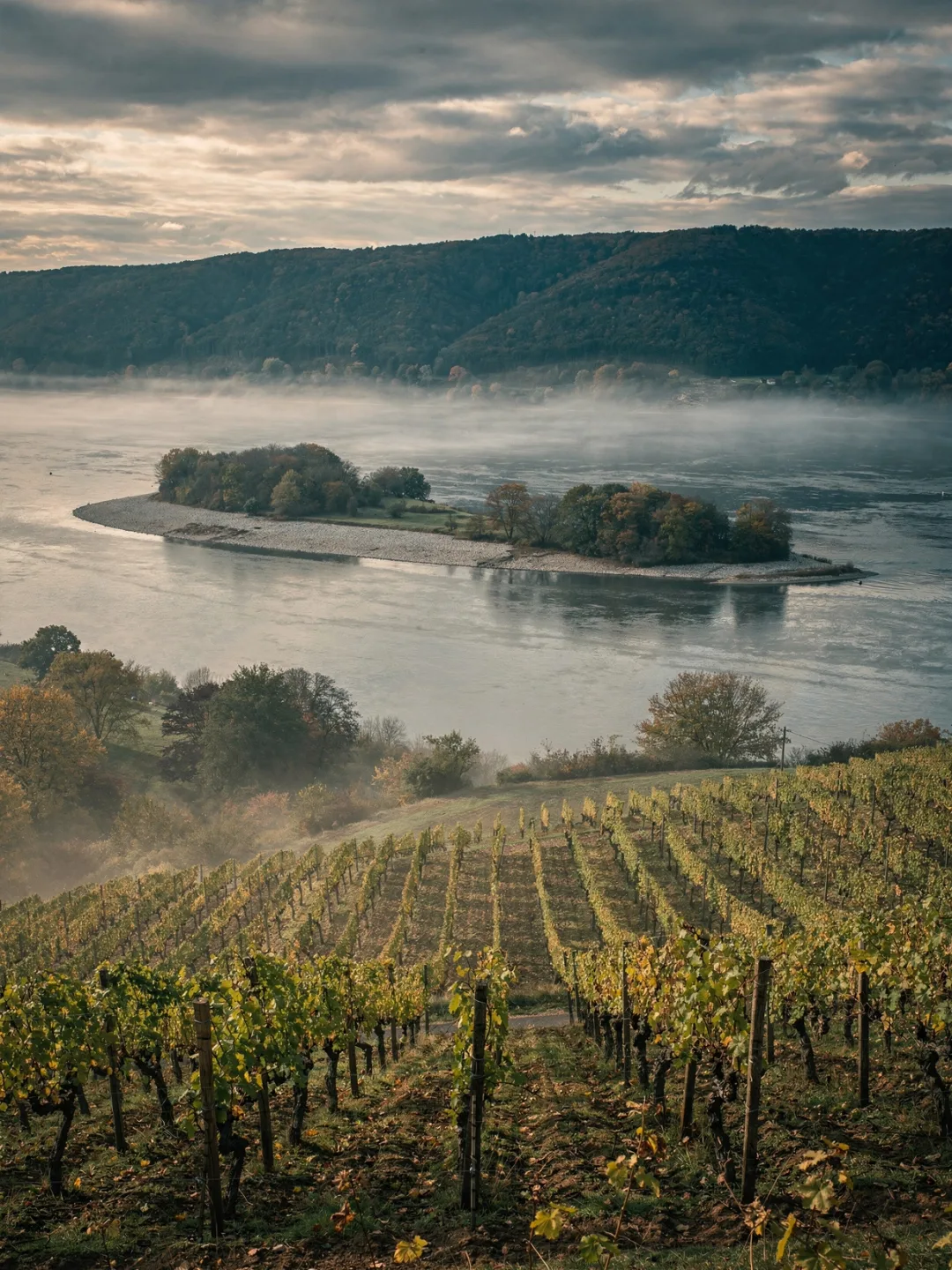
The river itself acts as a second radiator. Water holds heat longer than air, and the broad stream releases it again at night, so that spring frosts strike less often here than elsewhere. In autumn, the same effect flips: mornings bring fog over the lower vineyards, keeping the grapes damp. That's exactly what the fungus needs that accidentally made the Spätlese possible in 1775 — Botrytis, noble rot.
The Rheingau counts around 1,649 hours of sunshine a year on long-term average, more than most regions north of the Alps. Still, not every slope is equally warm. Growers at the foot of the Taunus harvest later. At three hundred meters elevation, ripening is tighter than a hundred meters lower down by the river. Small climate zones exist here within just a few kilometers of each other.
Heading west, toward Assmannshausen and Lorch, the valley narrows and cools, the river grows slimmer, the warming effect weaker. That's why the late-ripening, cool-loving Spätburgunder thrives better there than Riesling. Climate change is currently shifting this balance: harvests that used to begin in mid-October now often start as early as September. Winegrowers in the Rheingau are already openly asking whether the Taunus's protection will still be enough in twenty years.