Halbstück & Handwork
Production
Riesling is handled gently in the Rheingau, since its aromas sit just beneath the skin and can't tolerate heat. The grapes usually go straight from the cool morning harvest into the press, without any skin contact at all. The juice then often ferments for weeks at low temperatures — the slower, the more of the delicate fruit survives to the glass.
Stricter rules apply to an Erstes Gewächs than to simple wine. The vines are pruned hard so that fewer, riper grapes grow. Harvesting is done by hand, often in several passes, and the wine must ultimately be vinified dry. This isn't a new idea. The Charta association already required it in 1984, fifteen years before it became official Rheingau law.
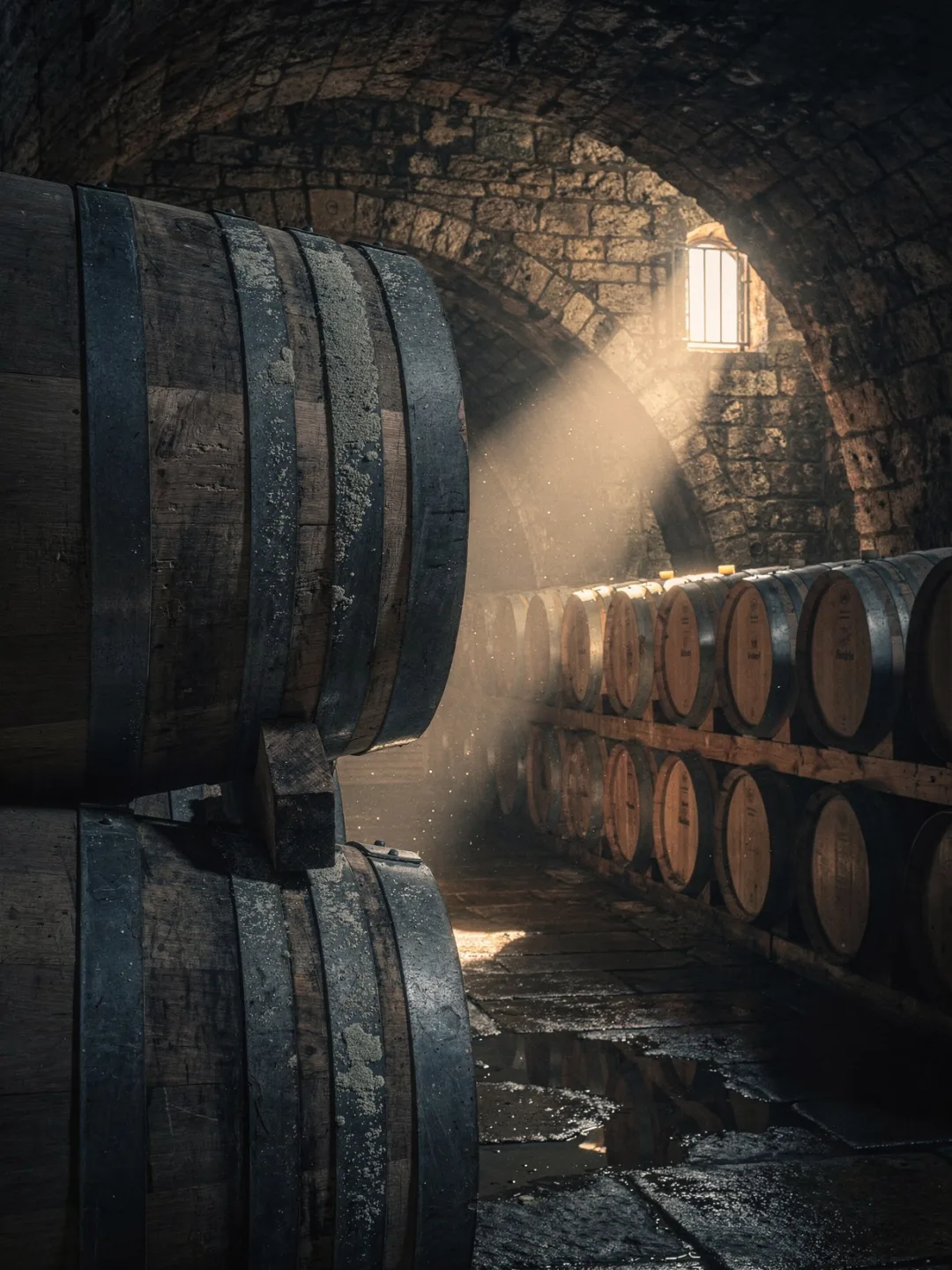
In the cellar, you'll still find the old Halbstückfass, a six-hundred-liter barrel built from local oak. It's smaller than the Fuder used on the Mosel, larger than a barrique, and after a few vintages practically neutral in flavor — it lets the wine breathe slowly without imposing vanilla or toasty notes, which would be out of place in a Riesling anyway.
This separation of good from exceptional is age-old in the Rheingau. In the Cabinetkeller of Kloster Eberbach, first mentioned in 1730, the finest barrels of a vintage were stored apart from the rest of the harvest. It was an early form of what we now call selection.
Assmannshausen Spätburgunder, by contrast, is made like any red wine: the skins remain in the vat for two to three weeks so that color and tannin transfer into the juice. The wine then goes into smaller barrels to age. Because the grapes here rarely ripen as powerfully as in the warm south, extraction tends to stay restrained. Paler color, finer tannin — a red wine more interested in aroma than in power.