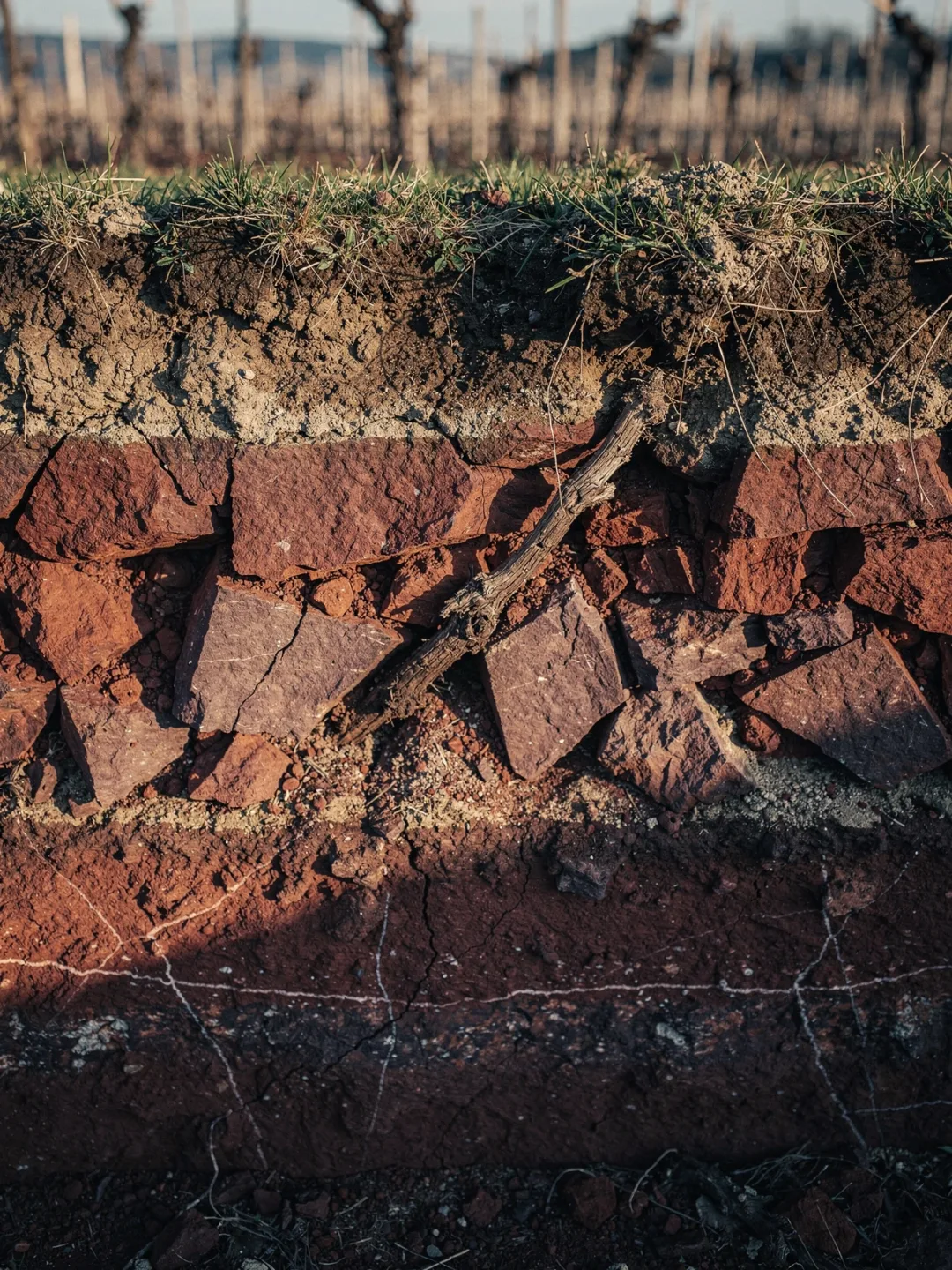
Rotliegend & Limestone Marl
Soils
Dig a hole at the foot of the slope between Nackenheim and Nierstein, and after just a few spade cuts the earth turns red. This isn't the rust-red of ordinary clay — it's a deep, almost violet red that looks from a distance like a wound in the landscape. This roughly five-kilometer-long strip is known as the Roter Hang, and its rock is about 280 million years old.
The rock is called Rotliegend and dates from the Permian, a time when a subtropical desert climate prevailed here. In the sediments of clay and sandstone, iron oxidized into hematite, the same mineral that gives rust its color. What lies today as a vineyard was, millions of years ago, dry floodplain at the edge of a vanished mountain range — and it's precisely this rock that today crumbles into thin, brittle plates, holding little in the way of nutrients or water.
The vine roots must therefore work their way far down. This is exactly what has traditionally produced very old vines on the Roter Hang — some vines have stood on the same plot for over sixty years. The result is small, concentrated berries, yielding Rieslings with a smoky, mineral note that connoisseurs immediately attribute to this soil.
Just twenty kilometers southwest, in the Wonnegau around Westhofen, the ground looks completely different. Instead of red shale, pale limestone marl lies here, often covered by loess, and it retains far more water than the sparse Rotliegend — which is why the Kirchspiel site produces fine-boned, almost delicate Rieslings. The neighboring Morstein, by contrast, with its deeper, more calcareous soil, yields more powerful, broader wines. Two soils, less than thirty minutes apart by car, and two entirely different wine styles.
One misconception persists stubbornly, here as elsewhere: that the wine tastes of stone. Supposedly because the root draws minerals from the rock and passes them straight on. That's simply not true. What actually works on the Roter Hang is an indirect route — it's about heat storage, water balance, and root depth. The iron-rich rock warms faster than limestone or loess and releases that warmth back to the grapes at night. The taste in the glass comes from this interplay, not from dissolved rock.
A thin, pale top layer of loess and loam, in some places on the slope almost entirely eroded away.
The root: The fine roots live here, active right after rain — and just as quickly dry again.