Rain Shadow & Sunshine
Climate
Draw a line from Bingen to Worms and you're standing right in the middle of one of Germany's driest regions. The Hunsrück and Donnersberg intercept the moist clouds from the Atlantic before they reach Rheinhessen. What's left sinks as warm, nearly cloudless air into the hill country — a rain shadow that has long made the region grain country first and wine country second.
On average, only about 530 millimeters of rain fall per year, considerably less than in the Mosel or Ahr. In return, the sun shines here longer than almost anywhere else in Germany: nearly 1,970 hours a year. For the vines, this rarely means rot, but often drought stress — especially on the shallow soils toward the Rhine, where in some years certain vines already enter a kind of dormancy as early as August in high summer.
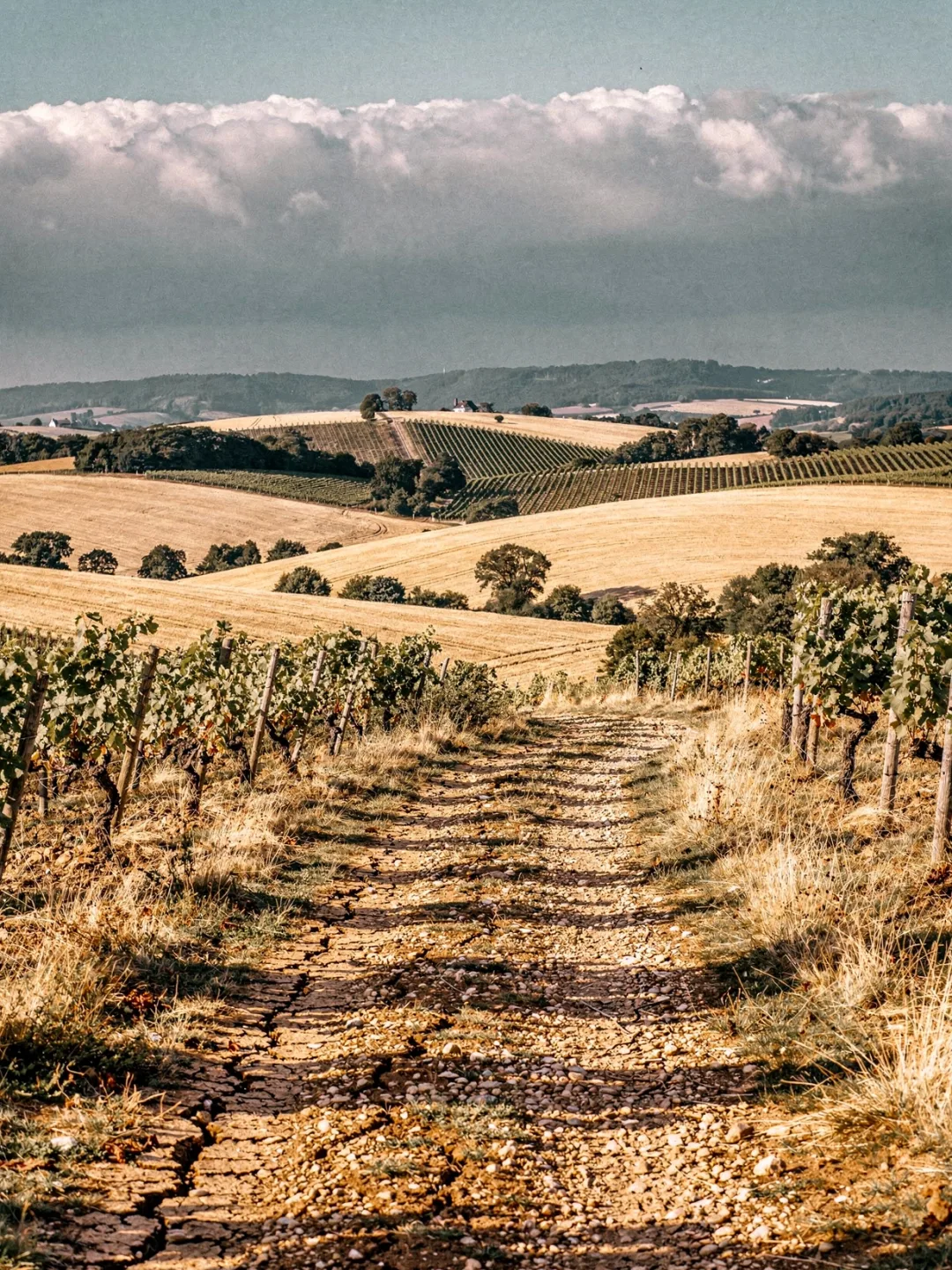
"Land of a Thousand Hills" is what the people of Rheinhessen call their landscape. The name captures it more precisely than any climate statistic. Between the gentle rises, slope angle and orientation shift within a few hundred meters, and with them the microclimate changes too. A south-facing slope near Nierstein often sits three to four degrees warmer than a hollow near Alzey, just a few kilometers away. Anyone making wine here chooses their hill as carefully as one might choose an entire region elsewhere.
On the Roter Hang, a second effect comes into play. The Rhine lies directly below the vineyards of Nackenheim and Nierstein, storing warmth during the day and releasing it again at night, while the water also reflects extra light onto the vines. Combined with the rapid warming of the dark, iron-rich Rotliegend rock, something special emerges here — one of the region's warmest microclimates.
Climate change hits a region that already manages water tightly especially hard. Harvest has moved forward by a good two weeks over thirty years, and in hot vintages it has begun as early as late August in some sites. Many estates are therefore replanting higher up on the Hunsrück foothills and seeding cover crops between the vine rows. They're also leaving more leaf canopy standing to shield the grapes from the midday sun.