Riesling & Silvaner
Grape Varieties
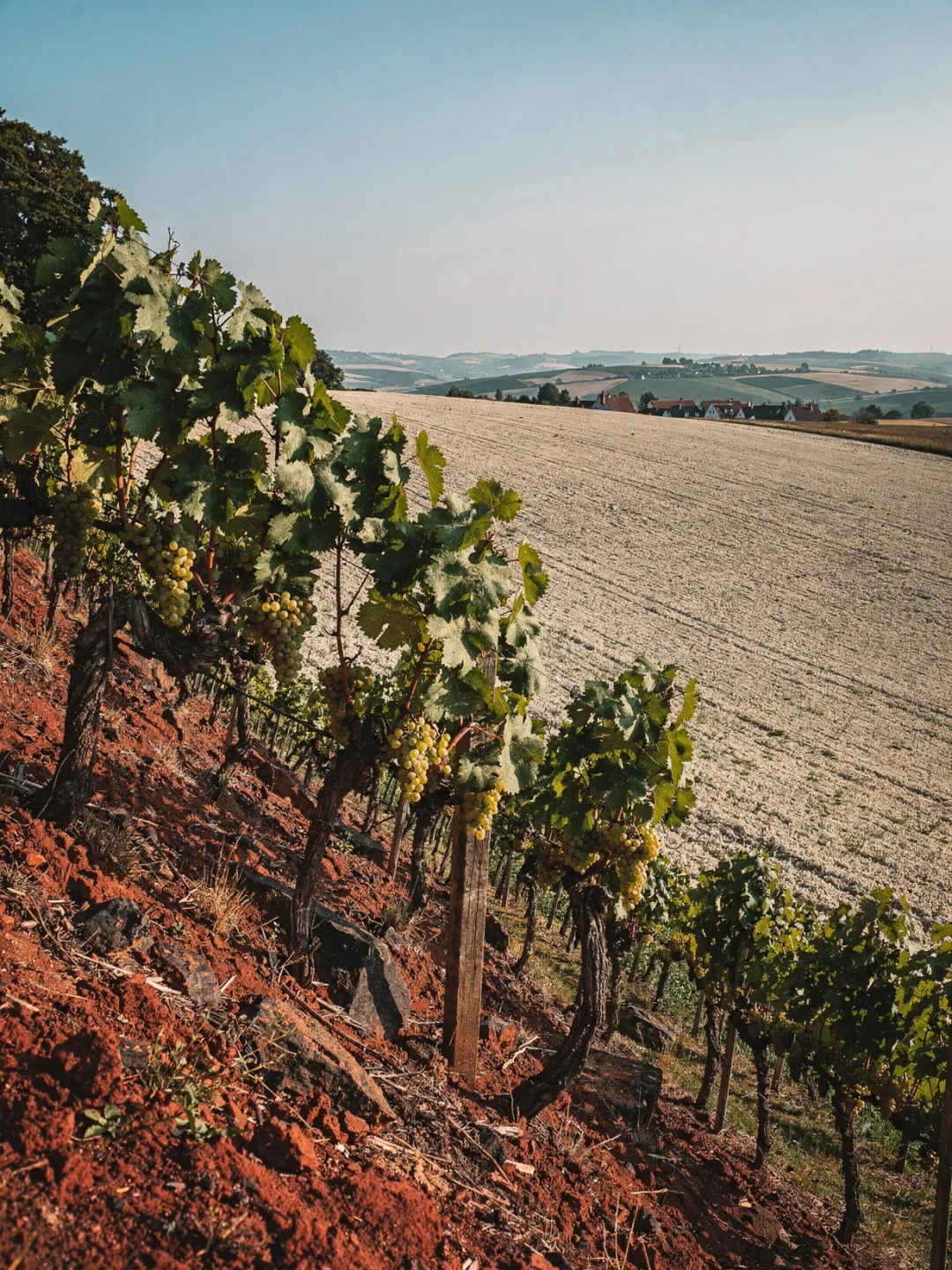
Drive from Alzey to Nierstein and the grape variety changes with nearly every hill. On the warm limestone and loess soils further inland, plenty of Müller-Thurgau and Dornfelder grow, while on the steep slopes toward the Rhine it's almost exclusively Riesling. At around 5,400 hectares, Riesling is by far Rheinhessen's most important grape, making up nearly a fifth of the entire vineyard area — only the Pfalz grows slightly more.
It wasn't always this way. For decades, Müller-Thurgau dominated the harvest, supplying the easy-drinking, uncomplicated wine for Liebfraumilch and its ilk. It still covers almost 3,800 hectares today, though it tastes far less distinctive than Riesling: mild, floral, with little acidity. Dornfelder, the region's most important red variety, arrived only in the 1970s and now covers eleven percent of the area. It's dark in color, soft in tannin, and usually drunk young.
A third variety has its true home here. Franconia may claim the fame, but forty-three percent of Germany's entire Silvaner area lies in Rheinhessen, mostly on the deeper, water-retentive soils of the Wonnegau plain. The wine tastes restrained, with little aroma and a fine earthiness — and it's precisely this restraint that makes it an ideal food companion.
And then there's a variety that wouldn't exist without Rheinhessen at all. In 1916, grape breeder Georg Scheu crossed Riesling with a second variety at the breeding institute in Alzey. For almost a century it was believed to be Silvaner, until DNA analysis in 2012 revealed it was actually Bukettraube. The result was named after its breeder: Scheurebe. It smells of blackcurrant and grapefruit and today covers about 740 hectares.
Over the past twenty years, a fourth group has quietly grown: the Pinot varieties — Pinot Gris, Pinot Blanc, and the red Pinot Noir — now cover a good fifth of the vineyard area. Many winemakers seek out cooler, deeper sites for Pinot Noir in response to climate change. Anyone driving through Rheinhessen today sees less monoculture than a generation ago: Riesling on the slopes, Silvaner on the plain, Pinot varieties in between.