Syenite & Loess
Soils
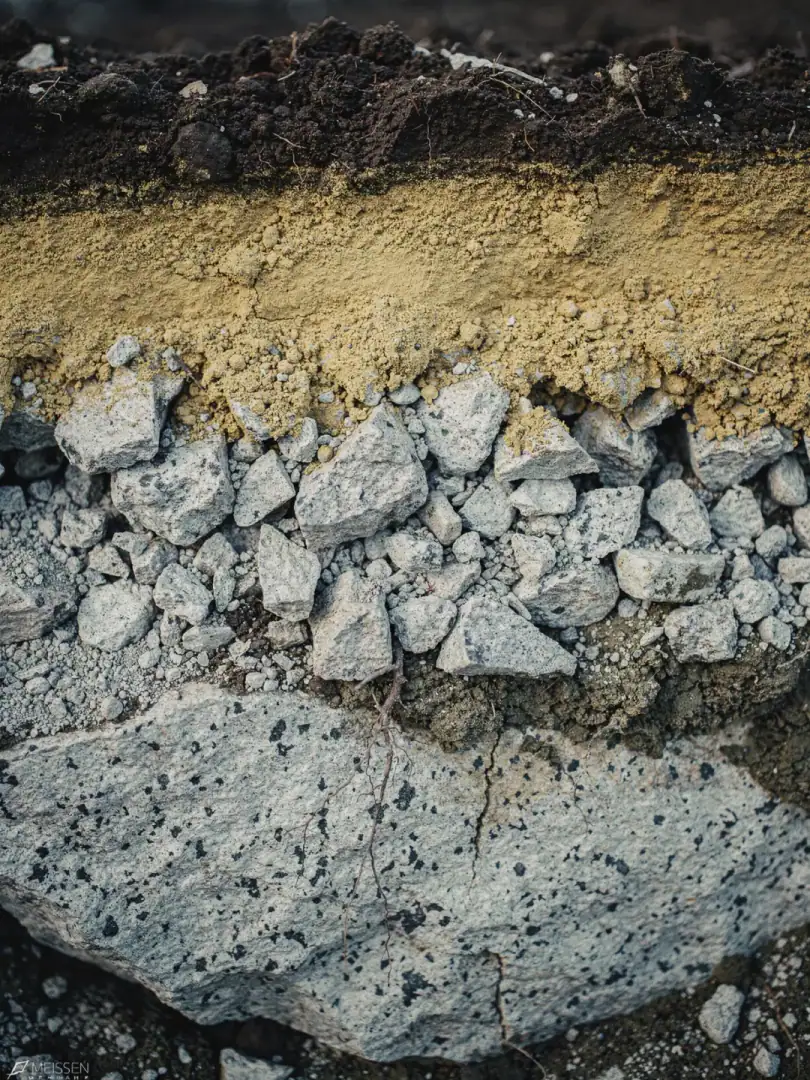
Dig a hole in a vineyard near Meissen. After barely a hand's width, the earth turns coarse and hard. What you're now holding is weathered syenite — a pale gray plutonic rock that solidified from molten rock beneath the earth's surface roughly 300 million years ago.
The so-called Meissen Massif extends from there beneath a large part of the Elbe Valley. It's made up of several related rock types at once — syenite, monzonite, and granodiorite — which differ little in color or hardness. Over millions of years, the surface rock weathered into coarse rubble, while the hard core beneath remained intact.
Above it lies a second layer that has nothing to do with the rock below: loess. This fine, yellowish dust blew in from the barren surrounding land during the ice ages and settled as a blanket over the slopes. Sometimes it was thin, sometimes meters deep, depending on how sheltered a given site was. This loess holds water that the underlying rock can barely retain.
For the vine's roots, that means two very different layers to navigate. Up in the loess, the roots find plenty of moisture and nutrients in spring and grow vigorously at first. Down in the weathered syenite, things get tight — the root has to squeeze between coarse rock fragments, finds little water, and has to fight for what it gets. That very struggle slows growth later in the year and concentrates whatever ends up in the berry.
One misconception persists here as elsewhere: the idea that wine somehow tastes of the rock, as if the root passed minerals directly along. That's not how it works. What syenite really delivers is warmth. The dark terrace walls, built from the same stone, absorb sunlight by day and release it back to the lowest-hanging grapes at night — crucial in a climate where every degree counts.
Fine, ice-age dust that settled as a yellowish-brown blanket over the rock. Stores water that the rock beneath cannot hold.
The root: Here the vine finds moisture and nutrients in spring and shoots up quickly and vigorously.