1161 to today
Region & History
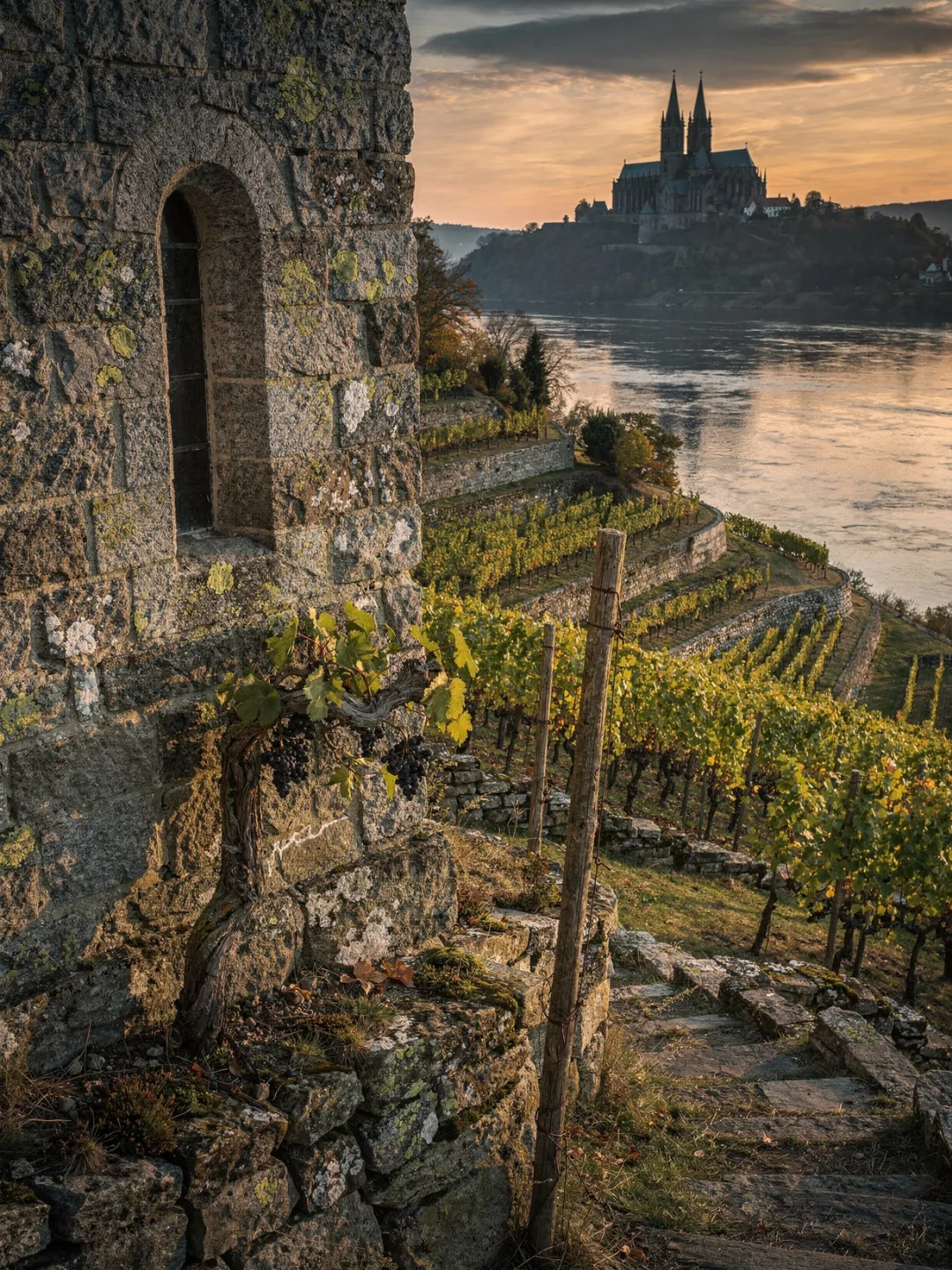
In 1161, Otto the Rich handed over a vineyard near Meissen to the Chapel of St. Egidius. The deed already describes it as yielding well — so vines must have stood there even earlier. Still, this very document remains the oldest written trace of viticulture in the Elbe Valley, and everything assumed about the time before it stays just that: assumption. Monasteries carried the tradition forward; as early as 1195, Altzella Monastery acquired the village of Zadel near Meissen to plant vines of its own. With the monks, vineyards spread both up and down the Elbe.
Viticulture grew for centuries, reaching its greatest extent shortly before the Thirty Years' War: around five thousand hectares, nearly ten times today's area. Saxony was thus one of the great wine landscapes of the German-speaking world, not the marginal footnote it is today. In 1799, Saxon winegrowers founded Europe's first viticultural society to improve cultivation scientifically. The ambition ran deep.
Then came phylloxera. From the 1880s onward, the louse attacked vine after vine, gnawing at the roots until the plants starved. In 1907, Saxon authorities officially declared the entire growing region infested. By the time reunification came in 1990, only 220 hectares of vines remained in the whole region — barely three of today's estates combined.
What happened next can be traced through a single family. The zur Lippe family had farmed Schloss Proschwitz near Meissen for generations until it was expropriated in 1945. Starting in 1990, Georg Prinz zur Lippe bought back the house and vineyards piece by piece, built Proschwitz into Saxony's largest private wine estate, and became a member of the VDP (Verband Deutscher Prädikatsweingüter) in 1996. Similar stories exist elsewhere, though rarely documented as completely as this one.
Today the region counts 531 hectares again, spread across roughly 1,400 growers. Most are tiny plots under two ares, interspersed with a handful of professional estates like Proschwitz. The Saxon Wine Route links the old waypoints of this history over 55 kilometers, running from Pirna through Dresden and Radebeul to Diesbar-Seusslitz. Saxony lies at 51 degrees north latitude, making it Germany's easternmost wine region.