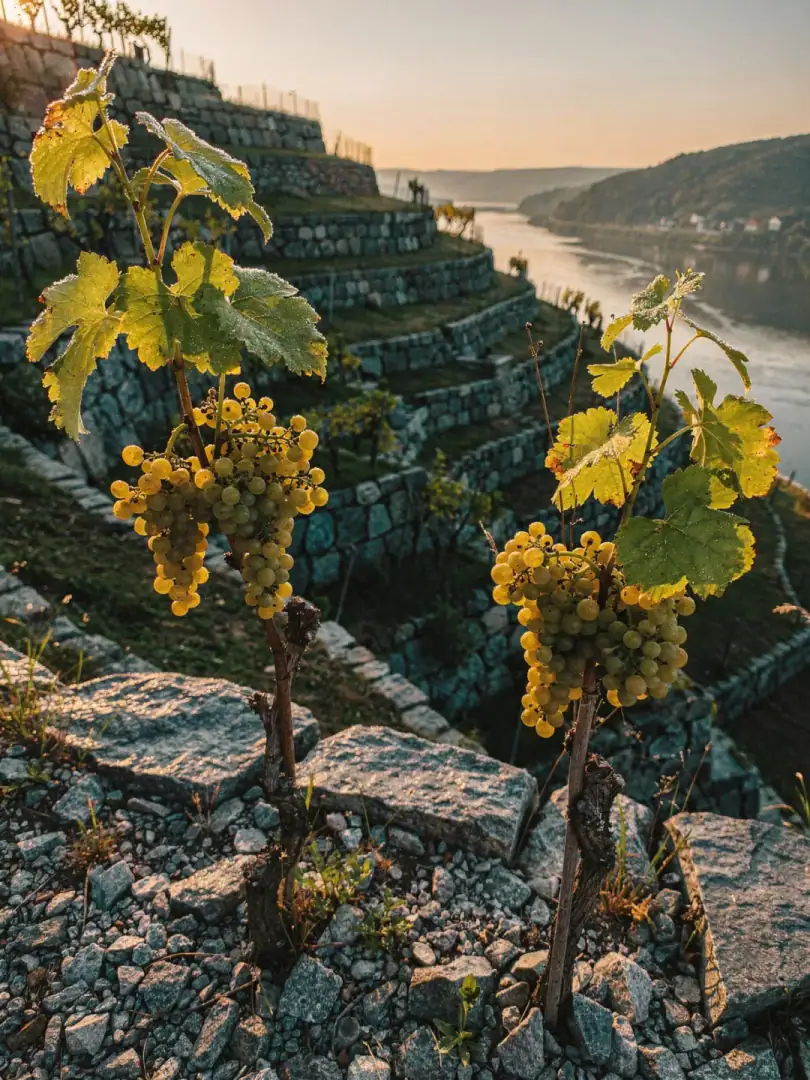
Riesling & Goldriesling
Grape Varieties
Walk through the vineyards near Radebeul in autumn, and you'll mostly see pale grapes hanging on the vines. Roughly four out of five vines in Saxony carry white varieties. The reason is simple: at 51 degrees north latitude, red wine ripens reliably only in the very best sites.
Riesling now leads the way with about 75 hectares. It thrives on exactly what the steep slopes along the Elbe offer: plenty of sun by day, cool nights, and lean, stony soil that forces the vine to dig deep rather than pile on volume. As a result, its acidity stays high even in warm vintages. Acidity is the freshness element in wine, felt along the sides of the tongue.
Close behind come Müller-Thurgau and Weissburgunder (Pinot Blanc), each covering about thirteen percent of the area. Müller-Thurgau ripens early and reliably, even in a cool year, making it the Saxon winegrower's safety net for generations. Weissburgunder delivers the region's quieter, creamier side, often showing notes of pear and almond rather than Riesling's sharp fruit.
One variety exists almost nowhere else: Goldriesling. Breeder Christian Oberlin created it in 1893 in Colmar, Alsace, crossing Riesling with a second variety that remains unconfirmed to this day. Courtillier Musqué Précoce is often named as the likely parent, though it's never been proven. What's certain is the taste: musky, high in acidity, and early-ripening enough that it reaches the cellar safely even in a cool autumn. Of the roughly 30 hectares planted worldwide, nearly all of them stand in the Saxon Elbe Valley.
Among reds, Spätburgunder (Pinot Noir) leads with around 45 hectares. This thin-skinned variety actually wants more warmth than the local climate typically provides, and succeeds only on the steepest, sun-favored sites. Then there's Traminer, which produces a spicy, almost oily wine on the granite slopes around Pillnitz and Meissen. Between the unassuming Müller-Thurgau and the rare Goldriesling, you see just how varied Saxon wine can be, despite the region's small size.