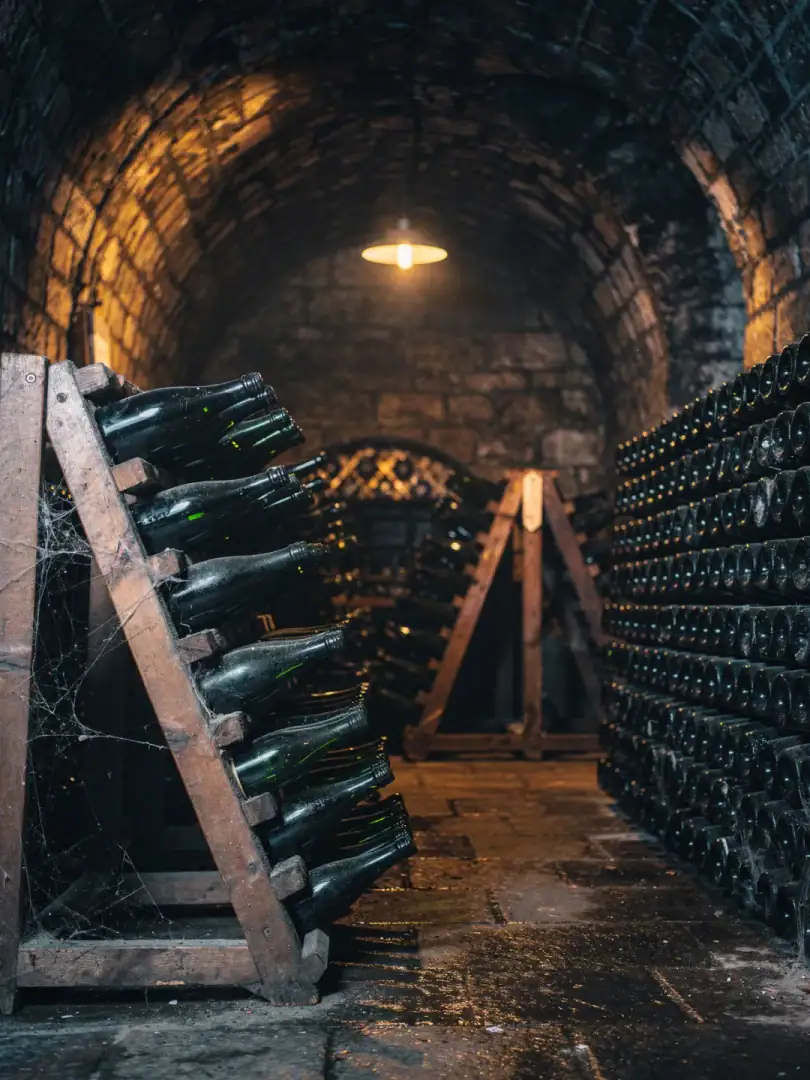
Bottle Fermentation Since 1836
Production
In Saxony, not every grape ends up as still wine. For nearly two centuries, part of the harvest has taken a second, much longer road toward sparkling wine, following a method that has its own distinct tradition in Radebeul.
In 1836, cellar master Joseph Mouzon brought classic bottle fermentation from France to Schloss Wackerbarth. It's the same method used to make Champagne: the base wine ferments a second time inside a sealed bottle, with its own yeast and sugar. It then rests on its lees for months or years before being hand-riddled and disgorged. By 2026, that adds up to 190 years of uninterrupted sparkling wine tradition.
With still wine, coolness is everything. Saxon winegrowers mostly ferment their must at low temperatures, so the delicate aromas of varieties like Goldriesling or Riesling don't cook off in the fermentation heat. Nearly everything is finished dry — any residual sweetness would only mask the already scarce acidity.
The steep slopes demand a great deal of hand labor that's long since been mechanized elsewhere. Where terrace walls squeeze the rows down to just a few meters wide, no harvesting machine can get through. Grapes travel by hand in small tubs to the nearest access path — a harvest that costs many times the effort per hectare compared to flatland vineyards.
Since the 2012 vintage, the VDP (Verband Deutscher Prädikatsweingüter) has also awarded its Erste Lage (Premier Cru) designation in Saxony for the region's best vineyard sites. So far, only two Saxon estates carry the VDP eagle emblem, including Weingut Proschwitz. That came barely a dozen years after the zur Lippe family's return — and already they stood among the country's very best.