Trollinger & Lemberger
Grape Varieties
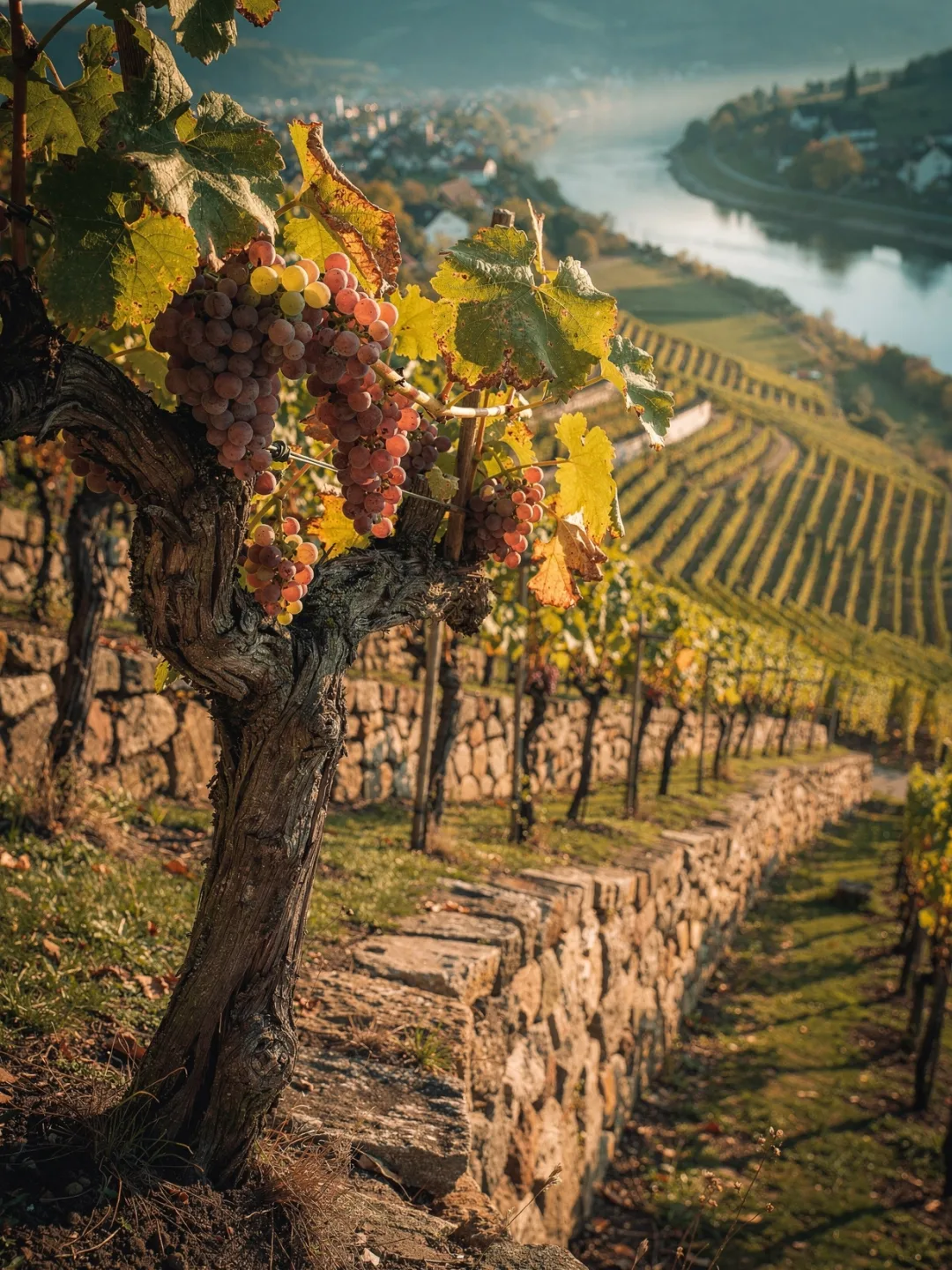
Two varieties define the picture, and both are red. Trollinger covers around sixteen hundred hectares, making it Württemberg's most widely planted red variety; nowhere else in Germany grows anywhere near as much of it. The name comes from Tirolinger: in the sixteenth century, merchants brought the variety from South Tyrol over the Brenner Pass to Württemberg. To this day it's drunk there mainly as a pale, juicy everyday wine: little tannin, plenty of acidity, aromas of red berries.
Lemberger takes up almost as much area. It's named after the city of Lemberg in what is now Lower Styria, from where the first vines came to Württemberg in 1877, while the same variety still grows in Austria today under the name Blaufränkisch, in Burgenland and around Vienna. In the 1980s, barely four hundred hectares of it stood in Württemberg; today there are over sixteen hundred, some of it now aged in barrique. Darker than Trollinger, spicier, with more tannin and ageing potential.
The white side belongs to Riesling, nearly two thousand hectares. It mostly grows on the steep slopes directly above the Neckar, where the sun hits the rock all day long. Alongside it stands Schwarzriesling, not related to Riesling at all but a mutation of Pinot Noir. Over seventy percent of Germany's entire Schwarzriesling area lies in Württemberg alone. And from it, in turn, Samtrot emerged. In 1928, a winegrower in Heilbronn discovered a red-mutated vine on his stock and named it after its gentle character. Today it grows almost exclusively in the area around Heilbronn.
The youngest of Württemberg's major varieties was bred right here. In 1929, August Herold at the Weinsberg teaching and research institute crossed Trollinger with Riesling and named the result after the Weinsberg poet-physician Justinus Kerner. Kerner combines Riesling's acidity with a milder, often lightly muscat-scented fruit. The variety ripens reliably even in difficult sites, which is why it spread from here across all of Germany.