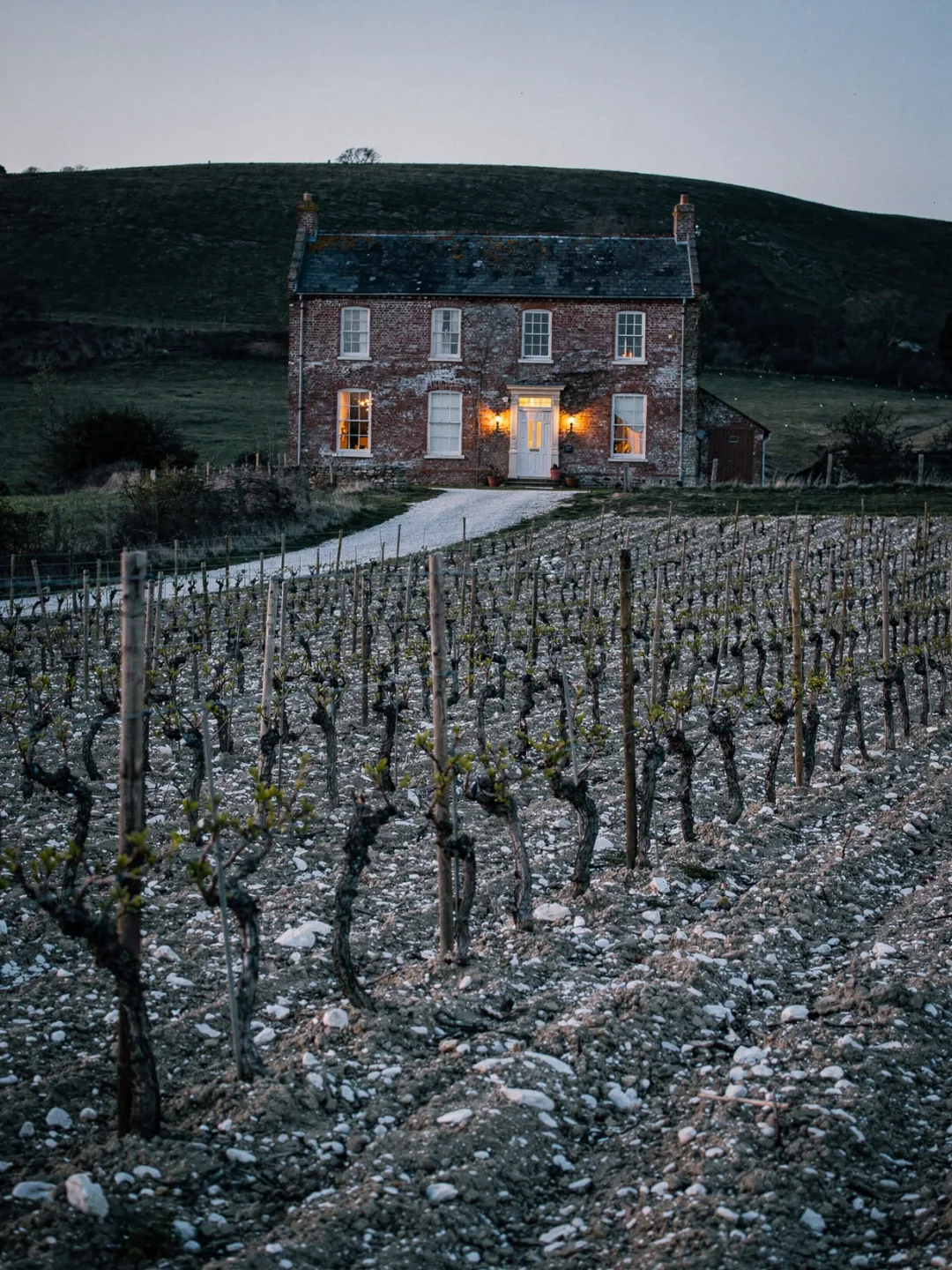
Chalk Instead of Champagne
Region & History
Until 1952, England had not a single serious vineyard. Retired diplomat Sir Guy Salisbury-Jones changed that, almost by chance, while gazing out the window of his house in Hambledon at the chalky south-facing slopes of the South Downs. His stepson asked why no wine grew there. Salisbury-Jones was a Francophile who had spent years in Paris as a diplomat, and he turned to friends at Champagne house Pol Roger for advice on which grape varieties to plant. In 1952 he planted the first vines. The first harvest came in 1954, and the first wine a year later: a still Seyval Blanc. The Daily Telegraph later called Salisbury-Jones the father of English wine.
The fame didn't last. In the 1990s, the estate changed hands and viticulture was neglected. Of the original ten acres, only four remained by the end. For a country that had only just learned wine could grow here at all, it was a bitter setback.
In 1999, businessman Ian Kellett bought the estate. Before planting a single vine, he had the soil and climate thoroughly surveyed. The result surprised no one familiar with Champagne: the same chalk, just under an English sky. In 2005 he planted 27 different combinations of clone and rootstock — that is, of grape variety subtype and the root it's grafted onto — using the three Champagne varieties Chardonnay, Pinot Noir and Pinot Meunier. What had been a country estate with winemaking as a sideline became an operation of roughly eighty hectares built entirely around bottle fermentation.
Kellett wasn't alone. In 2003, estate owner Malcolm Isaac planted the same three varieties on chalk soil at his property, Exton Park. Five years later, investor friends Nicholas Coates and Christian Seely built their own brand using bought-in grapes from that very vineyard. That same year, 2008, farmer Simon Robinson launched his own project near Alresford, which became Hattingley Valley. The winemakers all knew each other, trading grapes and know-how. Jacob Leadley, for instance, founded Black Chalk while still working for Hattingley Valley.
Today Hampshire has roughly 380 hectares under vine. That's a tenth of England's total planted area, enough for fourth place among the country's wine-growing counties. Unlike neighboring Sussex, which in 2022 became the first English county to receive its own PDO, Hampshire has no protected designation of origin of its own yet. Its wines fall under the general English quality mark. Still, the nickname Hambledon gives itself doesn't sound like an exaggeration: "Birthplace of English Wine."