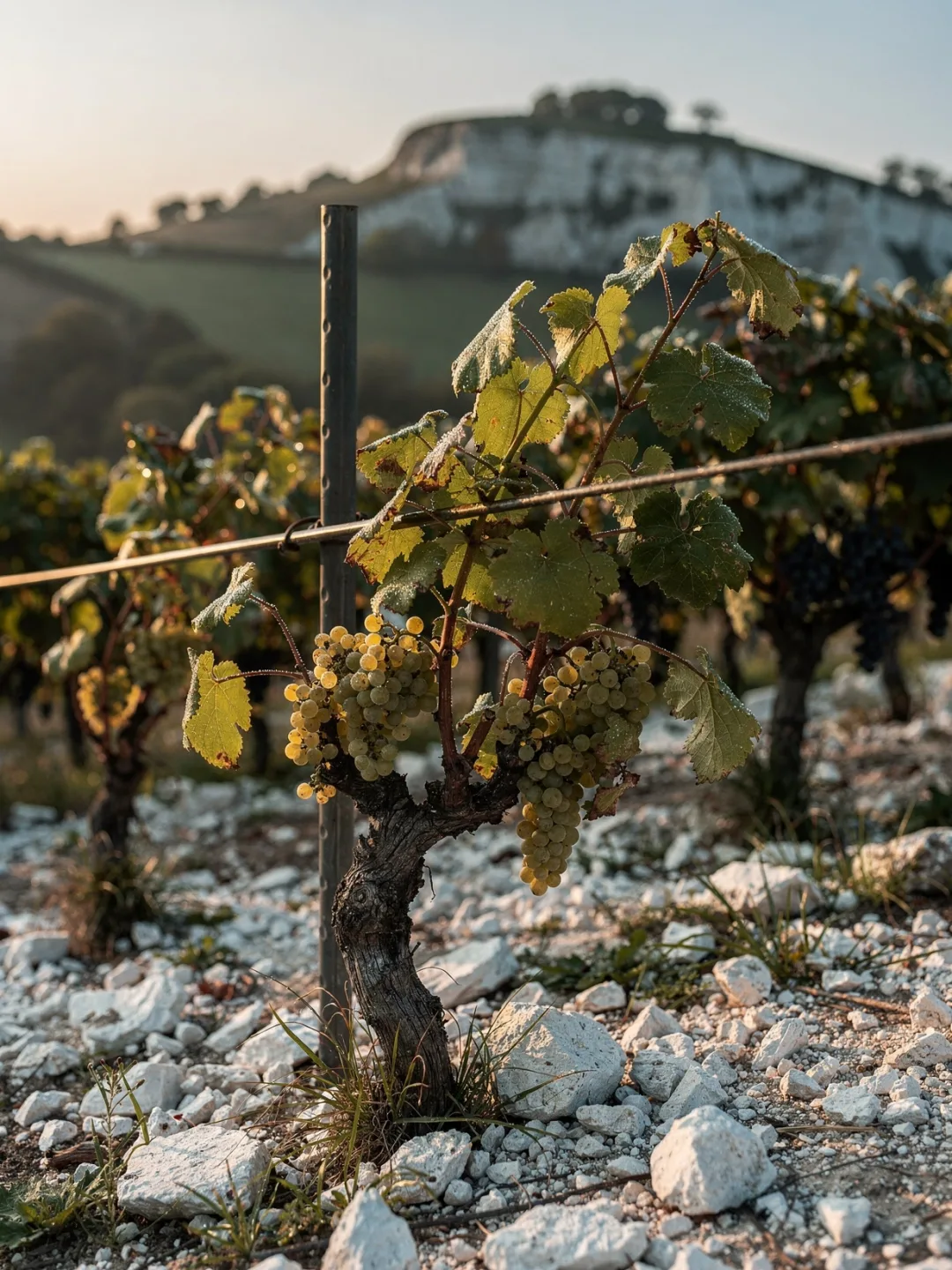
The Champagne Trio & Bacchus
Grape Varieties
Three varieties carry almost all of English sparkling wine. All three come from Champagne: Chardonnay, Pinot Noir and Pinot Meunier. Together they account for about two-thirds of England's vineyard area. In Hampshire, practically every major producer plants the same three, from Hambledon to Exton Park to Hattingley Valley.
The reason lies in the climate, not in flavor preference. At a cool average annual temperature of eleven to twelve degrees Celsius, thin-skinned, early-budding varieties ripen more reliably than late, robust ones — and that's exactly what Chardonnay and the two Pinots are. Their berries stay small, their acidity stays high. For a base wine destined to spend years on the lees, that's not a drawback but a prerequisite.
For still white wines, a different variety takes the lead role: Bacchus. It sounds English, but isn't. It was bred in 1933 at the Geilweilerhof in the Pfalz, a crossing of Silvaner with Riesling and Müller-Thurgau, and wasn't approved for cultivation until 1972. In Germany it has since faded into near-irrelevance. In England, by contrast, it has risen to become the third most-planted variety overall, right behind Chardonnay and Pinot Noir. Its aromas of elderflower, gooseberry and freshly cut grass have led many to call it England's answer to Sauvignon Blanc.
Which clone-and-rootstock combination sits on a given slope matters in Hampshire almost more than the choice of variety itself. Clone refers to the exact subtype of a grape variety; rootstock is the root it's grafted onto. When Ian Kellett replanted Hambledon in 2005, he tested 27 such combinations at once, because no one yet knew which would cope best with chalk soil and cool nights. Some producers also plant Pinot Noir Précoce, an earlier-ripening mutation of Pinot Noir, just to reach adequate ripeness in cold years.