The Champagne Trio and Bacchus
Grape Varieties
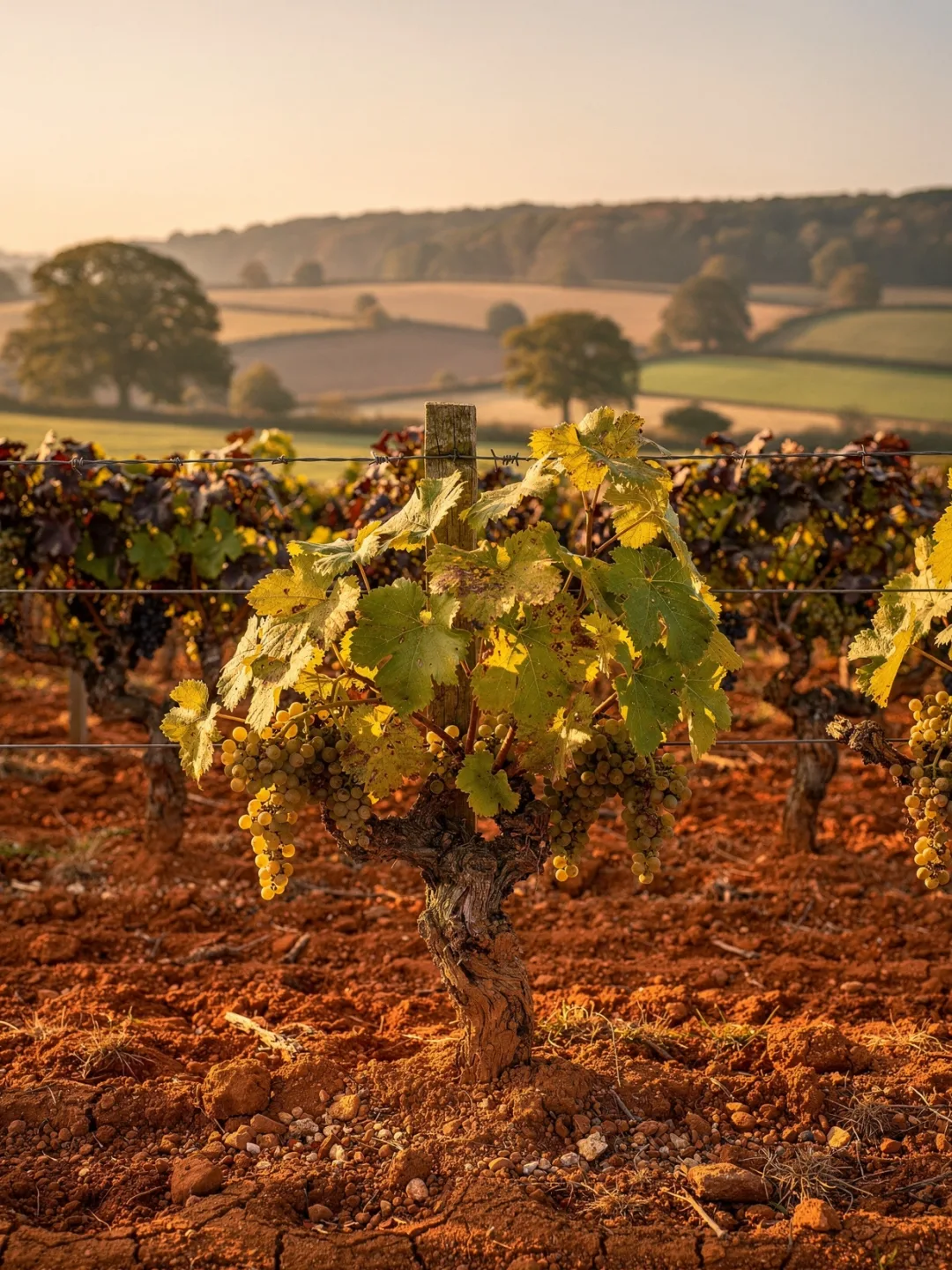
Three grape varieties share nearly the entire area of Sussex vineyards. Chardonnay, Pinot Noir, and Pinot Meunier are the very same three varieties that make up Champagne. Nationwide, they together account for roughly two-thirds of England's vineyard area. Sussex, as the country's largest wine region, leans even further into this ratio.
In this cool climate, Chardonnay rarely delivers the broad, creamy fruit of warmer sites. Instead, it offers lean acidity, apple, and citrus – exactly the backbone a base wine needs for bottle fermentation. It's almost always picked early, while the acidity is still sharp. That very bite is what needs to carry the wine through years in the bottle.
Pinot Noir and Pinot Meunier contribute body and color. For white sparkling wine, the dark grapes are pressed immediately and gently before the skins release color; only for rosé is a touch of color allowed into the must. On the warmer soils of the Weald, Pinot Noir now also matures as a standalone still red wine or rosé, as at Bolney's Foxhole vineyard, where the variety grows alongside some Pinot Gris and Bacchus.
Bacchus, meanwhile, has become its own Sussex specialty. The variety was bred in Germany in 1933, a cross of Silvaner and Riesling with Müller-Thurgau, though it long played only a minor role in its homeland. In Sussex it yields an aromatic yet dry white wine with notes of elderflower, gooseberry, and freshly cut grass. It thrives especially well on the greensand- and clay-rich soils of the Weald.
None of these varieties, incidentally, were where it all began. When Janet and Rodney Pratt planted the first thousand vines in Bolney in 1973, it was Müller-Thurgau. This hardy, early-ripening cross was the variety most English wineries of that era started with. Only with warmer summers and greater experience did winemakers dare to work with the late-ripening Champagne trio and with Bacchus, which now define the image of Sussex.