Limestone & Marl
Soils
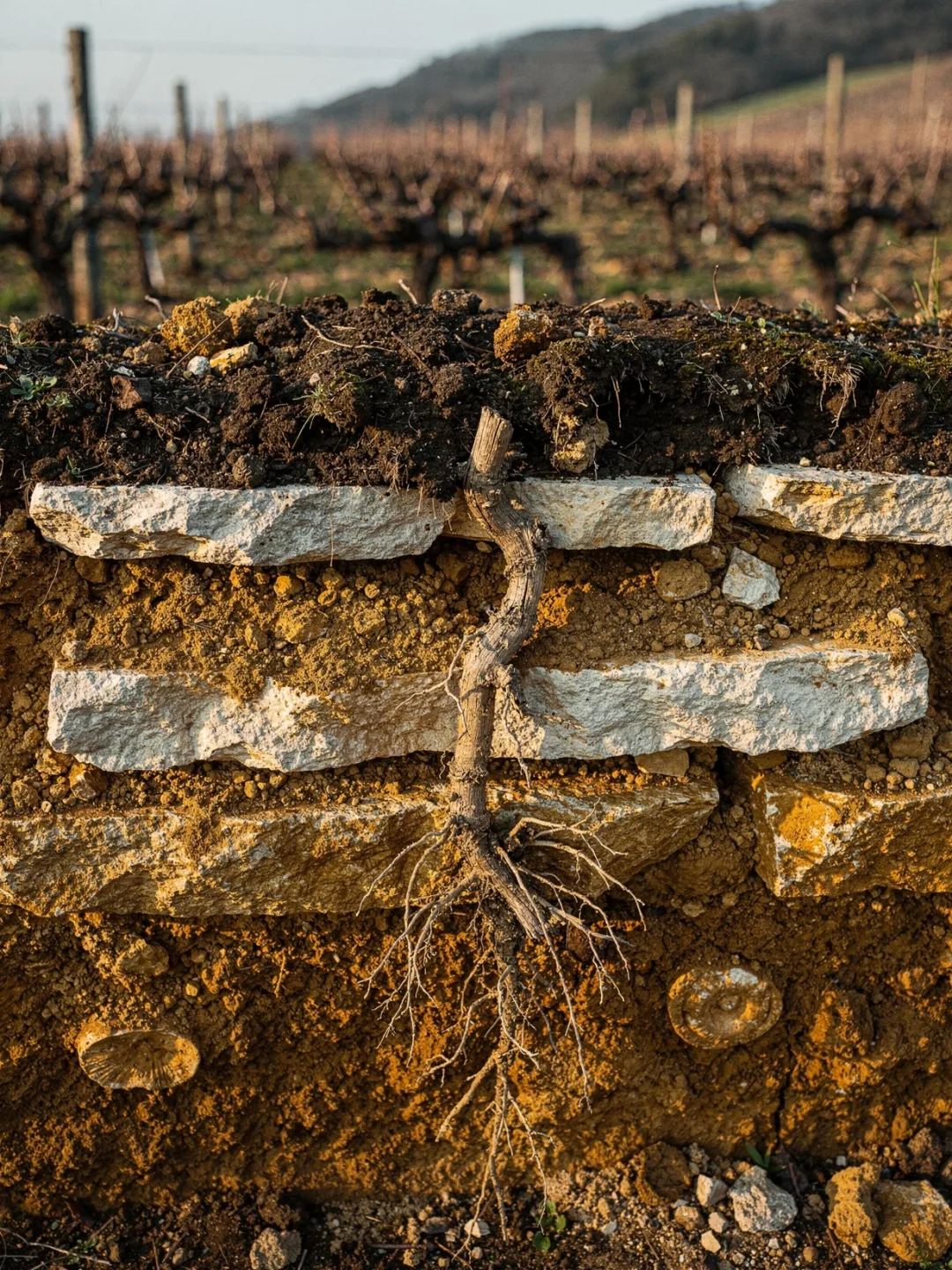
Dig a hole anywhere on the slopes of the Côte d'Or. After just a few spadefuls, you'll hit stone. Beneath a thin layer of humus, pale bands of limestone alternate with softer, clay-rich marl, often just a few meters apart up the slope, barely wider than a handful of vine rows. It's precisely this alternation, not any single soil type, that explains why two neighboring Climats can taste so different.
The reason lies deep in geological history. Around 150 to 170 million years ago, present-day Burgundy lay beneath a warm Jurassic sea. There, limestone slowly settled from the remains of dead marine organisms, layer upon layer, over unimaginable stretches of time. Later, as the Rhine Valley and the Bresse depression subsided, the earth's crust fractured along a major fault line and tilted individual blocks of rock at an angle. This created the characteristic escarpment of the Côte d'Or. Along this narrow ridge, different geological layers emerge side by side at the surface, like steps.
Higher up the slope often sits hard, pale limestone, named after the village of Comblanchien, where it's still quarried today in large blocks for building façades. This stone holds almost no water, but plenty of heat. During the day it warms up, and at night it slowly releases that warmth back to the roots. Vines on this kind of soil bud early and ripen reliably, but rarely deliver the concentration found on the mid-slope sites, where water is scarcer and roots reach deeper.
The best Grand Crus are almost always found in the middle of the slope, where brown marl is interspersed with chunks of limestone. The marl retains moisture better than the pure limestone above it, without drowning the vine, delivering exactly the balance of drought stress and water supply that produces small, concentrated berries. Down in the valley, by contrast, loose, nutrient-rich soil accumulates. There, the vines grow lush and vigorous. That's usually where the simpler village wines come from today.
Ninety kilometers to the north, in Chablis, the soil tells its own story. There, Kimmeridgian marl lies exposed, a gray, flaky mixture of limestone and clay, studded with tiny comma-shaped oyster fossils that geologists call Exogyra virgula. Only the slopes on this Kimmeridgian marl may be called Chablis Grand Cru or Premier Cru. The harder, younger limestone plateau above, where these same fossils are absent, yields only Petit Chablis. Rarely does a geological boundary line, one barely visible to the naked eye, determine so directly what name ends up on the label.
A thin, dark layer of decomposed leaf litter. On the slopes of the Côte d'Or, rarely thicker than a handspan.
The root: This is where the fine roots sit. They grab whatever rain has just brought, and are the first to dry out.