Frost, Hail, Heat
Climate
The Côte d'Or sits exactly at the latitude where Pinot Noir can still reliably ripen, and that's not a footnote, it's the very core of the whole region. Further north, the grape can barely achieve enough ripeness. Further south, it loses the acidity that defines it. In between reigns a temperate climate with continental leanings, hot summers, cold winters, and a spring fickle enough to keep winemakers on edge every single year.
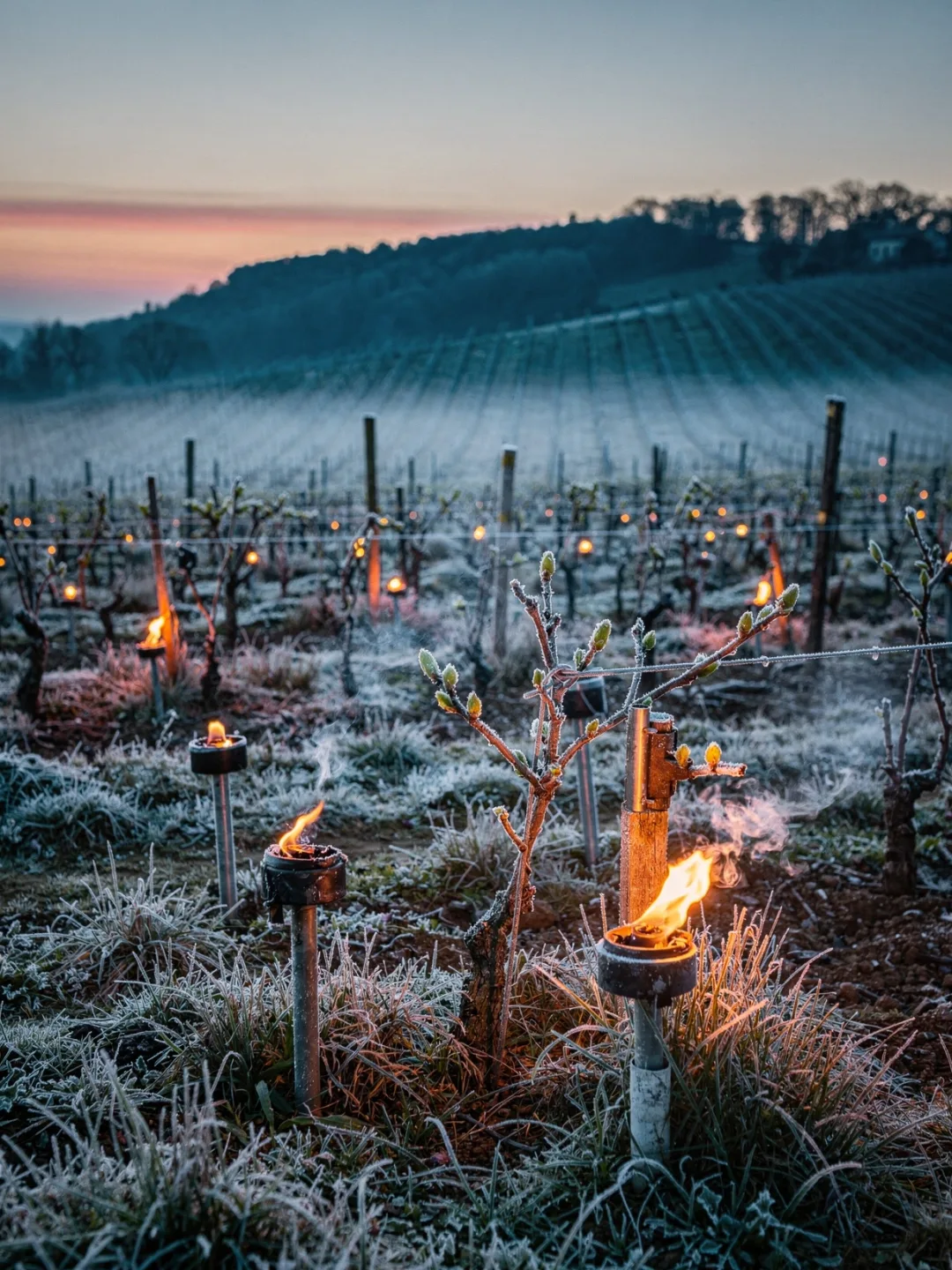
This nervousness has a name: late frost. When the vines have already budded by April and the night suddenly drops below minus four degrees Celsius, the young shoots die within hours. 2016, 2017, and 2021 hit winemakers particularly hard, so hard that hardly any area from Chablis through the Côte de Nuits to the Mâconnais was spared. As a countermeasure, many estates place paraffin candles between the rows, often several hundred per hectare. On cold nights, they warm the air by just a few degrees, but those degrees make all the difference.
After the frost comes the hail. It strikes more selectively, and sometimes with brutal precision: a single storm can pass over a village in June and destroy the harvest within minutes, while two kilometers away not a single drop falls. Anyone who's experienced this firsthand immediately understands why almost every domaine now takes out hail insurance. Thirty years ago, hardly anyone did.
How much the climate has shifted is shown by a unique series of records from Beaune: historians found harvest dates there going back to 1354 and analyzed them across six hundred years. On average, the harvest began in late September, with remarkably little variation from generation to generation. Since 1988, that has shifted dramatically. The average now falls in early September. In 2020, picking in some sites began as early as mid-August. What was once the exception of an entire century is now nearly routine.
Winemakers are responding by rethinking practices where a single approach once sufficed. Some now leave more leaf canopy to shield the grapes from direct sun, others plant in the higher, cooler parcels of the Hautes-Côtes, which just a few decades ago were considered too unreliable for good wine. What was once a secondary site is becoming a reserve for the future.