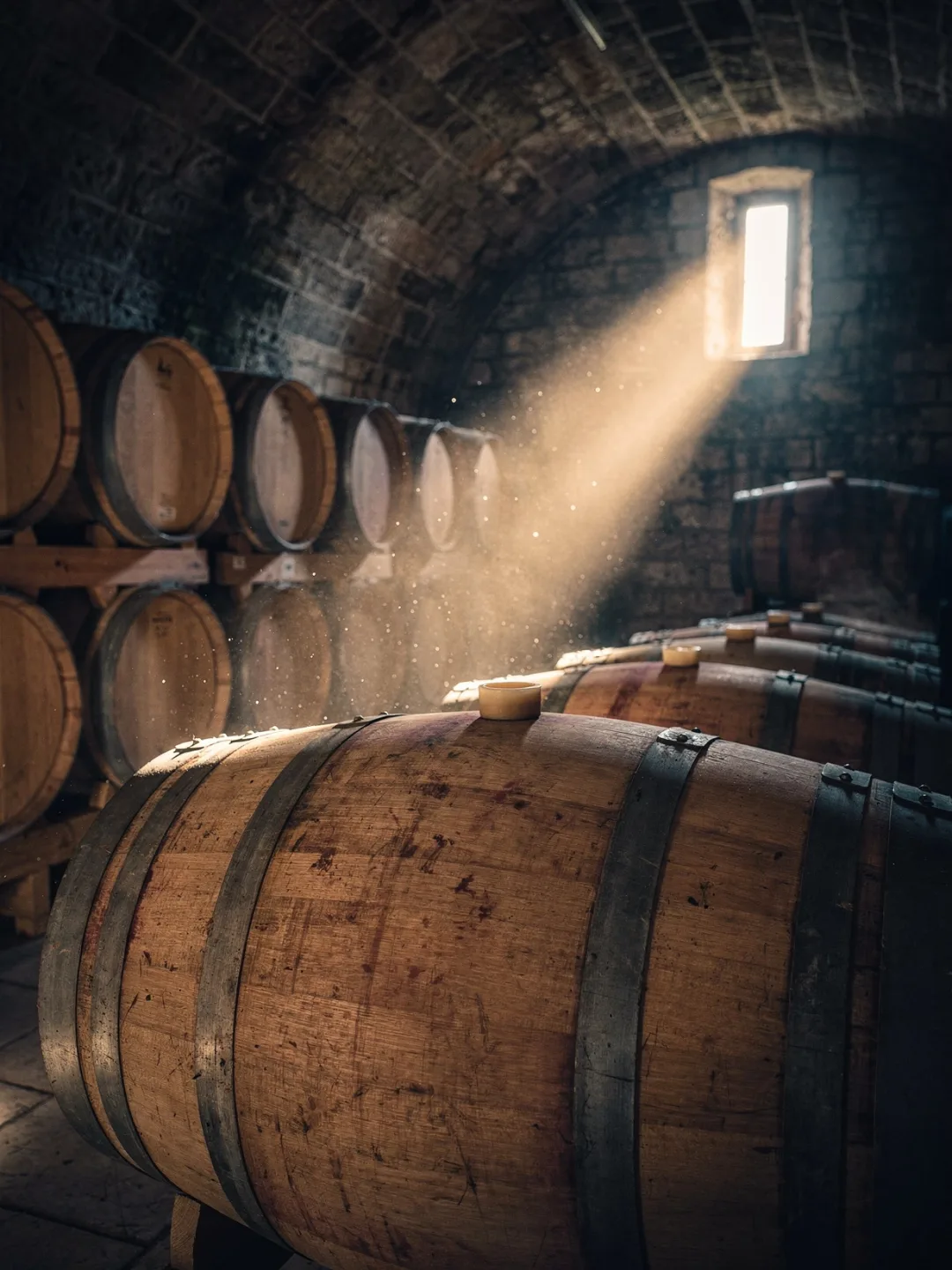
The 228-Liter Pièce
Production
A great deal is decided at harvest, long before any grape reaches the cellar. Some domaines still pick Pinot Noir entirely by hand and place the grapes, whole or partly, with their stems into the fermentation vats, a technique known as whole-cluster fermentation. It gives the wine more spice and structure but risks green, herbaceous notes if the stems aren't ripe enough.
During fermentation, the skins rise to the top as a solid cap. That's where the color and tannin lie, not in the juice. Cellar masters regularly push this cap back down, a process called pigeage, or pump juice from below over it, known as remontage: both methods extract more from the skins, but too much of either can make even a fine Pinot Noir hard and bitter. This calls for a delicate touch rather than a fixed rule.
Afterward, the wine typically ages in the Pièce, the traditional Burgundian barrel holding 228 liters. Its shape is round-bellied, its walls comparatively thick. This limits the contact between wine and wood and allows for very slow, gentle oxidation. How much of the barrel is brand new determines much of the wine's character. A high proportion of new oak brings vanilla and toasty notes, which suit some wines beautifully and overwhelm others.
White Burgundy is made differently, but in the same barrel cellar. Chardonnay often ferments directly in the Pièce. Many winemakers regularly stir up the spent yeast lees in the barrel, a technique called bâtonnage, which gives the wine more richness and creaminess. A second, malolactic fermentation converts sharp malic acid into softer lactic acid, usually carried out fully in Meursault, but often only partially in Chablis, to preserve its characteristic crispness.
The parcels here are tiny. That's why a single estate could rarely grow enough grapes for large-scale trade. As early as 1720, Edme Champy founded Burgundy's first négociant house in Beaune. It bought grapes or finished wine from many small winemakers, aged it, and sold it under its own name. This négociant model still carries the region today, alongside the independent domaines that vinify only their own grapes.