Craie & Crayères
Soils
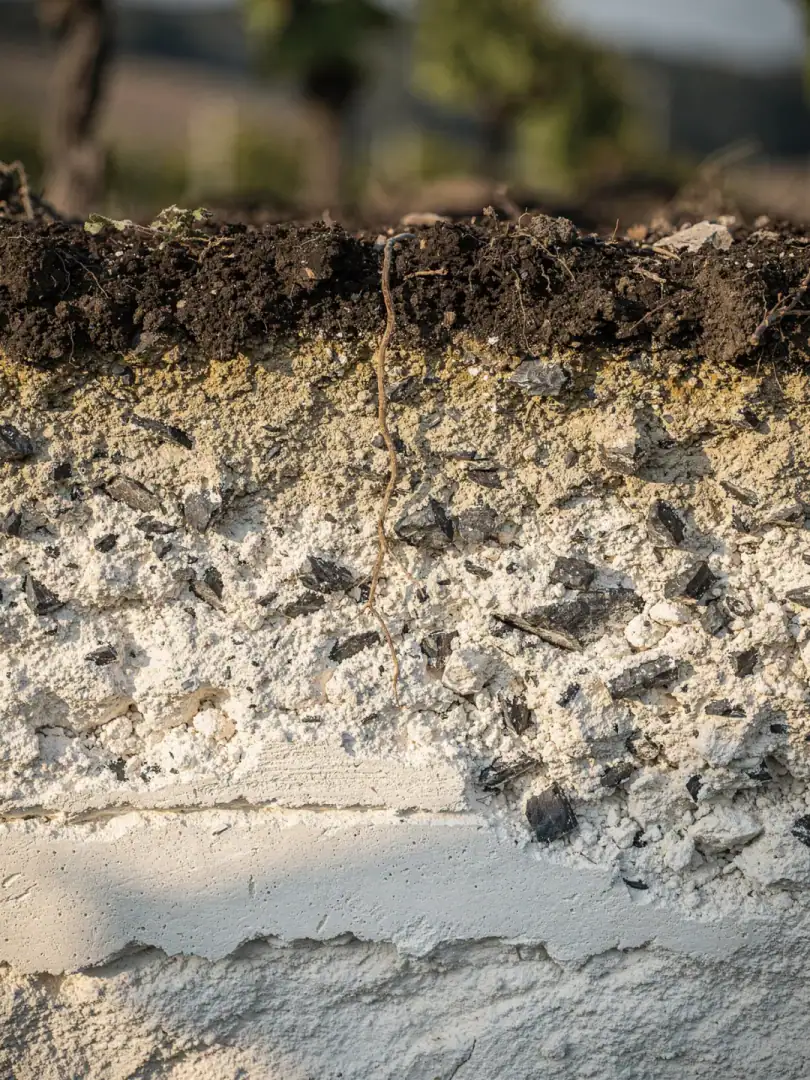
Dig a hole in a vineyard on the Côte des Blancs. After just a hand's width, you'll hit pure white rock, soft enough to scratch with a fingernail, yet firm enough to have supported cellars for centuries. This is chalk, craie in French. It's the reason high-quality wine grows here at all, this far north.
It formed on the floor of a shallow, warm sea many millions of years ago, from the shells of tiny algae and the skeletons of sea urchins, mollusks, and belemnites. Belemnites were extinct, squid-like creatures whose pointed, fossilized rear parts are still turned up by plows today. Over long periods, this calcareous sludge compacted into layers meters thick. It never became hard limestone, though — it stayed remarkably porous.
This porosity is exactly what makes the difference. Chalk stores water like a sponge and releases it the moment a root demands it: it never waterlogs, and it never fully dries out even in a dry summer. Vine roots therefore push down several meters. There, they still find moisture in August, while the soil on the surface is long since dusty, and it's precisely this steady, never-quite-failing supply that keeps the grapes' ripening calm and even.
The chalk isn't quite the same everywhere, though. On the Côte des Blancs, it lies almost pure and undisturbed. On the Montagne de Reims, chalk alternates with tertiary clay layers, and in the river valley of the Vallée de la Marne a layer of sand and loam often sits on top, beneath which Meunier still finds its roots a way through. Far to the south, chalk is almost entirely absent. Around the Côte des Bar near Troyes lies the same Kimmeridgian marl found in Chablis in Burgundy, and the wines taste correspondingly different: fuller and less austere.
Where people quarried chalk since Roman times to build Reims, galleries were left behind: the crayères. These are underground caves with a constant ten to twelve degrees and high humidity, today used as the aging cellars of the great houses. One myth persists stubbornly: that the wine tastes of chalk because the vine draws minerals from the rock and passes them on in the glass. That's not quite true. What reaches the vine via the root are dissolved salts in vanishingly small amounts, far too little to actually taste. What's described in the glass as 'mineral' comes by way of water, warmth, and the depth to which the soil forces the root down. The white crystals sometimes seen in the glass or on the cork, by the way, are something else entirely: tartrate, precipitated acid, not chalk.
A thin layer of clay-calcareous earth, often mixed with fragments of weathered chalk.
The root: This is where the fine roots sit, the ones that react first to every rainfall — and the first to dry out again.