49 degrees North
Climate
No French vineyard lies farther north. Champagne grows around the forty-ninth parallel, between Reims and Épernay, closer to London than to Bordeaux. Its climate is shaped by two forces: the Atlantic, which brings mild, moist air, and the continent to the east, which brings clear summers but also harsh winters. The annual average temperature is around eleven degrees Celsius. That's close to the threshold below which grapes barely ripen properly at all.
For most red wines, that would be too cool. For Champagne's base wines, it's almost ideal: they're not meant to taste fully ripe and round. Their cutting acidity isn't a flaw but the very precondition for the wine to still feel fresh, not flabby, after the second fermentation in the bottle. A base wine with too little acidity can't be fixed later on.
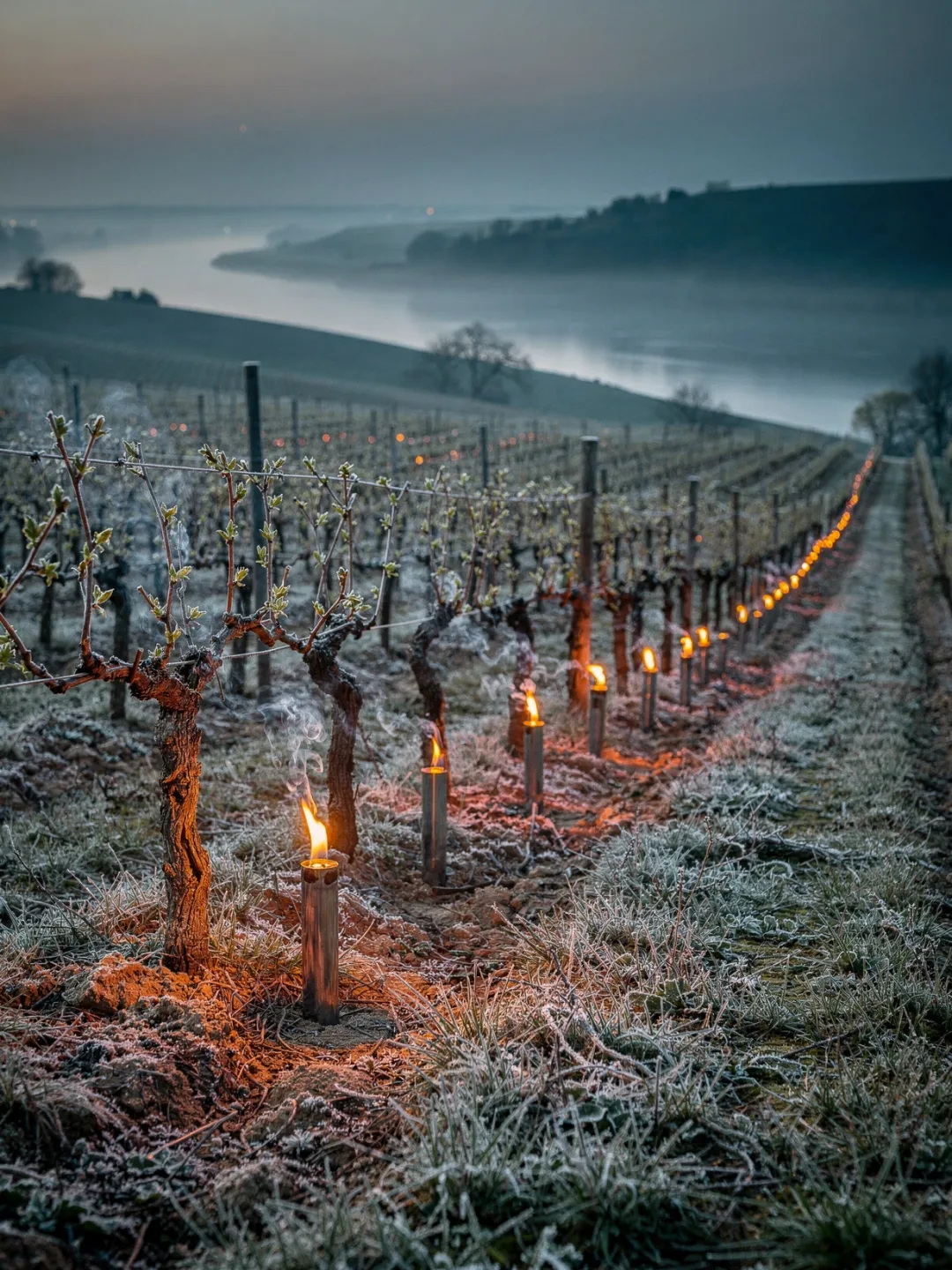
The flip side of the cool climate is frost. For sixty to eighty days a year, the temperature drops below zero, especially in the lower-lying sites of the Vallée de la Marne. In April and May of all times, just when the young shoots are already emerging from the buds, a single cold night can cost half the harvest. Growers fight back. They set out thousands of candles between the vine rows: at minus six degrees with no wind, a hectare needs five to six hundred of them to save nine out of ten buds. Others rely on wind machines that push warm air down from higher layers, gaining one to three degrees.
How much the climate is shifting right now was shown by the 2026 vintage itself. Five heat waves over the summer pushed the grapes to ripeness faster than ever recorded. Harvest began on August 6. Nationwide, it was already in full swing by August 17 — two weeks earlier than in the already-early previous year. The grapes brought in so much sugar that the regulatory body INAO approved an exception, allowing alcohol levels up to fifteen percent, far beyond what a Champagne is normally even permitted to reach.