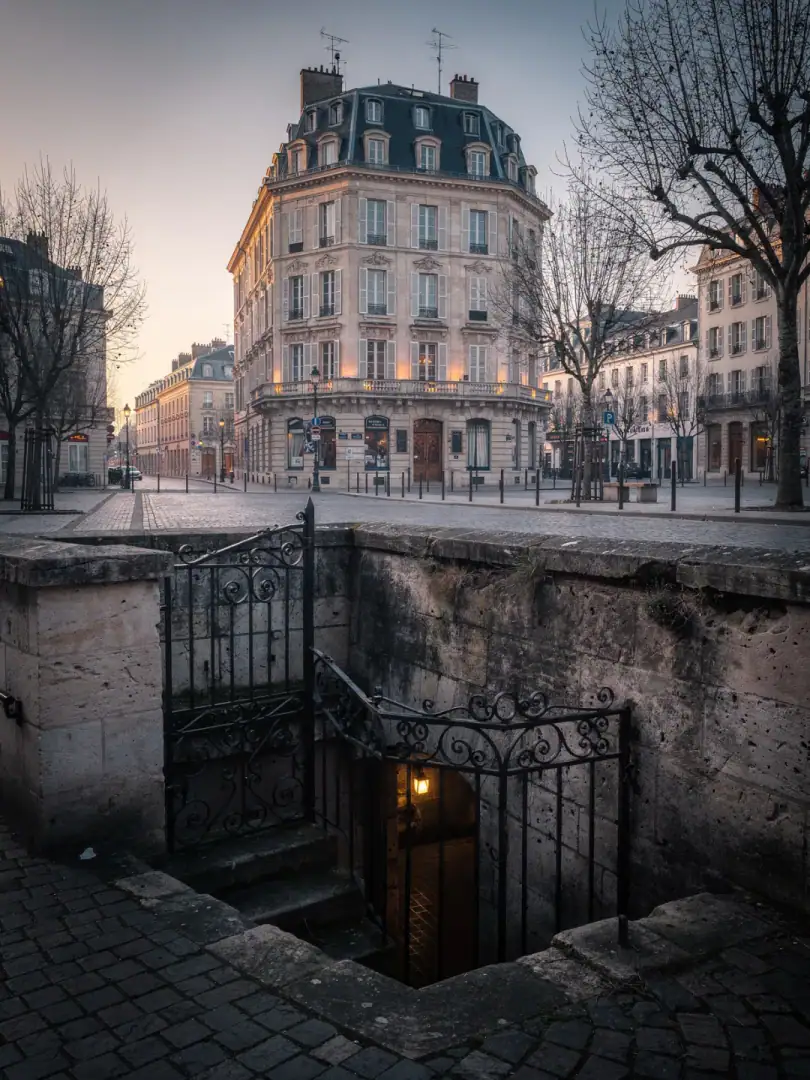
Hautvillers up to 1936
Region & History
The Romans were already planting vines on the slopes around Reims. Even so, the wine remained what it was: still, sharp, and barely stable. Not until the Middle Ages did monasteries take over large-scale cultivation, above all the Abbey of Hautvillers. There, from 1668 to 1715, a Benedictine monk worked as cellar master: Pierre Pérignon. He selected better grapes, pressed them faster and by variety, and genuinely improved the abbey's wines.
Even so, he was only made into 'the inventor' much later. The story that he was the first to discover carbonation and cried out that he was drinking stars first appears in a letter written by his successor, Dom Grossard, in 1821 — more than a hundred years after Pérignon's death. No earlier document backs it up. Sparkling wine was already well known by then anyway: in Limoux, in southern France, it was described as early as 1531, a hundred and sixty years earlier. Moët, which bought the abbey in 1794, later did little to contradict the legend.
What actually changed the wine came as an administrative act. Until 1728, Champagne could only travel in barrels. But no wine undergoes a second fermentation in a barrel. A royal decree in May of that year changed this and, for the first time, allowed transport in bottles, packed fifty or a hundred to a basket. Only in the sealed bottle could the residual sugar from spring trigger a second fermentation and trap the bubbles that would later make the wine famous.
The problem after that was the lees, dead yeast that settled as a cloudy sediment in the bottle. The Widow Clicquot solved it in 1816 together with her cellar master, Antoine Müller. Her tool was a simple piece of furniture, the riddling rack, drilled at an angle to hold the bottle neck. By turning the bottles a little each day and tilting them ever steeper, the yeast was slowly driven down toward the cork until it could be removed in a single motion. Every Champagne house adopted the method within a few years.
Then came phylloxera. From 1890 onward it ate its way from the Aube through almost the entire vineyard, and the number of wine-growing communes shrank by a third before replanting on American rootstock began. Barely recovered, growers and merchants fell into conflict over the boundaries of Champagne itself. On the night of April 12, 1911, the houses of the négociants in Aÿ burned, and it was not until 1927 that a law reincorporated the Aube. In 1936, Champagne finally received its own Appellation d'Origine Contrôlée. Nearly eighty years later, in 2015, UNESCO declared the hillsides, houses, and cellars of Champagne a World Heritage Site.