Méthode Traditionnelle
Production
Champagne is made under a rule stricter than almost anywhere else in winemaking. From four tonnes of whole, unpressed grapes, known as a marc, no more than twenty-five and a half hectoliters of juice may be pressed. This splits into two qualities. The first twenty and a half hectoliters are called the cuvée, clear and very acidic; the rest is called the taille, more pronounced in aroma but faster to mature. Many of the best houses therefore don't even sell the taille as Champagne, using it only as base wine for other purposes.
What follows is millimeter-precision work: the assemblage. In the cellar, a cellar master blends base wines from different sites, often from different vintages too, trying each year anew to hit the same house style. In a non-vintage Champagne, twenty or more individual wines can go into a single cuvée, many of them drawn from the great cellars beneath Épernay and Reims. Only once this blend is set does the second fermentation begin — the one that turns the wine into Champagne.
For this, sugar and yeast, the liqueur de tirage, are added to the already-sealed bottle. The yeast consumes the sugar, producing alcohol. And, because the carbon dioxide can't escape, pressure builds too: up to six bar, twice that of a car tire. After that, the wine must rest on the dead yeast, the lees, for at least fifteen months in total before it can be sold. For a vintage Champagne, it's at least three years. Most houses age their wines considerably longer, since it takes years for the toasty, bready aromas that Champagne is famous for to develop.
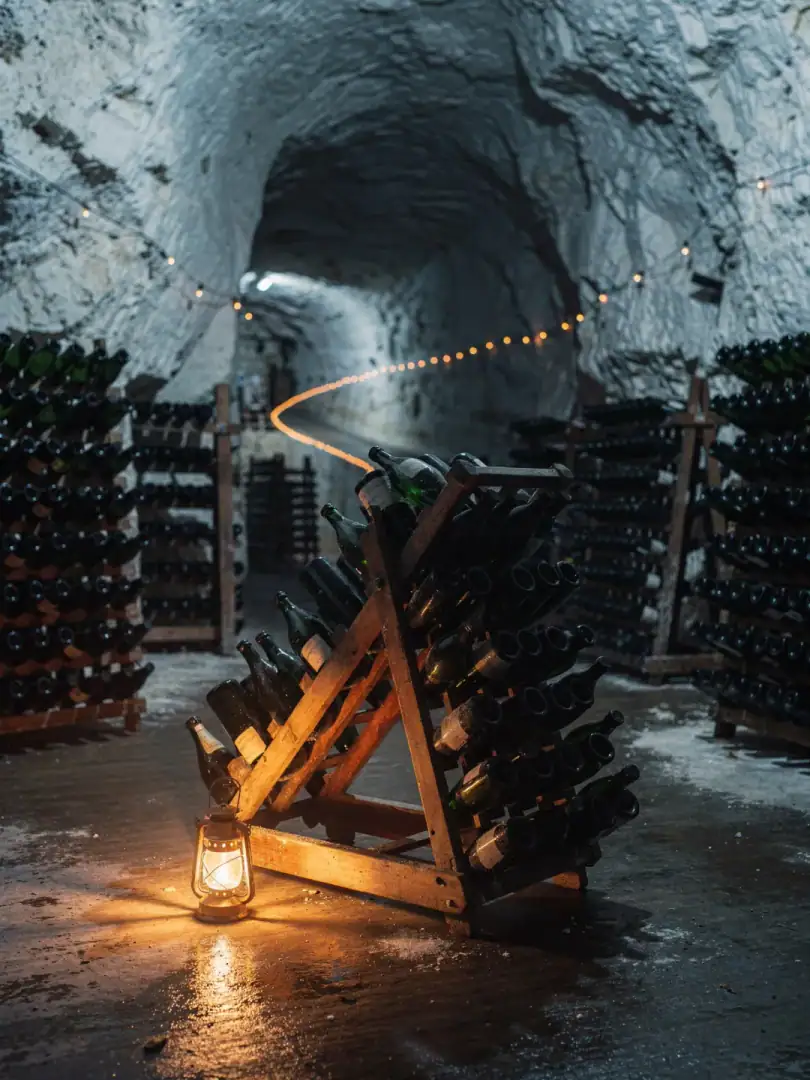
In the end, the yeast sits in the wine as a cloudy sediment that has to be removed without losing the pressure. During riddling, the sediment collects in the neck of the bottle: ever since the riddling rack was invented in 1816, this has meant a tiny daily turn of the slightly tilted bottle. During disgorgement, this neck is briefly frozen and the closure removed. The frozen plug shoots out almost without loss, propelled by the wine's own pressure. What's missing afterward is topped up with the dosage. This sugar solution determines whether the final wine ends up as Brut Nature, with under three grams of sugar per liter, or Demi-Sec, with up to fifty.