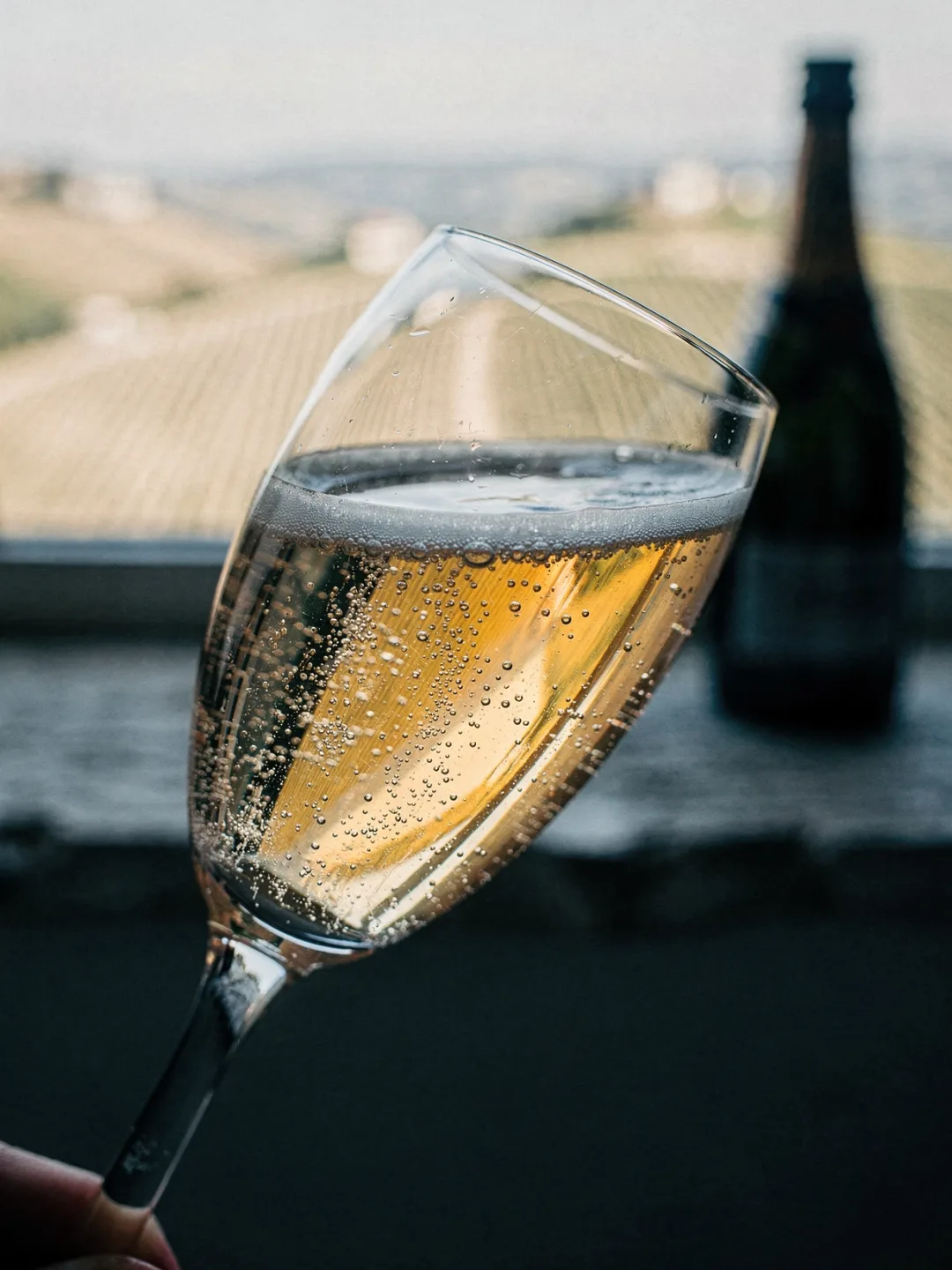
Perlage and brioche
Tasting
Hold a glass of Champagne up to the light. The first question isn't about color, but about the bubbles. In a well-made Champagne, they rise fine and even in an almost endless chain from the bottom of the glass — the so-called perlage. Large, irregular bubbles that vanish quickly, by contrast, point to a young, poorly blended wine, or to too little time spent on the lees.
When you nose it, a young, barely aged Champagne stands clearly apart from one that has spent years in the cellars of Reims or Épernay. In its youth, green apple, citrus, and sometimes white blossom dominate—fruit shaped by the cool Champagne climate. After years on the lees, more emerges. Brioche, toasted bread, hazelnut, and almond paste come to the fore. This is autolysis: the slow breakdown of dead yeast cells, which returns proteins and aromatic compounds to the wine that a fresh base wine could never possess.
On the palate, acidity is the defining element. Sweetness doesn't count here, and tannin even less so: Champagne has hardly any to begin with, since the skins barely make contact with the juice when whole clusters are pressed. The carbonation intensifies this impression. Every bubble that bursts on the tongue releases a tiny bit of pressure, and combined with the acidity, a good Champagne feels sharper and livelier than a still white wine with the same numbers.
In the end, one thing matters: how long the flavor lingers once the bubbles have long faded. With a simple cuvée, that's a matter of seconds. With an aged vintage Champagne, it's considerably longer. Connoisseurs pay particular attention to the mousse, the sensation of the bubbles in the mouth, which can be creamy or aggressive, fine or coarse, depending on how much pressure and how much time on the lees were involved. A Champagne without a fine mousse has lost its most important feature.