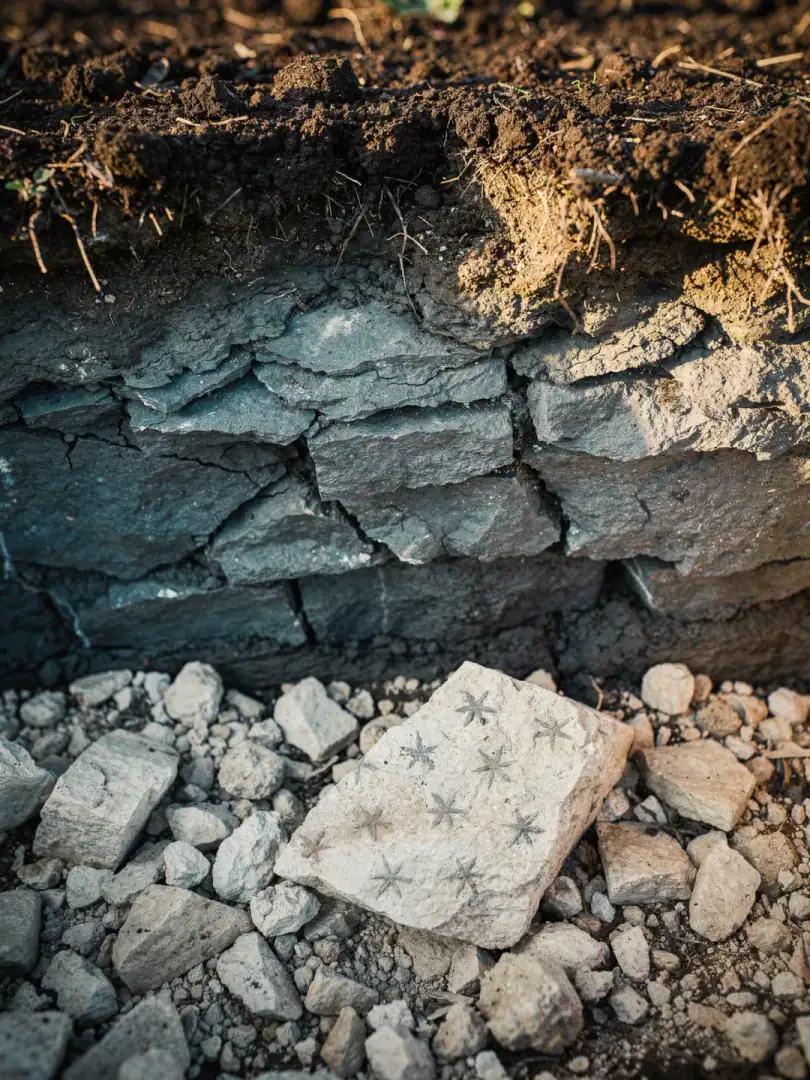
Marls & Limestone Rubble
Soils
Dig a hole in a vineyard near Arbois, and after just a few spadefuls you'll hit blue-gray clay that breaks into thin, brittle plates. This is a marl, a rock between clay and limestone, mostly blue to gray here, formed in the Lias, a geological era around 180 million years ago, when a shallow sea still covered what is now the Jura.
These blue marls store water like a sponge and release it slowly. This is crucial for Savagnin. The variety ripens late and needs steady moisture well into September, or else it stalls mid-ripening. Where these marls occur, mostly around Arbois and L'Étoile, you'll find the Jura's most demanding white wines.
A few kilometers further, around Pupillin, the color changes completely. There lie colorful Triassic marls, black to dark red, clayey and rich in silica. Poulsard feels most at home on this soil. You can taste the difference: lighter, more delicate red wines than on the heavier Lias soil.
In between and beneath lies limestone, often as coarse rubble from the plateau's steep slopes, well-draining and a counterbalance to the heavy marls. Where it reaches the surface, as in L'Étoile, something special appears. The soil is scattered with tiny fossilized stars, fragments of sea lilies from that same ancient sea. The village and its appellation likely owe their name to these fossils.
A thin, dark layer of decomposed leaves, barely a hand's width thick on the steep slopes of the Revermont.
The root: This is where the fine roots lie. After every rain, they're the first to get water and the first to dry out again.