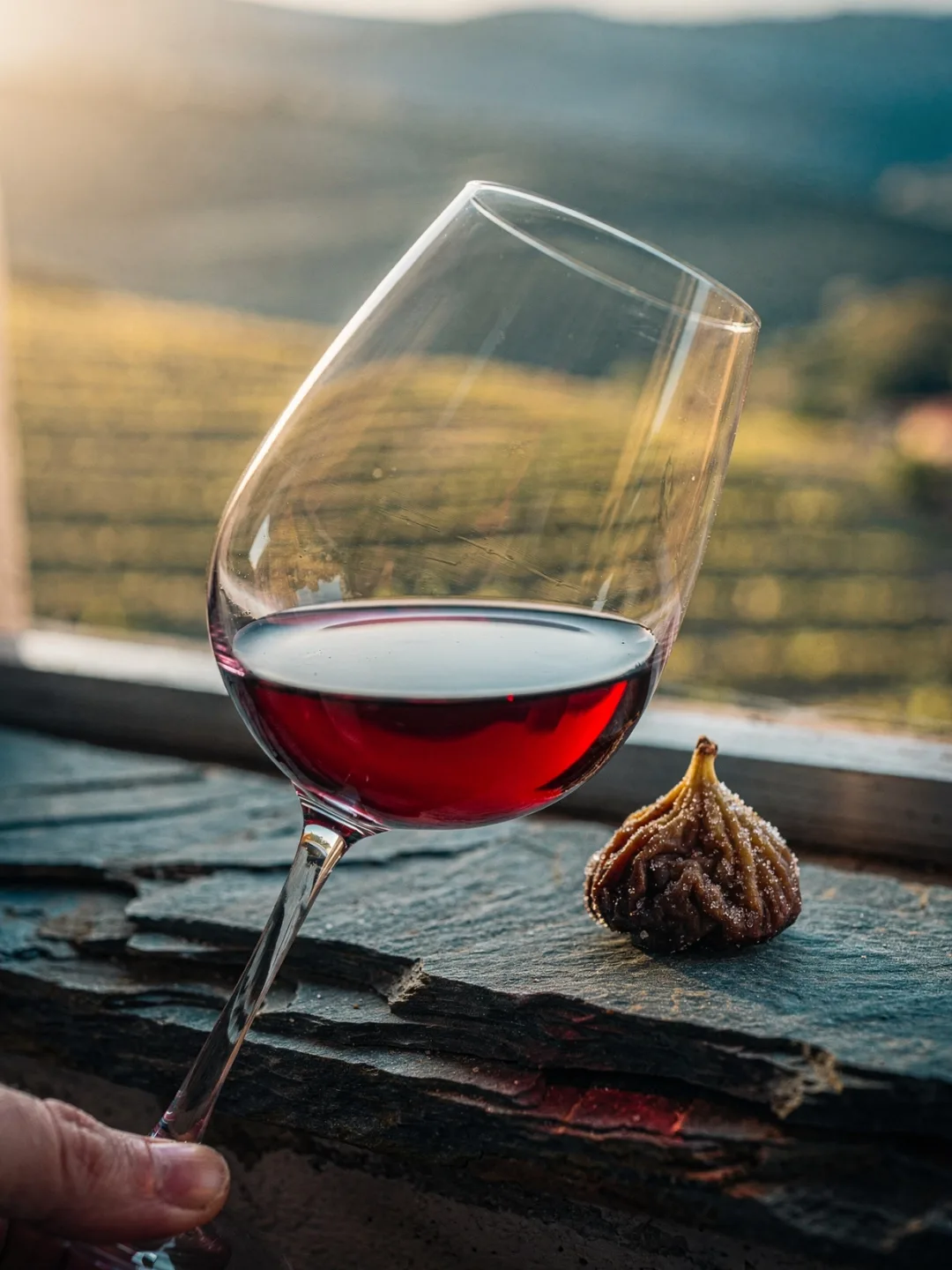
A Banyuls in the glass
Tasting
Take a glass of Banyuls and tilt it against something white. The color immediately reveals which style you're looking at. A young Rimage glows dark red to violet like a robust red wine, a mature Traditionnel shifts toward brick red, and an old Rancio appears almost amber to mahogany brown. Between these three colors can lie as much as twenty years of aging in the barrel.
Smell first, without swirling. In a young Banyuls, fruit comes through — sour cherry, cooked-down blackberry, a hint of licorice. In a mature Rancio, that fruit is almost entirely absent, and instead walnut, roasted coffee bean, and dried fig rise from the glass, sometimes with a touch of caramel. This isn't a flaw. It's intentional: the wine has absorbed oxygen until the fruit has transformed into something else entirely.
On the palate, pay attention to three things that appear simultaneously here and would normally be mutually exclusive: sweetness, tannin, and alcohol. The sugar from the arrested fermentation sits at a minimum of forty-five grams per liter, noticeable across the whole tongue. The tannin from Grenache and Carignan sits alongside it as a rough coating on the gums, and the alcohol leaves a warming sensation in the throat afterward. A well-made Banyuls balances all three — none should overpower the others.
Finally, count the seconds. A young Rimage fades out after ten or fifteen seconds. An old Rancio can echo for a full minute, with shifting aromas that reveal themselves one after another: first nut, then coffee, and finally something smoky. This length is the real proof of the time the wine has spent in the barrel or demijohn — years cannot be shortcut, not even with the best recipe.