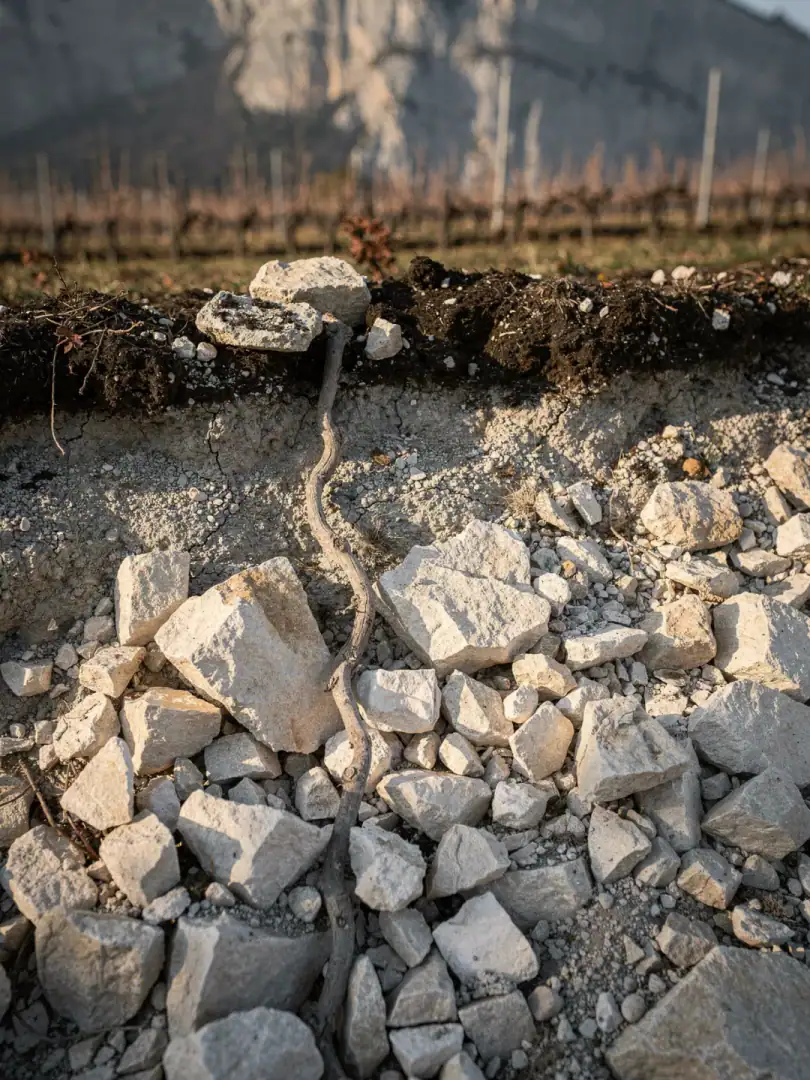
Debris from the Granier
Soils
Dig a hole in a vineyard near Apremont, and you'll quickly hit angular, pale stones. Limestone, some fist-sized, some the size of small blocks, loosely stacked on top of each other. This is the debris of Mont Granier, which collapsed in 1248 across an area of more than twenty-three square kilometers, and to this day appears in every wine description of the area under the name éboulis, or scree.
Water and air pass easily through this loose rubble, but nutrients hardly at all. The Jacquère root reacts as vines usually do: it drives deep, several meters down, searching for both. This very effort slows growth. It concentrates the little that ultimately ends up in the berry.
A few kilometers away, in the Combe de Savoie near Arbin, the soil looks completely different. There, a thinner layer of scree from the Massif des Bauges sits atop dark Jurassic marl. This soil holds noticeably more water than the pale limestone rubble of Apremont. It's precisely on these dark soils, known locally as "terres noires," that Mondeuse thrives best. It needs that extra reserve to ripen at all in a cool summer.
In Chignin, meanwhile, the soil is lean and shot through with marl, both calcareous and stony. Roussanne, called Bergeron here, loves exactly that. On rich soil it turns fat and clumsy, but on this bare slope it stays fragrant and keeps its acidity. Three vineyards, three soils, three completely different wines, and less than ten kilometers separate them all.
What unites the three sites isn't their composition, but their origin. Glaciers and rockfalls created, within just a few millennia, a patchwork microclimate of soils found nowhere else so densely on any geological map of France. Drive through the Combe de Savoie, and you'll cross into different bedrock every few hundred meters, and taste it in the end in the glass, without ever having seen a map.
A thin, dark layer of leaves and rotted grass, rarely thicker than a hand's width on the steep slopes around Apremont.
The root: This is where the fine roots sit, taking in the first rains — and the first to dry out in August.