From Fondue to Diots
Wine & Food
Savoyard cuisine and Savoyard wine were born at the same hearth, quite literally. Fondue savoyarde is often made with the very same dry white wine that later sits alongside it in the glass. Beaufort, Comté, and Tomme de Savoie melt together with a splash of Jacquère or Chasselas into a stretchy, cohesive mass. It's precisely that acidity in the pot that later cuts through the richness in the mouth.
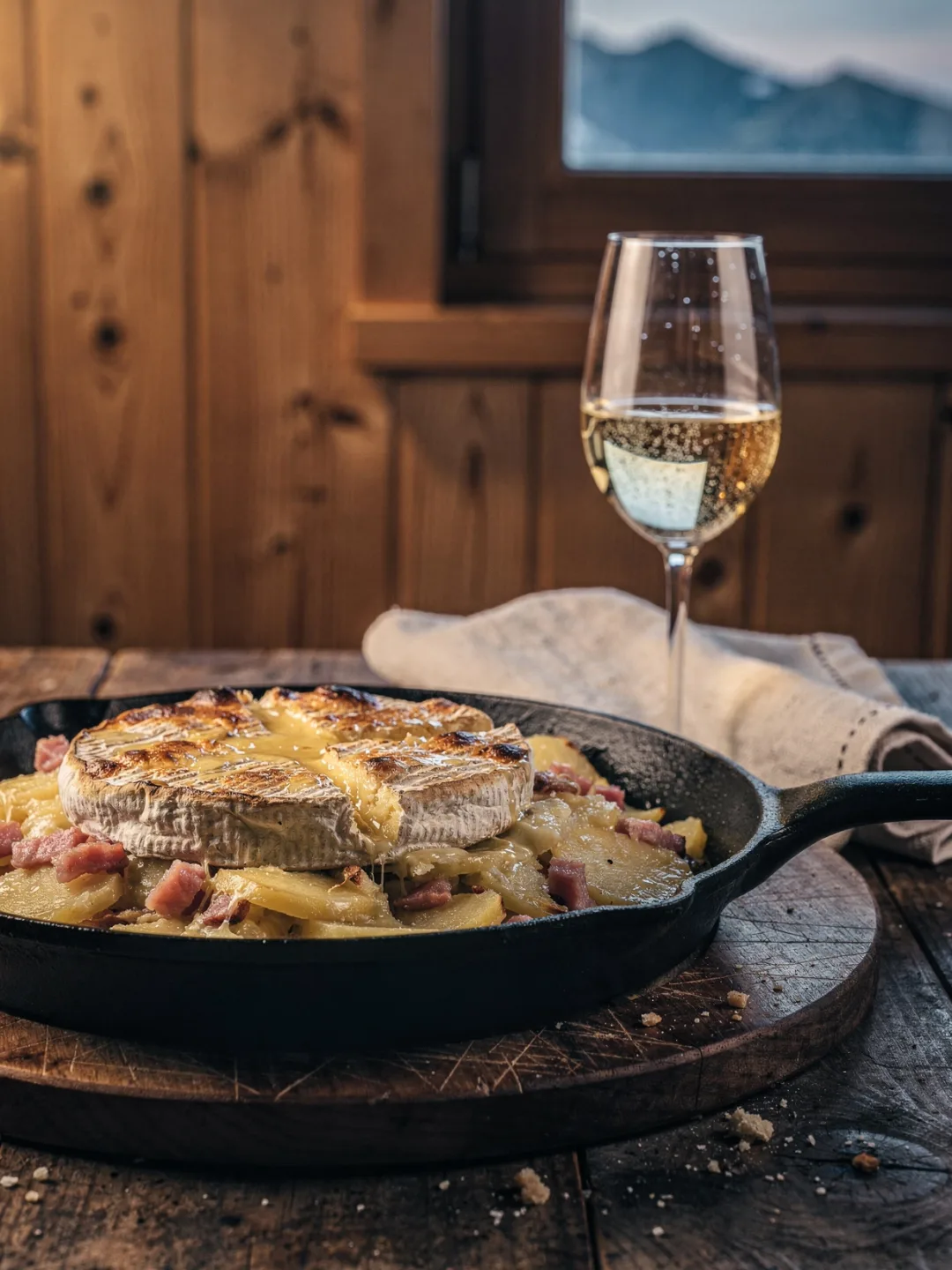
Tartiflette, on the other hand, is younger than its reputation suggests. No one invented it in the Middle Ages. In the 1980s, the Reblochon trade association transformed an old shepherd's dish called Péla into a gratin with melted Reblochon, as a way to offload a cheese surplus. The trick worked brilliantly. A young, acid-driven Chignin suits the melting, salty Reblochon better than a heavy red wine, since here the acidity alone has to carry the fat.
Diots, the coarse Savoyard sausages, are traditionally served poached in white wine, often alongside Crozets, small square pasta made from buckwheat flour. Here the wine is allowed a bit more weight. A Chignin-Bergeron made from Roussanne, with its oily texture, holds its own against the hearty sausage far better than a lean Apremont, which would seem thin by comparison.
On Lake Geneva, a different rule applies. Whitefish and char, known locally as Féra and Omble chevalier, have delicate, mild flesh that a powerful wine would instantly overwhelm. A cool Crépy made from Chasselas, barely aromatic but with a fine saline note, lets the fish keep its own character while simply adding the freshness it lacks.
Finally, the counterpoint: aged Beaufort, matured in the cellar for at least a year, crystalline and intensely flavored with nut and caramel. Neither a young white nor a simple red wine suits this cheese, but rather an aged Mondeuse from Arbin or a Roussette from Marestel. Both bring enough depth of their own not to be overshadowed alongside such a cheese.