Jacquère & Mondeuse
Grape Varieties
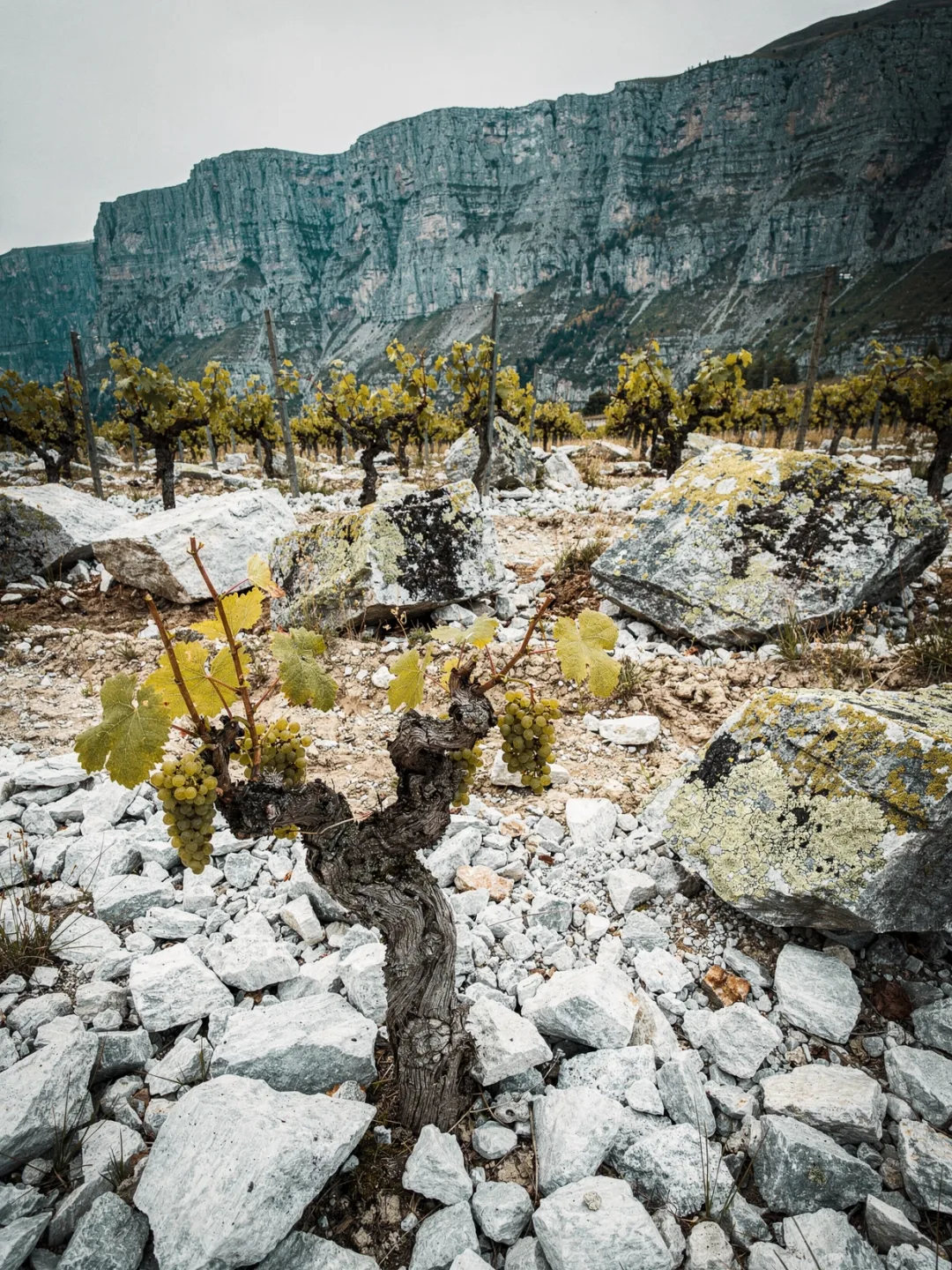
A single white variety defines the region's character. Jacquère covers almost half of Savoie's vineyard area, especially in the Cluse de Chambéry and the Combe de Savoie. It yields light, crisp, low-alcohol wines with a hint of flint on the nose. It buds early and produces generously, which makes it well suited to the slopes. Yet it isn't without vulnerabilities: a late frost hits it first.
For wines with more weight, Altesse takes over, also known as Roussette, which according to legend was brought by Anne of Cyprus in 1432 when she married Duke Louis I of Savoy. The variety is only documented from 1530 onward, in Lucey near Mont du Chat. What's certain is what arrives in the glass: plenty of extract, aromas of hazelnut and bergamot, plus a touch of honey that intensifies with age. As a standalone Roussette de Savoie, it may only come from four named sites such as Frangy or Marestel. As a simple Vin de Savoie, however, it lends depth to nearly every blend.
When it comes to red wine, there's really only one serious answer: Mondeuse. Before phylloxera, it was by far the most important variety in Savoie. It ripens late, is dark in color, and brings plenty of tannin along with a spiciness of black pepper and violet. It performs best in Arbin, where the vines root in stony, dark marl. For a long time, it existed almost exclusively as a simple, rough country wine. Only in recent decades have a handful of winegrowers shown just how age-worthy a good Arbin can become.
Two other varieties belong exclusively here. Roussanne likely crossed the Alps in the Middle Ages and has been known in Chignin for generations simply as Bergeron; on the region's lean limestone soils, it becomes broad, floral, and fragrant with apricot. Even more narrowly confined is Gringet: it grows almost exclusively around the village of Ayze. Nobody knows for certain where it came from — some suspect Cyprus in the fourteenth century, others point to the Templars. What's well documented, however, are its fine, lively wines with citrus notes.
Along the shore of Lake Geneva, near Crépy and Marin, yet another variety dominates: Chasselas, thin-skinned and neutral in aroma, but carried by the mild air over the water. In total, Savoie counts twenty-three grape varieties out of the two hundred fifty registered in France. Seven of these grow in significant quantities nowhere else in the world. So anyone drinking wine here is, almost always, drinking something that simply doesn't exist anywhere else.