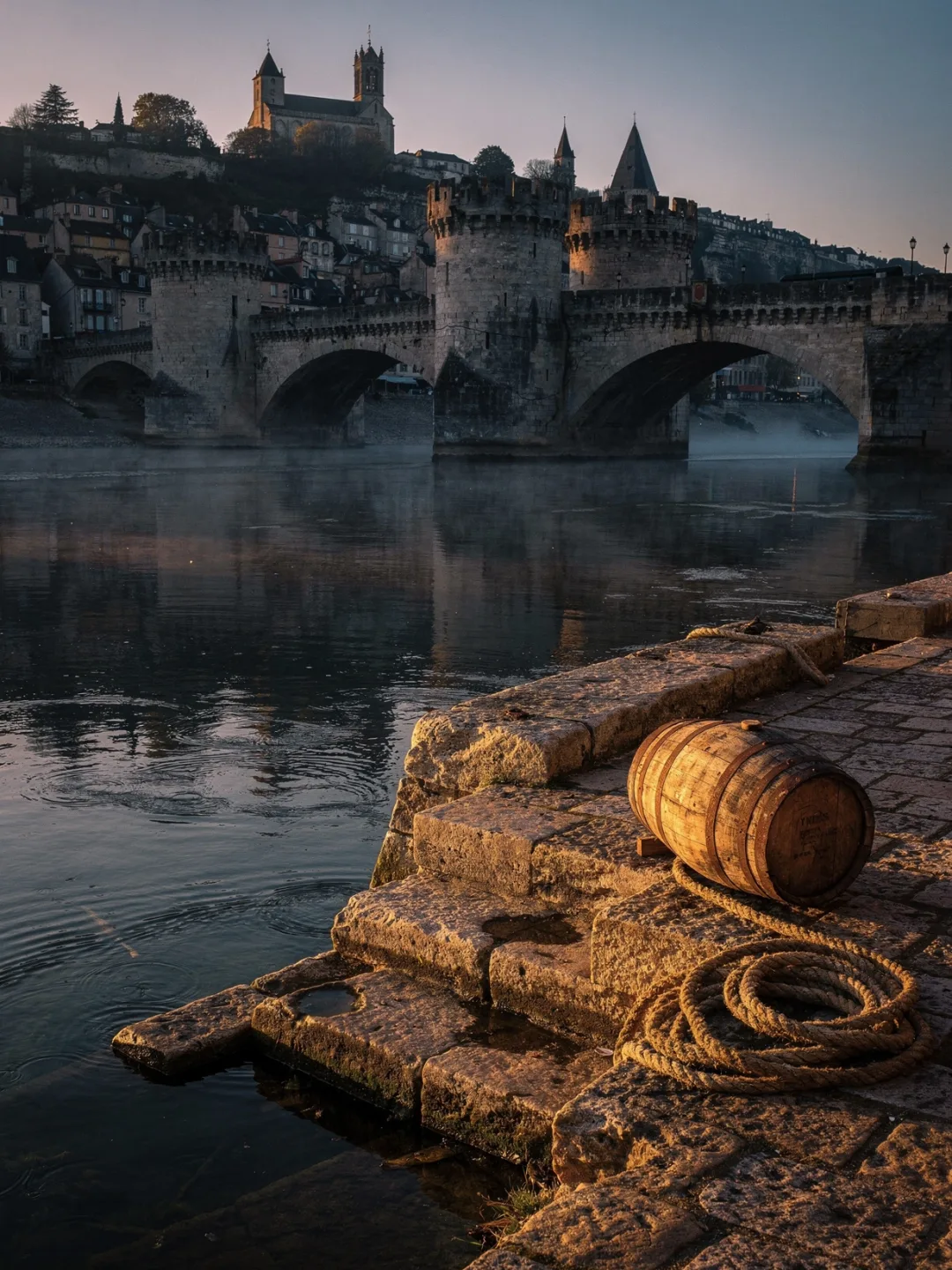
Vin Noir & Pilgrim's Path
Region & History
The Romans already grew wine here, in the Lot valley near Cahors and around Gaillac, where vine cultivation can be traced back to the first century. After the fall of Rome, many vineyards ran wild. That lasted for centuries. Monks brought them back into order around the year 900, row by row, laying the foundation for one of France's oldest wine regions.
In the Middle Ages, wine from Cahors traveled by barge down the Lot to the Garonne, then on to Bordeaux and from there to England and Russia. Because of its almost black color, it was called vin noir. But in 1241 the English king granted Bordeaux a privilege that specifically held back this competitor: wines from the hinterland—from Cahors, Gaillac, or Bergerac—were only allowed to reach the port of Bordeaux after November 11th, by which time Bordeaux's own harvest had long since sold. This was known as the Privilège de Bordeaux. For five hundred years, this single rule determined who became famous in Europe and who did not.
Further south, a different route created its own wine. Pilgrims on the Camino de Santiago passed through Madiran, drank Mass wine there, and carried its reputation with them across the Pyrenees. This is how Madiran became the pilgrims' wine. Legend and document merge in Jurançon: young Henri of Navarre, later King Henry IV, is said to have had his lips rubbed with garlic and moistened with a few drops of Jurançon at his baptism in 1553. This is hardly true. The scene was only embellished in 1820, when the French court restaged it for a royal baptism.
Phylloxera reached the region in 1876 and crippled the vineyards for decades. Cahors had barely recovered when, in February 1956, frost below minus fifteen degrees Celsius destroyed over ninety percent of the vines. A single winter, almost everything lost. Instead of many varieties, winegrowers afterward planted almost exclusively Malbec, out of sheer focus on what worked best. The result came late, but it came. Jurançon was recognized in 1936, Gaillac in 1938, Madiran in 1948, and Cahors not until 1971.