Alluvium & Basalt
Soils
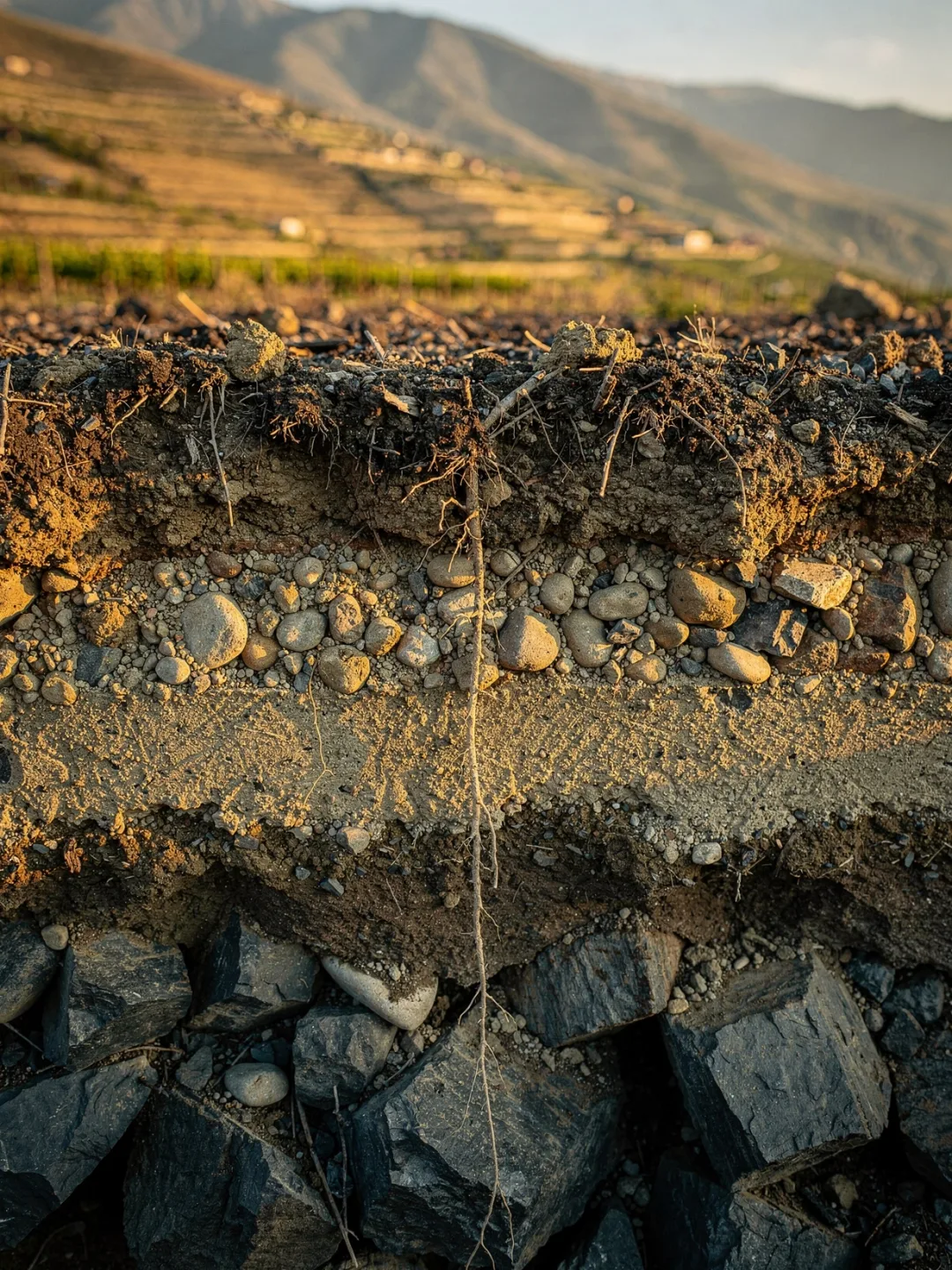
Dig a hole in the Mukhrani valley and you won't get far before your spade hits gravel. Over millennia, the Mtkvari River has deposited sand, silt, and stones here, layer upon layer, each flood adding a new stratum. For vines, this is good news: water drains away, roots reach deep, and the grape has to work to get at nutrients.
Beneath the gravel often lies coarse rubble studded with dark, almost black chunks — basalt, washed down from the volcanic highlands of the Trialeti Mountains further south. There, around Bolnisi, pure volcanic rock even lies exposed at the surface, dark and porous, a legacy of ancient eruptions. Such soils store heat during the day and release it again at night, helping the grapes cope well even with cooler nights. Further north, in the Ateni Gorge, the picture changes completely. There, pale limestone marl prevails, on which Chinuri has grown for centuries to make sparkling wine.
One persistent misconception holds that soil lends wine a mineral taste because the roots absorb minerals from the basalt or limestone. That isn't quite true. What actually enters through the root are dissolved ions in quantities no palate on earth could ever detect. The soil works indirectly instead — through the water it holds or drains away, through the heat its stones store, and through the depth to which it forces the roots. This indirect effect explains exactly why a Chinuri grown on gravel tastes so different from one grown on basalt, even though nothing in the cellar was done differently.
In Bolnisi, this fragmentation goes even further. Winemakers there now distinguish more than a dozen individual micro-sites, each with its own soil profile and its own wind patterns within the narrow gorges of the Mashavera and its tributaries. Two vineyards that look like the same slope from the road often produce entirely different wines as a result — one mineral and taut, the other soft and round.
A thin, dark layer of decomposed leaves and root remnants. In dry Kartli, it's often barely a hand's width thick.
The root: This is where the fine roots sit. They draw whatever rain arrives — and are the first to feel thirst in dry summers.